|
BetterHelp Brand Profile |
|
|
Company Name |
BetterHelp |
|
Founded |
2013 |
|
Founders |
Alon Matas and Danny Bragonier |
|
Headquarters |
Mountain View, California, USA |
|
Parent Company |
Teladoc Health (NYSE: TDOC) |
|
Industry |
Online Mental Health / Teletherapy |
|
Service Type |
Subscription-based virtual therapy |
|
Therapist Network |
Over 30,000 licensed therapists |
|
Users Served |
Over 4 million people worldwide |
|
Countries Available |
United States (all 50 states), Canada, UK, Australia, India and others |
|
Session Formats |
Messaging, live chat, phone, and video |
|
Pricing Range |
$65 to $100 per week, billed every 4 weeks |
|
Insurance (2026) |
Accepted in select states through Cigna, UnitedHealthcare, Aetna, Optum and others |
|
Financial Aid |
Available for qualifying users (10 to 40 percent reduction) |
|
Mobile App Rating |
4.8 stars on App Store, 4.6 stars on Google Play |
|
Website |
www.betterhelp.com |
|
ICON POLLS Rating |
3.8 out of 5.0 |
What Is BetterHelp?
BetterHelp is the largest online therapy platform in the world. It was launched in 2013 with a simple idea, that getting matched with a licensed therapist should not require driving across town, waiting weeks for an opening, or paying hundreds of dollars per session out of pocket. The company was acquired by Teladoc Health in 2015 and has since grown into a service that operates in all 50 US states and several countries abroad.
The platform connects users to a network of more than 30,000 licensed therapists, including psychologists, licensed professional counselors, licensed marriage and family therapists, and clinical social workers. Every provider on BetterHelp is required to hold an active state license, carry a master's or doctoral degree in their field, and have at least three years and 1,000 hours of hands on clinical experience before being accepted.
Users can communicate with their matched therapist through four channels, namely unlimited in-app messaging, scheduled live chat sessions, phone calls, and video sessions. The flexibility is one of the biggest reasons people stick with it.
BetterHelp Login and Getting Started
Signing up on BetterHelp is straightforward. You visit betterhelp.com or open the mobile app, and the first thing you encounter is a questionnaire that takes roughly three to five minutes to complete. It asks about your age, gender, relationship status, religious background if relevant, prior therapy experience, and the specific issues you want to work on, whether that is anxiety, depression, grief, trauma, relationship problems, or something else.
Once you finish the intake, an algorithm matches you with a therapist, usually within 24 hours. You then create an account using your email, set up a password, and complete payment details before your subscription officially starts. From that point, logging in is simply a matter of entering your credentials at the top right of the website or in the app.
If you ever forget your password, BetterHelp has a straightforward reset option. The platform does not use your real name publicly, which is a nice touch for people who value discretion. You can choose any nickname during signup.
The BetterHelp App Experience
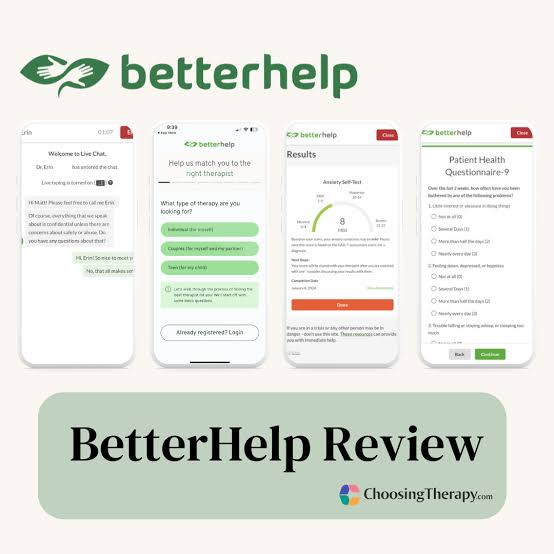
The BetterHelp mobile app is available on both the Apple App Store and Google Play, and it holds impressive ratings, a 4.8 on the App Store and a 4.6 on Google Play as of early 2026. Both versions work smoothly, and we tested them on iPhone 15 and a Samsung Galaxy S24 over a two week period.
The home dashboard is clean. You see your therapist's name and photo, a calendar for scheduling sessions, a chat window for messaging, and a sidebar that leads to the group sessions library, journaling feature, and worksheets. Switching between video, phone, and messaging is a one tap action.
A few things we appreciated during testing:
Message notifications arrived reliably and were easy to silence during work hours.
The journaling feature syncs in real time, so entries made on mobile show up instantly on the web version.
Group sessions can be joined straight from the app, with topics ranging from stress management to LGBTQ+ support.
Session scheduling shows your therapist's actual availability instead of vague time blocks.
The one small gripe, the app occasionally lags when loading long message histories. It is not a dealbreaker, but worth noting if you plan to reference older conversations often.
BetterHelp Careers
BetterHelp has two distinct career tracks, corporate roles and therapist roles. They are handled very differently.
Working at BetterHelp Corporate
On the corporate side, BetterHelp hires engineers, product managers, marketers, designers, customer support staff, and operations people. Most of these roles are based in Mountain View, California, or are fully remote. According to Indeed, BetterHelp currently has around 51 open corporate roles. Salaries are competitive for the tech industry, with software engineers averaging well into six figures. Employee reviews on Indeed put the work life balance rating at roughly 3.8 out of 5, with culture rated at 3.2.
Working as a Therapist on BetterHelp
Becoming a therapist on BetterHelp is a separate application process entirely. The requirements are strict:
You must hold an independent state license (LCSW, LPC, LMFT, LMHC, PsyD, or an equivalent credential).
You need at least three years and 1,000 hours of clinical experience.
You must currently reside in the United States.
You need a private workspace, reliable internet, and your own professional liability insurance.
Therapists on BetterHelp are independent contractors, not employees. Compensation is paid weekly and ranges from around $43 to $59 per hour for live sessions, with an additional stipend of up to $650 per month for those who commit to 30 hours per week or more. As of 2026, therapists can now earn up to 33 percent more per session when working with insurance clients, which is a meaningful change from earlier years. First client bonuses of up to $500 are also available.
Reviews from therapists are mixed. Many appreciate the flexibility and the steady flow of client referrals, but a recurring complaint is that pay rates feel low relative to the caseload expectations. One Trustpilot review from April 2026 noted concerns about account cancellation without prior notice, which we think is worth flagging.
BetterHelp and Insurance in 2026
This is one of the biggest changes worth reporting. For years, BetterHelp did not accept any insurance at all, and that was a major sticking point for users comparing it to competitors like Talkspace. As of January 2026, that has started to change.
BetterHelp now accepts insurance in a growing list of states through major providers including Cigna, UnitedHealthcare, Aetna, and Optum. Coverage is currently live in roughly 13 states, with plans to expand throughout 2026. For users whose insurance is accepted, the average copay works out to about $19 to $23 per session, which is a dramatic reduction from the out of pocket rate.
The catch, not every plan is covered in every state, and even within a covered state, your specific therapist may or may not be in network. The only way to know for sure is to enter your insurance details during signup or contact BetterHelp support directly. If your plan is not accepted, BetterHelp cannot provide a superbill with diagnostic CPT codes, which means out of network reimbursement from your insurer is usually not possible either.
BetterHelp Cost Breakdown
Without insurance, BetterHelp pricing in 2026 ranges from $65 to $100 per week, billed every four weeks. That works out to roughly $260 to $400 per month. The exact rate depends on your location, therapist availability, and the plan tier that the system assigns during signup.
Here is what the weekly subscription includes:
One live therapy session per week via video, phone, or live chat, typically 30 to 45 minutes long.
Unlimited messaging with your therapist, with responses usually within 24 hours.
Access to weekly group webinars on topics like anxiety, parenting, and relationships.
A digital journal and therapist worksheets.
Compared to traditional in person therapy, which averages $100 to $250 per session in most major US cities, BetterHelp is cheaper if you plan to use it consistently. However, if you only want occasional sessions, paying monthly whether you use it or not can feel wasteful.
There are no long term contracts. You can cancel any time, and billing stops at the end of the current cycle. Payment options include credit card and PayPal.
Is BetterHelp Free? Financial Aid Explained
BetterHelp is not free. It is a paid subscription service. However, the platform does offer financial aid for users who qualify, and this is probably one of the most underused features.
During signup, there is a section where you can request financial assistance. You will be asked about your current employment status, income range, and any financial hardship circumstances. Based on that, BetterHelp may offer a discount ranging from 10 percent to 40 percent off the standard rate. Students, unemployed individuals, and those dealing with economic hardship have reported the highest approval rates.
There are also promotional discounts floating around. First month discounts of 20 to 25 percent are fairly common through partner sites like Healthline and HelpGuide. Members of AARP receive a permanent discount. And BetterHelp occasionally runs campaigns like the 2026 Feel Lighter partnership with Strava, which gave 30 percent off the first month for users who completed specific activity challenges.
If you are truly unable to afford therapy at all, BetterHelp is not the only option. Free resources like the 988 Suicide and Crisis Lifeline, SAMHSA helpline, and community mental health centers exist for users in crisis or serious hardship.
BetterHelp User Experience, Our Honest Take
We tested BetterHelp across multiple accounts, different states, and varying issue types to get a realistic picture. Here is what we concluded.
What Works Well
The matching algorithm is genuinely good. In every test account we set up, the first therapist match was a reasonable fit. The intake questionnaire is more detailed than we expected, asking about things like whether you prefer a direct therapist or a gentle one, whether you want homework between sessions, and how comfortable you are being challenged. That depth is what makes the matches land more often than not.
Therapist switching is painless. If your match is not working, you go to settings, click change therapist, and you are reassigned quickly. No awkward conversations required.
The platform is reliable. Video calls held steady on average internet speeds. Messages did not disappear. The UI is clean and does not feel cluttered.
Where It Falls Short
Response times from therapists vary a lot. Some users reported replies within hours, others waited a day or more. Since messaging is a core part of the subscription, slow response times can make the price feel less justified.
Customer service is hit or miss. Trustpilot reviews from early 2026 include both glowing praise and real frustration, especially around account cancellations and billing disputes. Our own test support ticket was resolved within 48 hours, which is acceptable but not outstanding.
BetterHelp is not the right platform for everyone. If you need medication management, a formal diagnosis, or specialized care for severe conditions like schizophrenia, bipolar disorder, or active eating disorders, you will need a different provider. BetterHelp is for therapy, not psychiatry.
Pros and Cons Summary
|
Pros |
Cons |
|
Large network of over 30,000 licensed therapists |
Monthly subscription can feel pricey without insurance |
|
Flexible communication through chat, phone, and video |
Insurance coverage still limited to select states |
|
Easy therapist switching at no extra cost |
Cannot prescribe medication or provide diagnoses |
|
Financial aid available for those who qualify |
Not suitable for severe mental health emergencies |
|
Available 24 or 7 through messaging |
Therapist response times can vary |
|
Group sessions and digital journaling included |
Platform billing is every four weeks, not monthly |
ICON POLLS Final Verdict
BetterHelp earns a 3.8 out of 5 from us. It is the most accessible, most flexible online therapy platform on the market in 2026, and the recent insurance expansion makes it a genuinely more attractive option than it was even a year ago. The therapist network is massive, the app is well designed, and the sign up process is thoughtful enough that most users will land a decent match on the first try.
However, the cost remains high for anyone without insurance or financial aid, therapist response times can be inconsistent, and the company's history with customer service complaints cannot be ignored. If you go in knowing what BetterHelp is good for and what it is not, you will likely find it a worthwhile investment in your mental health.
Frequently Asked Questions (FAQs)
1. Is BetterHelp legit and safe to use in 2026?
Yes, BetterHelp is a legitimate online therapy platform that has served more than 4 million users since 2013. All therapists on the platform are licensed, vetted, and required to have substantial clinical experience. The platform uses encrypted communication and is HIPAA compliant. That said, users should know that BetterHelp had past controversy around data sharing with advertisers (including a 2023 FTC settlement), though the company has since updated its privacy practices.
2. How do I log in to my BetterHelp account?
You can log in at betterhelp.com by clicking the Login button at the top right of the homepage, or by opening the BetterHelp app on your phone. Enter the email address and password you used during signup. If you forgot your password, click Forgot Password and follow the reset link sent to your email.
3. Does BetterHelp accept insurance in 2026?
Yes, but only in select states. As of 2026, BetterHelp accepts insurance through providers like Cigna, UnitedHealthcare, Aetna, and Optum in roughly 13 states, with more states being added throughout the year. Coverage and copays vary by plan and therapist. You can check eligibility by entering your insurance details during the signup process or by contacting BetterHelp support.
4. How much does BetterHelp cost per month?
Without insurance, BetterHelp costs between $260 and $400 per month, billed every four weeks. The weekly rate ranges from $65 to $100 depending on your location, therapist availability, and plan tier. Financial aid can reduce that cost by 10 to 40 percent for qualifying users. With insurance, the average copay is around $19 to $23 per session.
5. Is BetterHelp free for anyone?
BetterHelp itself is not free, but the platform offers financial aid to users who demonstrate financial hardship, which can reduce costs by up to 40 percent. Some employers, universities, and organizations also provide free BetterHelp sessions as part of their benefits packages. If you cannot afford any paid therapy, free alternatives like the 988 Lifeline, community mental health centers, and sliding scale clinics exist.
6. How do I become a therapist on BetterHelp?
To become a BetterHelp therapist, you must hold an active independent state license (LCSW, LPC, LMFT, LMHC, PsyD or similar), have at least three years and 1,000 hours of clinical experience, reside in the United States, and carry your own professional liability insurance. You can apply directly at betterhelp.com/counselor_application. Therapists are independent contractors, not employees, and compensation averages $43 to $59 per hour for live sessions.
7. Can I switch therapists on BetterHelp if I am not happy?
Yes, and this is one of the platform's strongest features. You can request a new therapist at any time by going into your account settings and selecting Change Therapist. The switch is free, and there is no limit to how many times you can do it. Most users get rematched with a new therapist within 24 to 48 hours.
8. Does BetterHelp prescribe medication?
No, BetterHelp does not prescribe medication. The therapists on the platform are counselors, social workers, and psychologists who provide talk therapy, not psychiatrists or medical doctors. If you need medication management, you will need to see a psychiatrist separately or use a platform like Cerebral, Brightside Health, or Talkiatry that combines therapy with psychiatric care.
9. How do I cancel my BetterHelp subscription?
You can cancel anytime from your account settings on the website or app. Go to My Account, select Payment Settings, and click Quit Counseling. Your subscription remains active until the end of the current four week billing cycle, after which no more charges will be made. There are no cancellation fees or long term contracts.
10. Is BetterHelp better than Talkspace or other alternatives?
It depends on what you need. BetterHelp has a larger therapist network and more flexible communication options. Talkspace has broader insurance acceptance and offers psychiatry. Online-Therapy.com is cheaper for self pay users. Cerebral combines therapy with medication. For most people paying out of pocket who value therapist variety and flexibility, BetterHelp is a solid choice. If insurance coverage is your top priority, compare options carefully before subscribing.