Quick Verdict
Deel is one of the most successful software companies of the decade and, in 2026, the clear leader in the global employment category. Founded in 2019 by MIT graduates Alex Bouaziz and Shuo Wang along with Ofer Simon, it has grown from a scrappy startup into a company valued at $17.3 billion after a $300 million raise in October 2025, with over $1 billion in annual recurring revenue, profitability since 2023, and roughly 35,000 to 37,000 companies from startups to Fortune 500s using its platform. The product genuinely earns its reputation. Deel lets companies hire and pay employees and contractors in more than 150 countries through its own network of owned entities and local partners, without setting up local legal entities, and it handles the taxes, benefits, compliance, and documentation automatically. Its Capterra rating of 4.9 out of 5 across more than 4,250 reviews is one of the highest review averages of any platform in its category, and it ranks number one on G2 for Employer of Record, Global Employment, and Multi-Country Payroll. The 2026 additions of AI-powered compliance, device management, and workforce planning extend it into a genuine all-in-one global HR system. The 4.0 rather than higher reflects honest limitations. Deel is one of the more expensive options, with EOR starting at $599 per employee per month and sometimes exceeding $1,000, and it requires a refundable security deposit of one to three months of salary per EOR employee. US Payroll pricing is quote-based rather than transparent. Support, while 24/7, is platform-led and can feel transactional for very small teams. And service quality in partner markets where Deel does not own the entity is a common consideration across the EOR category. For companies hiring internationally at any scale, Deel is genuinely excellent. The cost and the deposit are the things to plan for.
At a Glance: Icon Polls Ratings
Here is how Deel scored across the areas we evaluated in our 2026 research:
|
Category |
Stars |
Score |
|
Global Coverage (150+ countries) |
★★★★★ |
5/5 |
|
Platform and Automation |
★★★★★ |
4.5/5 |
|
Compliance and Security |
★★★★★ |
4.5/5 |
|
Contractor and EOR Management |
★★★★★ |
4.5/5 |
|
Ease of Use and Onboarding |
★★★★★ |
4.5/5 |
|
Pricing and Transparency |
★★★☆☆ |
3/5 |
|
Support for Very Small Teams |
★★★☆☆ |
3/5 |
|
Overall |
★★★★☆ |
4/5 |
What Is Deel?
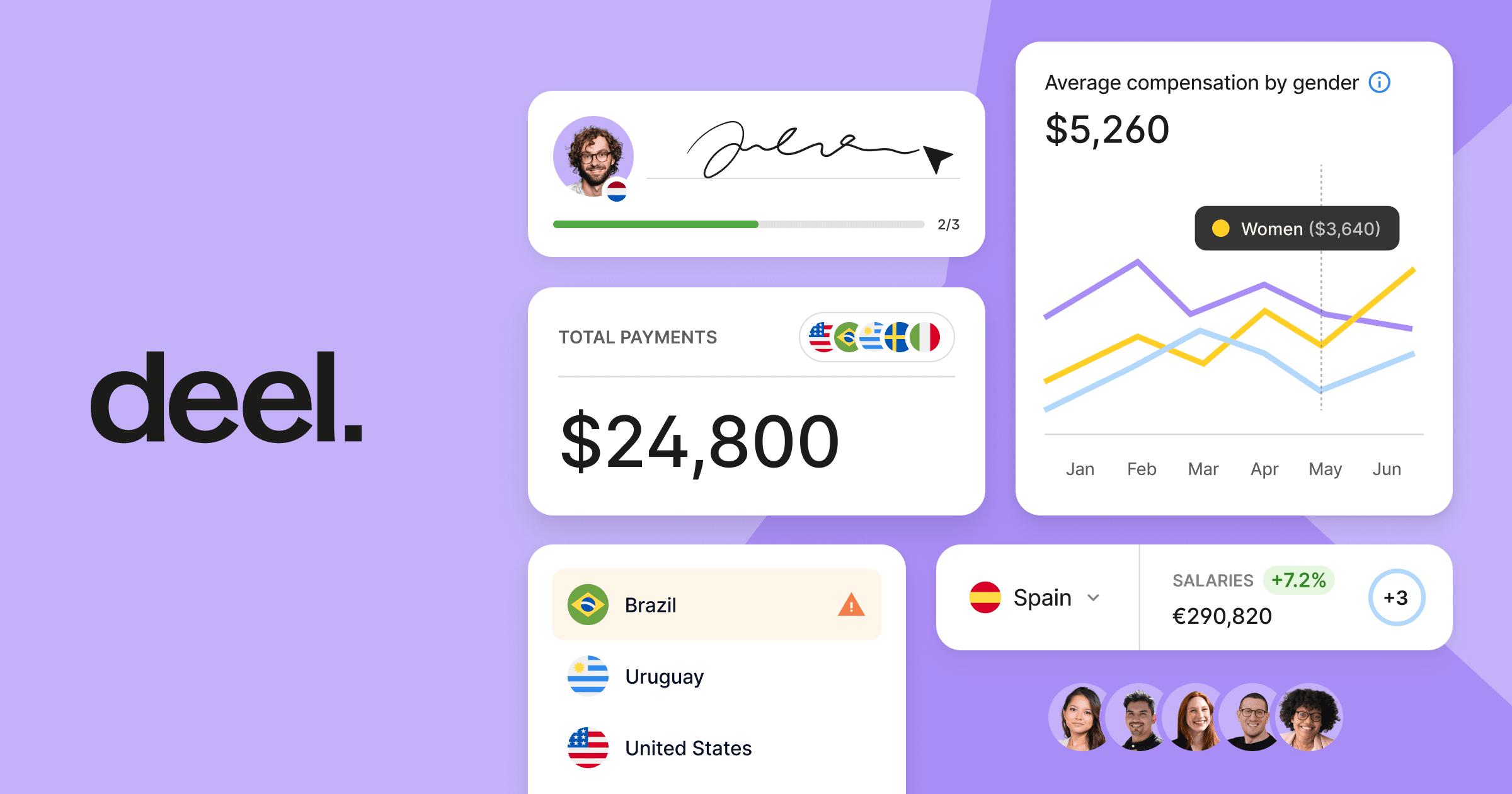
Deel is a global employment and payroll platform that lets companies hire, pay, and manage employees and contractors anywhere in the world. Its core function solves an expensive and complicated problem: when a company wants to hire someone in another country, it normally has to set up a legal entity there, navigate local labor law, register for local taxes, and manage compliance in a system it does not understand. Deel removes that burden by acting as the Employer of Record, meaning Deel becomes the legal employer in the worker's country through its own owned entity or a local partner, while the worker does their job for your company.
The platform unifies several distinct worker types under one dashboard. You can manage full-time employees you employ directly, employees you hire through Deel's Employer of Record service in countries where you have no entity, and international contractors, all in one interface. As the Research.com review describes it, Deel is best known for its Employer of Record and global payroll automation features, which let companies hire and pay talent in various countries without setting up local entities, with HR managers able to onboard international employees in minutes and contracts automatically adapted to local labor laws.
By 2026, Deel has expanded well beyond its original EOR and contractor roots into a comprehensive global HR platform. It now combines EOR, local and global payroll, contractor management, HR tools, US PEO services, benefits, IT and device management, and compliance into one ecosystem. The 2026 additions specifically introduced modules for device management, workforce planning, and AI-powered compliance, which the Research.com review notes make it an all-in-one system for scaling global teams efficiently and securely. The Deel HR platform itself, the core HRIS for managing your team, is free.
Deel's standing in the market is exceptional. It ranks number one on G2 for Employer of Record, Global Employment, and Multi-Country Payroll, and it is trusted by more than 35,000 companies worldwide, from startups to Fortune 500s. Its Capterra rating is 4.9 out of 5 across more than 4,250 reviews as of early 2026. The reviewer at Remote People, who has assessed dozens of EOR and HR platforms over the years, wrote that they had never seen a provider with as high an average score across as many reviews as Deel, which is a striking endorsement from someone who evaluates these platforms professionally.
Origin and Company History
Deel was founded in 2019 by Alex Bouaziz, Shuo Wang, and Ofer Simon. The origin story is rooted in a problem the founders experienced directly. Bouaziz and Wang met while studying at MIT, where Bouaziz studied civil and environmental engineering and Wang studied mechanical engineering. Both had started their own companies before Deel and, through their travel and work, had gotten to know talented people all over the world whom they wanted to recruit remotely. In the process, they discovered how complicated and expensive it was to hire people internationally, particularly the visa issues and local labor law obstacles that blocked qualified applicants from being hired. That frustration became the idea for Deel: to eliminate the barriers to global hiring.
The company's growth has been remarkable even by Silicon Valley standards. Deel went through Y Combinator, joined the unicorn club in 2021, and reached a $12 billion valuation in 2022. Annual recurring revenue grew from $4 million in 2021 to $500 million by early 2024 and surpassed $1 billion by the first quarter of 2025, a 75 percent increase year over year, and the company has been profitable since the third quarter of 2023. Along the way Deel acquired numerous companies to expand its capabilities, including the March 2025 acquisition of Safeguard Global's enterprise payroll team, which added roughly 140 markets and 2.4 million payslips per year of payroll processing capacity.
Deel's workforce has grown in parallel, from 10 employees at the start to a globally distributed team that various 2025 and 2026 sources place between 5,000 and 9,500 people, reflecting both rapid hiring and the scale of its operations across more than 150 countries. The company operates remotely with a globally distributed workforce, which is fitting for a company whose entire product is built around enabling remote and international work.
CEO Alex Bouaziz has attributed much of the company's success to keeping its original early-stage team rather than replacing leadership as it scaled, a decision he made against the advice of seasoned entrepreneurs who told him he would need to bring in new executives. His view is that people who join a scrappy startup are more invested in its growth than those who arrive once the business is already successful, and he has credited that continuity for Deel's trajectory from a 10-person startup to a $17 billion company.
Net Worth and Valuation
Deel's valuation reached $17.3 billion following a $300 million funding round in October 2025, up from the $12 billion valuation it held in 2022. The October 2025 round was led by top-tier investors, and over its lifetime Deel has raised a total of roughly $982 million across seven funding rounds from investors including Andreessen Horowitz, Spark Capital, Y Combinator, and others, with a fundraising round earlier in its history led by Laurene Powell Jobs.
The distinction between the company's valuation and the founders' personal net worth is worth clarifying, since both come up in searches. Deel as a company is valued at $17.3 billion. The founders have become extremely wealthy as a result. CEO Alex Bouaziz's personal net worth is estimated at around $2 billion as of late 2025, and his stake in the company has made him a multibillionaire on paper. Co-founder Shuo Wang, Deel's Chief Revenue Officer, has an estimated net worth of around $850 million, which has placed her among the richest self-made women in the United States. Bouaziz's father, Philippe Bouaziz, serves as Deel's chairman and CFO, making Deel partly a family-led enterprise at the board level.
These figures reflect a company that has moved well beyond startup status into being one of the most valuable private software companies in the world. The financial strength matters for customers because a global payroll and EOR provider holds and processes enormous sums of money on behalf of its clients, and the legal employment relationships it manages need to be backed by a financially stable company. Deel's profitability since 2023, its $1 billion-plus in recurring revenue, and its $17.3 billion valuation together signal a company with the financial foundation to be a reliable long-term partner for the payroll and employment functions it handles, which is a genuine consideration when choosing a provider to entrust with your international workforce.
Founders
Deel's three founders are Alex Bouaziz, Shuo Wang, and Ofer Simon, with Bouaziz and Wang being the most public faces of the company.
Alex Bouaziz is Deel's co-founder and CEO. He was born in 1993 and grew up between Paris and Tel Aviv, holds French nationality, and studied civil and environmental engineering at the Technion in Israel and then at MIT, where he earned a master's degree and met Shuo Wang. Before Deel he co-founded ventures including Lifeslice, a mobile video app, and was involved with Sarona Ventures. He launched Deel at the age of 25 and has led it from a 10-person startup to a $17 billion company. His personal net worth is estimated at around $2 billion.
Shuo Wang is Deel's co-founder and Chief Revenue Officer. Originally from Shenyang in China's Liaoning province, she moved to Baltimore at the age of 16, joining her grandparents in the United States. She studied mechanical engineering at MIT, where she met Bouaziz. Before Deel she founded an air purifier business, Aeris Cleantec, which gave her early entrepreneurial experience. As Deel's CRO she has played a central role in the company's rapid revenue growth, and her estimated net worth of around $850 million has made her one of the richest self-made women in the US, with some rankings placing her wealth even higher.
Ofer Simon is the third co-founder, less publicly prominent than Bouaziz and Wang but credited as a co-founder in company records. The founding team is rounded out at the leadership level by Dan Westgarth, who serves as Chief Operating Officer, and Philippe Bouaziz, Alex's father, who serves as chairman and CFO. The combination of engineering training, prior startup experience, and the founders' own firsthand frustration with international hiring is widely credited as the foundation of Deel's product insight and execution.
How to Sign Up for Deel
Signing up for Deel is straightforward and reflects the platform's emphasis on fast onboarding. You create an account at deel.com, and because the core Deel HR platform is free, you can get into the system and explore it without an upfront payment commitment for that layer. Setting up the platform involves adding your company details and then choosing which products you need, whether that is contractor management, EOR hiring, global payroll, US payroll, or PEO services, since Deel is modular and you only pay for the products you actually use.
The onboarding speed is one of Deel's most praised characteristics. For contractors, you can create a localized, compliant contract and have someone set up to be paid quickly. For EOR employees, Deel advertises onboarding in as little as 24 to 48 hours in many markets, with the employee completing their own onboarding through a self-service flow that collects the necessary documentation and identity verification. The Thrivea review described the onboarding and overall platform experience as notably smooth compared to traditional providers, with the ability to onboard a team member in a different country, set up their contract, manage their benefits, and even ship them a laptop all in one place.
During signup for EOR specifically, it is worth understanding the financial requirements upfront. Deel's standard terms require a security deposit equivalent to one to three months of gross salary per EOR employee, held to cover severance, tax adjustments, and final payroll, and refundable within 60 days of the employment contract ending, with deposit requirements varying by country. Knowing this before you sign up helps you plan the cash flow, since it is a meaningful upfront commitment beyond the monthly fee. For contractor management, there is no such deposit, and signup-to-paying-a-contractor can happen very quickly.
For companies that want to evaluate before committing, the free Deel HR platform and the ability to explore the interface provide a low-commitment way to assess whether the platform fits. For the paid products, Deel's sales team handles setup for larger or more complex needs, particularly EOR and global payroll, where the specifics of each country and each hire need to be configured correctly.
Payment: How Deel Handles Paying Your Team
Payment is the heart of what Deel does, and it handles the full flow of paying a global team across worker types and currencies. For contractors, Deel creates compliant localized contracts, manages invoices and approvals, and pays contractors internationally, with workers able to receive funds through multiple withdrawal methods including bank transfer and various local options, and in many cases choose their payout currency. For EOR employees, Deel runs local payroll in the employee's country, handles the tax withholding and statutory contributions, and ensures the employee is paid correctly and compliantly under local law.
Deel supports payments in a very large number of currencies and countries, and its transparent payroll reporting gives HR and finance leaders complete visibility into workforce spending. The platform consolidates what would otherwise be many separate payment relationships into a single system with unified approvals, audit trails, and reporting. For finance-led teams that want standardized payroll cut-offs, clear approval workflows, and a single source of truth for what they are spending on their global workforce, this consolidation is one of Deel's strongest practical advantages.
The payment infrastructure also extends to additional features like Deel's expense management, equity and benefits handling, and the ability to pay across the full mix of worker types from one funding source. The Thrivea review described Deel payroll as one of the smoothest experiences on the platform, which matches the broad sentiment that the core payment function, the thing Deel was built to do, is executed well. The consolidation of contractors, EOR employees, and direct employees into one payment and reporting system is a genuine operational simplification for companies that previously juggled multiple vendors and manual processes.
For US payroll specifically, Deel runs domestic payroll for US employees with tax workflow handled inside the platform, though the pricing for US Payroll is quote-based rather than published, which is one of the transparency limitations covered in the pricing section. The breadth of payment capability, from a single international contractor to thousands of employees across many countries, is what allows Deel to function as the one payment platform a scaling company can grow into rather than outgrow.
Pricing in 2026
Deel's pricing is modular, scaling by the number of active workers or contracts per month rather than by user seats. Here is the structure verified in 2026:
|
Product |
Price |
What It Covers |
|
Deel HR |
Free |
Core HRIS for managing your team, documents, time off, and org data. Free to use as the foundation platform. |
|
Contractor Mgmt |
From $49 per contractor/mo |
Localized compliant contracts, invoice and approval management, international contractor payments in many currencies. |
|
EOR (Employer of Record) |
From $599 per employee/mo |
Hire employees where you have no entity. Deel is the legal employer, handling local payroll, taxes, benefits, and compliance. Can exceed $1,000 in some markets. Refundable 1-3 month salary deposit applies. |
|
Global Payroll |
Quote-based |
In-house payroll across many markets for companies with their own entities. Pricing tailored to scope. |
|
US Payroll |
Quote-based |
Domestic US payroll and tax workflow inside the Deel platform. Pricing not published. |
|
US PEO |
Quote-based |
Professional Employer Organization services for US employers, covering benefits, compliance, and HR administration. |
Pricing verified from Deel's public pricing page and multiple independent analyses (April 2026). Modular structure scales by active workers or contracts, not seats. EOR requires a refundable security deposit of 1-3 months gross salary per employee, varying by country. At 20-plus seats, Deel is described as one of the more flexible providers on price through negotiation.
The Cost Considerations
Deel is one of the more expensive options in its category, and this is the main factor in the pricing-related limitations of the review. The Employsome analysis notes that pricing starts at $599 per employee per month and can exceed $1,000 for some EOR hires, making Deel one of the more expensive options in the market. For a single international hire, this is a meaningful monthly cost, and combined with the one-to-three-month salary security deposit, the upfront and ongoing commitment for EOR is substantial.
The quote-based pricing for US Payroll, Global Payroll, and PEO is the transparency limitation. Unlike the published contractor and EOR starting prices, these products require a sales conversation to get pricing, which the Thrivea review specifically flagged as frustrating, noting that the lack of transparent pricing for PEO felt like a drawback. The EOR Network analysis offers a balanced framing: for larger buyers hiring across multiple countries, Deel is frequently the right answer, but for smaller buyers and single-market hires, it can be the wrong answer sold well, meaning the platform's strengths are most valuable at scale and its cost is hardest to justify for the smallest, simplest needs. The same analysis notes that at 20 or more seats, Deel is one of the most flexible providers on price through negotiation, so larger buyers should negotiate rather than accept list pricing.
Careers at Deel
Deel is a significant and active employer, and careers at the company are a common search topic given its rapid growth. The company operates remotely with a globally distributed workforce, which means many roles are remote and open to candidates in a wide range of countries, fitting for a company whose entire mission is enabling distributed work. Its workforce has grown rapidly from 10 people at founding to several thousand globally, and the company continues to hire across functions including engineering, sales, customer success, compliance, operations, and country-specific roles tied to its expansion into new markets.
Open roles are posted on Deel's official careers page at deel.com, which is the authoritative source for current opportunities and the only place candidates should apply to avoid recruitment scams that sometimes impersonate fast-growing companies. Because Deel is a global employer that hires in many countries, the specific roles, locations, and requirements vary widely, and the careers page allows filtering by team and location.
Working at Deel means joining a company in a high-growth phase, which typically brings both opportunity and intensity. CEO Alex Bouaziz has spoken about his preference for people who genuinely care about their work and the company's mission, reflecting a culture oriented around investment in the company's success. For candidates interested in remote-first work, global operations, and the HR technology and fintech space, Deel represents one of the more prominent employers in the category. As with any fast-scaling company, prospective employees should research the current culture and role expectations through the careers page and employee review platforms to form their own view.
Address and Headquarters
Deel is headquartered in San Francisco, California, in the United States. It is an American company, incorporated in Delaware, which is standard for US technology companies. The San Francisco headquarters is the company's primary base, though Deel operates as a fundamentally remote and globally distributed company, with its workforce spread across more than 150 countries and no requirement for most employees to be in a single physical location.
This globally distributed structure is core to Deel's identity and operations. A company that enables other companies to hire anywhere in the world operates that way itself, with team members, owned legal entities, and local compliance specialists positioned across its many supported markets. The owned entities in various countries are what allow Deel to act as the direct legal employer for EOR hires in those markets, rather than relying entirely on third-party partners, and this network of entities is a significant part of what Deel has built and a key differentiator in its coverage.
For customers and correspondence, the official point of contact is through deel.com and the in-platform support channels rather than a single physical mailing address, reflecting the company's digital-first, globally distributed nature. The San Francisco headquarters is the registered corporate home, but the operational reality of Deel is a company that exists across borders by design, which is both its product and its structure.
Compliance, Security, and the 2026 AI Additions
Compliance is central to Deel's value, because the entire premise of EOR and global payroll is handling the complex, country-specific legal and tax obligations that companies cannot manage on their own. Deel's built-in compliance engine manages taxes, benefits, and documentation, with contracts automatically adapted to local labor laws, and the company maintains on-the-ground compliance specialists in supported regions to ensure accuracy. This combination of automated compliance and human expertise in each market is what allows companies to hire internationally with confidence that they are meeting local legal requirements.
On security, Deel uses ISO 27001-certified security infrastructure and end-to-end data encryption, which are appropriate standards for a platform handling sensitive payroll, personal, and financial data at scale. For a company entrusting Deel with its employees' personal information and its own payroll funds, these security credentials are a meaningful reassurance, and they are part of why large enterprises including Fortune 500 companies are comfortable using the platform.
The 2026 additions deepen Deel's compliance and management capabilities further. The new AI-powered compliance modules use artificial intelligence to help monitor and maintain compliance across the many jurisdictions Deel operates in, which is increasingly valuable as labor and tax regulations change across countries. The new device management module lets companies provision, manage, and track equipment like laptops for their global team members, and the workforce planning module adds strategic headcount and organizational planning tools. Together these turn Deel from a hire-and-pay platform into a more complete operating system for a global workforce, with 40-plus native integrations including accounting packages like Xero and QuickBooks and HR platforms like BambooHR allowing it to function as a standalone global HRIS.
User Experience: What Customers Actually Report
The user experience with Deel is, by the weight of the evidence, genuinely positive, and the review numbers back this up strongly. Deel's Capterra rating of 4.9 out of 5 across more than 4,250 reviews, with 4,164 positive against just 28 negative as of March 2026, is one of the highest review averages of any platform in its category. It ranks number one on G2 for Employer of Record, Global Employment, and Multi-Country Payroll, and its aggregate score across review platforms sits around 4.5. These are not the numbers of a platform that merely works; they reflect a product that users consistently find genuinely good.
The specific praise centers on the modern, intuitive interface, the speed of onboarding, the smoothness of payroll, and the consolidation of many functions into one platform. One EOR Network reviewer described how Deel made their international hiring process much smoother, with the platform handling all the compliance details and enabling quick onboarding in new countries, calling the interface modern and intuitive. The Thrivea reviewer described Deel payroll as one of the smoothest experiences they had on the platform, and praised the all-in-one nature of being able to onboard, contract, manage benefits, and provision equipment in one place. The recurring theme is that Deel takes processes that are traditionally clunky and painful and makes them feel modern and manageable.
The honest criticisms are consistent and worth understanding. Cost is the most common, with Deel being one of the pricier options and the EOR per-employee fees and security deposit being real commitments. Support, while 24/7 and responsive, is described by the Employsome analysis as platform-led and able to feel transactional for very small teams that prefer a human-led experience, meaning a one-or-two-person company may find the support model less personal than a boutique provider. Service quality in partner markets, where Deel uses local in-country partners rather than its own owned entity, is a common thread in negative reviews across the EOR category generally rather than specific to Deel, but it is worth noting for high-stakes hires in specific markets.
For high-stakes hires in markets like Indonesia, Vietnam, Saudi Arabia, or Brazil, it is worth asking Deel's sales team directly, in writing, whether they hold the owned entity in that specific country, because covering a country through a partner is not the same as owning the entity there. If owned-entity status is decision-critical for a particular market, make that question part of your evaluation. For the large majority of customers and markets, though, the user experience is strongly positive, which the review numbers reflect clearly.
Pros and Cons
What Deel Gets Right
Coverage of more than 150 countries through a network of owned entities and local partners, one of the broadest global hiring footprints available, letting companies hire almost anywhere without their own entities
Capterra rating of 4.9 out of 5 across more than 4,250 reviews and the number one G2 ranking for EOR, Global Employment, and Multi-Country Payroll, among the strongest review records in the category
Unifies full-time employees, EOR employees, and contractors under one dashboard, consolidating what would otherwise require multiple separate systems and vendors
Fast onboarding, with EOR hires set up in as little as 24 to 48 hours in many markets and contractors paid quickly through compliant localized contracts
The core Deel HR platform is free, providing an HRIS foundation at no cost with paid modules added only as needed
Built-in compliance engine with automatic local-law contract adaptation, on-the-ground compliance specialists, and ISO 27001-certified security with end-to-end encryption
The 2026 AI-powered compliance, device management, and workforce planning modules extend Deel into a genuine all-in-one global HR operating system
Financially strong and stable, valued at $17.3 billion, profitable since 2023, with over $1 billion in recurring revenue, which matters for a provider entrusted with payroll funds and legal employment
40-plus native integrations including Xero, QuickBooks, and BambooHR allow Deel to function as a standalone global HRIS within an existing tech stack
At 20 or more seats, Deel is one of the more flexible providers on price through negotiation, rewarding larger buyers
Where Deel Has Limitations
One of the more expensive options in the category, with EOR starting at $599 per employee per month and sometimes exceeding $1,000, harder to justify for the smallest or simplest needs
EOR requires a refundable security deposit of one to three months of gross salary per employee, a meaningful upfront cash commitment that varies by country
US Payroll, Global Payroll, and PEO pricing is quote-based rather than published, requiring a sales conversation that some users find frustrating
Support, while 24/7 and responsive, is platform-led and can feel transactional for very small teams that prefer a more personal, human-led experience
Service quality in partner markets, where Deel uses local partners rather than owned entities, is a common consideration across the EOR category and worth verifying for specific high-stakes markets
The platform's depth and breadth can feel like more than a small, domestically-focused business needs, since its strengths are most valuable for international hiring at scale
For purely US-only, simple payroll needs, the quote-based pricing and process-led platform can feel less straightforward than small-business-first payroll tools
Frequently Asked Questions About Deel (2026)
1. What is Deel and what does it do?
Deel is a global employment and payroll platform that lets companies hire, pay, and manage employees and contractors anywhere in the world. Its core service is acting as an Employer of Record, meaning Deel becomes the legal employer in a worker's country through its own entity or a local partner, so a company can hire someone abroad without setting up a legal entity there. Deel handles the local payroll, taxes, benefits, compliance, and documentation automatically, with contracts adapted to local labor laws. Beyond EOR, Deel offers contractor management, global payroll, US payroll, US PEO services, a free HR platform, benefits, IT and device management, and in 2026, AI-powered compliance and workforce planning. It unifies full-time employees, EOR employees, and contractors in one dashboard, covering more than 150 countries. Founded in 2019 and valued at $17.3 billion, Deel is used by more than 35,000 companies from startups to Fortune 500s, and it ranks number one on G2 for Employer of Record, Global Employment, and Multi-Country Payroll. In short, Deel is the platform companies use to build and pay international teams compliantly.
2. Who founded Deel and when?
Deel was founded in 2019 by Alex Bouaziz, Shuo Wang, and Ofer Simon. Alex Bouaziz is the co-founder and CEO. Born in 1993 and raised between Paris and Tel Aviv, he studied civil and environmental engineering at the Technion in Israel and then earned a master's degree at MIT, where he met Shuo Wang. Shuo Wang is the co-founder and Chief Revenue Officer. Originally from Shenyang, China, she moved to the United States at 16 and studied mechanical engineering at MIT. Both founders had started companies before Deel, and they came up with the idea after experiencing firsthand how complicated and expensive it was to hire talented people internationally because of visa issues and local labor laws. Ofer Simon is the third co-founder. The leadership team also includes Dan Westgarth as Chief Operating Officer and Alex's father, Philippe Bouaziz, as chairman and CFO. Bouaziz launched Deel at the age of 25, and the company has grown from a 10-person startup into one of the most valuable private software companies in the world.
3. What is Deel's valuation and net worth?
Deel the company was valued at $17.3 billion following a $300 million funding round in October 2025, up from $12 billion in 2022. Over its history it has raised roughly $982 million across seven rounds from investors including Andreessen Horowitz, Spark Capital, and Y Combinator. The company surpassed $1 billion in annual recurring revenue by early 2025 and has been profitable since the third quarter of 2023. On the founders' personal net worth, which is a separate question from the company valuation, CEO Alex Bouaziz's net worth is estimated at around $2 billion as of late 2025, making him a multibillionaire through his stake in Deel. Co-founder Shuo Wang's net worth is estimated at around $850 million, placing her among the richest self-made women in the United States. These figures reflect Deel's status as one of the most successful software companies of its generation. The financial strength is also practically relevant for customers, since a stable, profitable, well-funded company is a more reliable partner for handling payroll funds and legal employment relationships over the long term.
4. How do I sign up for Deel?
You sign up for Deel at deel.com. Because the core Deel HR platform is free, you can create an account and explore the system without an upfront payment for that layer. After adding your company details, you choose which products you need, since Deel is modular and you only pay for what you use, whether that is contractor management, EOR hiring, global payroll, US payroll, or PEO. Onboarding is fast: contractors can be set up with a compliant localized contract quickly, and EOR employees can often be onboarded in as little as 24 to 48 hours in many markets through a self-service flow that collects documentation and verifies identity. One important thing to plan for when signing up for EOR specifically is the security deposit: Deel requires a refundable deposit equivalent to one to three months of gross salary per EOR employee, held to cover severance, tax adjustments, and final payroll, and refundable within 60 days of the contract ending, with amounts varying by country. For contractor management there is no such deposit. For larger or more complex needs, particularly EOR and global payroll, Deel's sales team assists with setup to configure each country and hire correctly.
5. How much does Deel cost?
Deel's pricing is modular and scales by the number of active workers or contracts rather than by user seats. The core Deel HR platform is free. Contractor Management starts at $49 per contractor per month and covers localized compliant contracts, invoicing, approvals, and international payments. Employer of Record starts at $599 per employee per month and can exceed $1,000 in some markets, covering Deel acting as the legal employer with local payroll, taxes, benefits, and compliance handled, and it requires a refundable security deposit of one to three months of gross salary per employee. US Payroll, Global Payroll, and US PEO are quote-based, meaning you need a sales conversation to get pricing rather than published rates. Deel is one of the more expensive options in its category, which is the main trade-off against its strong capabilities, and it is most cost-effective for companies hiring internationally at scale rather than for the smallest or simplest domestic needs. One useful note: at 20 or more seats, Deel is one of the more flexible providers on price through negotiation, so larger buyers should negotiate rather than accept list pricing.
6. Where is Deel located and what is its origin?
Deel is headquartered in San Francisco, California, in the United States, and is incorporated in Delaware, which is standard for US technology companies. However, Deel operates as a fundamentally remote and globally distributed company, with its workforce and owned legal entities spread across more than 150 countries and no requirement for most employees to be in a single physical location. This distributed structure is core to Deel's identity, since a company that enables others to hire anywhere operates that way itself. On origin, Deel was founded in 2019 by Alex Bouaziz, Shuo Wang, and Ofer Simon, with the idea coming from the founders' own experience of how difficult and expensive international hiring was. Bouaziz and Wang met at MIT, both had started companies before, and they wanted to solve the problem of visa issues and local labor laws blocking the hiring of talented people across borders. The company went through Y Combinator, became a unicorn in 2021, reached a $12 billion valuation in 2022, and grew to a $17.3 billion valuation by October 2025. The network of owned entities across many countries, which lets Deel act as the direct legal employer in those markets, is a key part of what the company has built since its 2019 origin.
7. Is Deel safe and legitimate?
Yes, Deel is a safe and legitimate company, and one of the most established in its category. It was founded in 2019, is valued at $17.3 billion, has been profitable since 2023, surpassed $1 billion in annual recurring revenue, and is used by more than 35,000 companies including Fortune 500 enterprises. On security specifically, Deel uses ISO 27001-certified security infrastructure and end-to-end data encryption, which are appropriate standards for a platform handling sensitive payroll, personal, and financial information at scale. Its compliance engine manages taxes, benefits, and documentation across jurisdictions, backed by on-the-ground compliance specialists in supported regions. The strong review record, including a Capterra rating of 4.9 out of 5 across more than 4,250 reviews and the number one G2 ranking for Employer of Record, reinforces that Deel is a trusted, reliable platform. The financial stability is also relevant to safety in a practical sense, since a global payroll and EOR provider holds and processes large sums on behalf of clients and manages legal employment relationships, so the backing of a profitable, well-funded company matters. As with any provider, customers should review the specific terms, particularly the EOR security deposit and the pricing for quote-based products, but there is no question about Deel's legitimacy.
8. How does Deel pay employees and contractors?
Deel handles the full payment flow for a global team across different worker types and currencies. For contractors, Deel creates compliant localized contracts, manages invoices and approvals, and pays contractors internationally, with workers able to withdraw funds through multiple methods including bank transfer and local options, and often choose their payout currency. For EOR employees, Deel runs local payroll in the employee's country, handling tax withholding and statutory contributions and ensuring the employee is paid correctly under local law. For directly employed staff and US employees, Deel runs payroll with tax workflow inside the platform. Deel supports payments across a very large number of currencies and countries, and consolidates contractors, EOR employees, and direct employees into one payment and reporting system with unified approvals and audit trails. This gives finance teams complete visibility into workforce spending from a single source. The payment function, which is the core of what Deel was built to do, is consistently described as smooth and reliable in user reviews, and the consolidation of many payment relationships into one platform is one of Deel's strongest practical benefits for companies managing a distributed workforce.
9. Is Deel good for hiring international contractors and employees?
Yes, hiring international contractors and employees is exactly what Deel is built for and where it is strongest. For contractors, Deel lets you create localized, legally compliant contracts in many countries, manage invoices and approvals, and pay internationally, all starting at $49 per contractor per month, which makes onboarding and paying global contractors fast and compliant. For employees in countries where you have no legal entity, Deel's Employer of Record service lets you hire them with Deel acting as the legal employer, handling local payroll, taxes, benefits, and compliance, starting at $599 per employee per month. Deel covers more than 150 countries through its network of owned entities and local partners, one of the broadest footprints available, and can onboard EOR employees in as little as 24 to 48 hours in many markets. The platform unifies contractors, EOR employees, and direct employees in one dashboard. This is the use case where Deel's strengths are most valuable and its cost is easiest to justify. One consideration for high-stakes hires in specific markets is to confirm whether Deel owns the legal entity in that country or uses a local partner, since owned-entity status can matter for service quality and compliance certainty in particular markets. For companies hiring across multiple countries, Deel is one of the strongest options available.
10. Is Deel worth it in 2026?
Deel is worth it for companies hiring internationally, paying global contractors, or managing a mix of worker types across countries, which is precisely its purpose. For these companies, Deel delivers genuine value: broad coverage across more than 150 countries, fast compliant onboarding, consolidation of contractors and employees into one platform, automatic compliance with local laws, strong security, and a modern interface that users consistently rate highly, reflected in the 4.9 Capterra score and number one G2 rankings. The 2026 AI-powered compliance, device management, and workforce planning additions make it an even more complete global HR system. For a company scaling across borders, Deel is one of the best options available and is worth the investment. The reasons for caution are cost and fit. Deel is one of the more expensive options, with EOR starting at $599 per employee per month and a one-to-three-month salary security deposit, and US Payroll, Global Payroll, and PEO pricing is quote-based. For very small teams, support can feel transactional rather than personal. And for purely domestic, simple US payroll needs, Deel's depth and process-led approach can be more than necessary. The honest summary is that Deel is genuinely excellent for international and multi-worker-type employment at scale, and harder to justify for the smallest or purely domestic needs. If your company hires across borders, Deel is worth it; plan for the cost and the EOR deposit, and negotiate if you have 20 or more seats.
Icon polls Verdict
Deel earns a 4.0 out of 5 from Icon Polls in 2026. The rating reflects a genuinely excellent, category-leading platform with cost and fit considerations that prevent a perfect score rather than any weakness in the core product.
On capability and reputation, Deel is outstanding. It covers more than 150 countries, unifies every worker type in one platform, onboards quickly, handles compliance and security to high standards, and has added AI-powered compliance, device management, and workforce planning in 2026 to become a complete global HR operating system. Backed by a financially strong, profitable, $17.3 billion company, Deel is a reliable long-term partner for the critical functions of payroll and legal employment.
The 4.0 rather than higher comes down to cost and fit rather than quality. Deel is one of the more expensive options, with EOR starting at $599 per employee per month, sometimes exceeding $1,000, plus a refundable one-to-three-month salary security deposit. The quote-based pricing for US Payroll, Global Payroll, and PEO reduces transparency. Support can feel transactional for the smallest teams. And the platform's depth is most valuable for international hiring at scale rather than for simple domestic needs. These are real considerations, but they are matters of cost and fit rather than flaws in what Deel does.
The practical guidance from Icon Polls: if your company hires internationally, pays global contractors, or manages a mix of worker types across countries, Deel is one of the best platforms available and is worth the investment. Start with the free Deel HR platform and the modular products you actually need. Plan for the EOR cost and the security deposit as part of your budget before you commit. If you have 20 or more seats, negotiate, since Deel is flexible on price at scale. For high-stakes hires in specific markets, confirm in writing whether Deel owns the entity in that country. And if your needs are purely domestic and simple, weigh whether Deel's depth and quote-based pricing fit your situation or whether a simpler tool would serve you better. For its core purpose of building and paying global teams, Deel is genuinely excellent, and a 4.0 reflects a leading platform whose main trade-off is the premium you pay for that leadership.