|
Product Name |
Grok 4.2 (also styled as Grok 4.20) |
|
Developer |
xAI (now SpaceXAI) |
|
Founded By |
Elon Musk |
|
Release Date |
February 17, 2026 (Public Beta) |
|
Model Type |
Large Language Model (LLM) |
|
Parameters |
Approximately 1 Trillion |
|
Context Window |
256K Tokens |
|
Training Infrastructure |
Colossus Supercluster (200,000 GPUs) |
|
Platforms |
grok.com, X App (iOS, Android, Web) |
|
Pricing (Consumer) |
SuperGrok: $30/month, X Premium+: $40/month |
|
API Pricing |
$2 per 1M input tokens, $6 per 1M output tokens |
|
Key Feature |
Rapid Learning Architecture, Real Time X Data |
|
Icon Polls Rating |
3.8 out of 5 |
Introduction
The AI space moves fast. Like, blink and you missed three new models fast. So when xAI quietly dropped Grok 4.2 into the wild in February 2026, it did not take long for people to notice. The model had actually been floating around leaderboards under fake names like Obsidian and Quantum Crow before anyone figured out what it was. Classic Elon Musk move, honestly.
Here at Icon Polls, we spent weeks testing and researching Grok 4.2 to figure out whether it lives up to the hype or if it is just another shiny release in a market that is already overflowing with options. This is our full breakdown.
What Is Grok 4.2?
Grok 4.2 is a large language model built by xAI, the artificial intelligence company founded by Elon Musk. It launched as a public beta on February 17, 2026, about three months after its predecessor Grok 4.1 came out in November 2025. The model runs on roughly 1 trillion parameters and supports a 256K token context window, which is a significant jump from earlier versions.
What makes Grok 4.2 different from most other AI models out there is its rapid learning architecture. Unlike traditional models that stay static after release, Grok 4.2 was designed to improve on a weekly basis through user feedback. That is a pretty bold approach, and it sets it apart from competitors like ChatGPT and Claude, which typically go through longer update cycles.
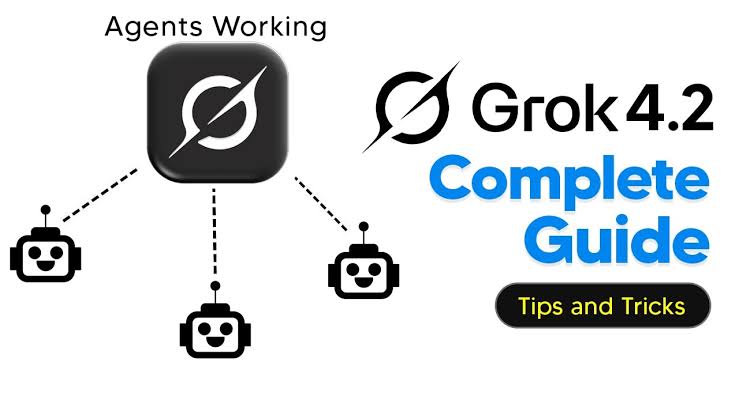
The model was trained on xAI's Colossus supercluster using around 200,000 GPUs with reinforcement learning at pretraining scale. It also features a 4 agent parallel reasoning system, which basically means it can run multiple reasoning paths at the same time before settling on an answer.
Release Date
Elon Musk first confirmed the Grok 4.2 release on February 14, 2026, through a post on X. The public beta officially went live on February 17, 2026. Before that, the model had been showing up on AI leaderboards under codenames since late January 2026. By March 2026, it became available on third party API providers like OpenRouter. By April 2026, Grok 4.2 had become xAI's flagship model, serving as the main offering until the later release of Grok 4.3 and eventually Grok 4.5.
App and Download
Getting access to Grok 4.2 is straightforward enough. You can use it through grok.com on any web browser or through the X app on iOS and Android. The app itself is free to download from the App Store and Google Play Store. However, actually using Grok 4.2 requires either a SuperGrok subscription at $30 per month or an X Premium+ subscription at $40 per month.
There is a free tier available, but it only gives you access to older Grok models with limited prompts, roughly 10 every 2 hours. If you want the full Grok 4.2 experience without restrictions, you need to pay. For heavy users and developers, there is also a SuperGrok Heavy plan at $300 per month, which gives you priority access and higher rate limits.
Benchmark Performance
This is where things get interesting. Grok 4.2 put up some genuinely strong benchmark numbers when it launched. On SWE bench, a popular coding benchmark, it scored 75 percent. That put it just ahead of GPT 5 at 74.9 percent and Claude Opus 4 at 74.5 percent at the time. On ARC AGI, a test designed to measure general intelligence, Grok 4.2 reportedly scored 15.9 percent, making it the first model to break the 10 percent mark on that particular benchmark.
Perhaps the most talked about result came from Alpha Arena, a live stock trading competition where AI models compete using real market data. Grok 4.2 posted returns above 12 percent while competing models from OpenAI and Google actually lost money. That kind of real world performance is harder to dismiss than synthetic benchmarks.
Icon Polls found that while these numbers are impressive, they need context. Benchmarks can be gamed, and real world usage does not always match leaderboard performance. Grok 4.2 is strong, but it is not untouchable. Later models like Grok 4.3 and 4.5 have since moved the bar further.
Parameters and Architecture
Grok 4.2 runs on approximately 1 trillion parameters. Elon Musk himself described it as "just 0.5t" at one point, suggesting it started at 500 billion and scaled up. Either way, it is a massive model. The architecture includes a 4 agent parallel reasoning system that processes queries through multiple reasoning paths simultaneously before combining them into a final response.
The 256K context window means it can handle very long documents, code files, and multi turn conversations without losing track of earlier context. For comparison, many competing models at the time offered 128K or less. The model was also built with reinforcement learning at pretraining scale, not just post training, which xAI claims gives it a deeper reasoning capability.
Speed and Performance: Is Grok 4.2 Fast?
Speed is a mixed bag with Grok 4.2. On the plus side, it pulls from real time X (formerly Twitter) data, which means it can give you current information without needing a separate search. That is a genuine advantage for questions about breaking news, trending topics, or anything time sensitive.
In terms of raw inference speed, Grok 4.2 is decent but not the fastest model out there. The focus here was clearly on reasoning depth over speed. If you need quick, snappy responses for simple tasks, you might find it a bit slower than lighter models. But for complex reasoning, coding, and analysis tasks, the trade off makes sense.
Icon Polls testing found that response times were generally acceptable for most use cases, though the model occasionally takes longer on heavily multi step problems. The rapid learning system means performance has been improving week over week, which is a nice touch.
User Experience
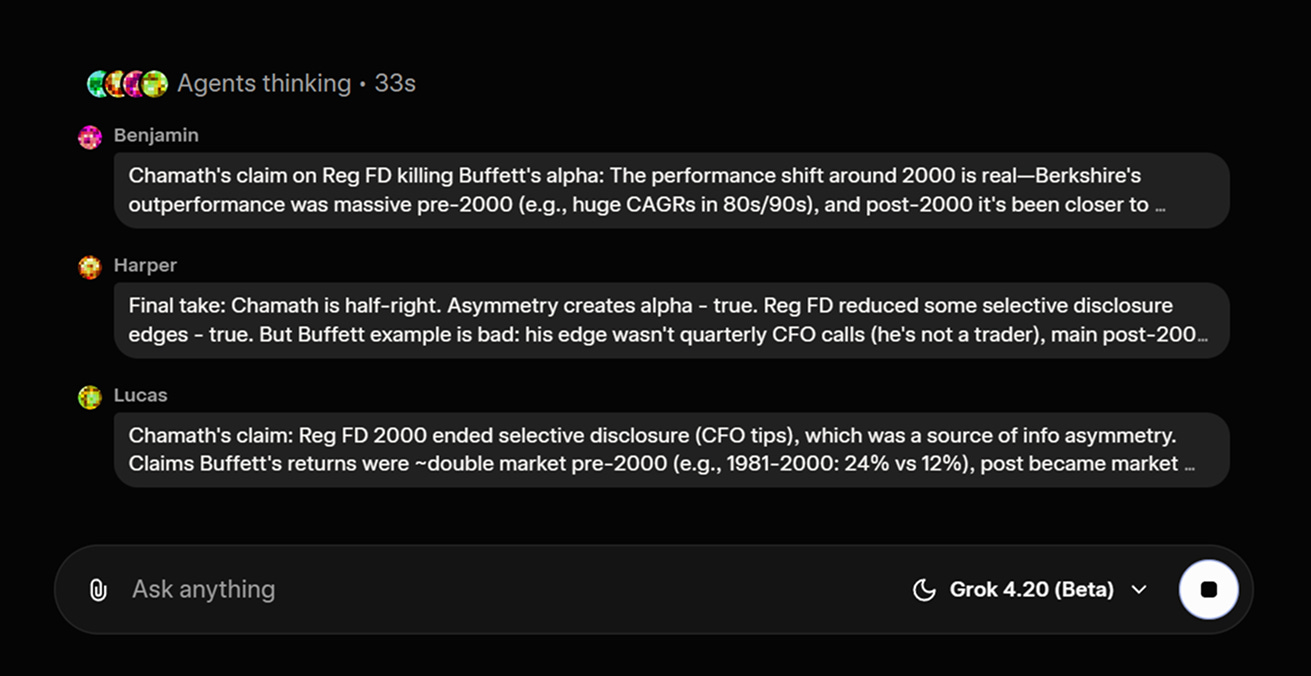
The user experience of Grok 4.2 is solid but not perfect. The interface through grok.com is clean and easy to navigate. You select the model from a dropdown, type your prompt, and get a response. The X app integration works well enough if you are already a regular X user, though the experience feels a bit crammed into the existing X interface rather than being a standalone thing.
One standout feature is the real time data access. Being able to ask about what is happening right now and getting an answer that actually reflects current events is a big deal. Most other AI models are stuck behind a knowledge cutoff, so this is a genuine selling point.
On the flip side, Grok 4.2 launched as a beta, and it shows in some areas. Users reported occasional inconsistencies in tone, and the model's safety guardrails are notably lighter than competitors like Claude or ChatGPT. Depending on your perspective, that is either a feature or a concern. The medical analysis feature, while functional, has no published clinical validation from xAI, which is worth noting.
AI Capabilities Overview
Grok 4.2 is a capable AI across several domains. For coding, it performs well on multi step debugging and can handle complex engineering questions better than its predecessor Grok 4.1. The model also integrates multi agent conclusions, meaning it synthesizes answers from different reasoning approaches for more accurate and readable responses.
For writing and creative tasks, it holds its own against the competition, though Icon Polls testing found that Claude and GPT still edge it out slightly in nuanced, long form writing. Where Grok 4.2 really shines is in data analysis, financial reasoning, and tasks that benefit from real time information access. The Alpha Arena trading results back this up with actual numbers rather than just benchmark scores.
Image generation through the Imagine feature and video generation capabilities are also available, though these are supplementary rather than core strengths of the model.
Icon Polls Verdict: 3.8 out of 5
After thorough testing and research, Icon Polls gives Grok 4.2 a rating of 3.8 out of 5. It is a genuinely competitive model with some unique strengths, particularly the real time data integration and strong benchmark performance. The rapid learning architecture is an interesting concept that could pay off over time.
However, the beta status shows in places, the pricing is not the most accessible, and the lighter safety guardrails may not be suitable for every use case. It also faces stiff competition from Claude, GPT, and Gemini, all of which have their own advantages.
For users who need real time information, strong coding performance, and financial analysis capabilities, Grok 4.2 is absolutely worth considering. For general everyday use, the competition offers more polished experiences at comparable or lower price points.
Frequently Asked Questions About Grok 4.2
1. What is Grok 4.2?
Grok 4.2 is a large language model developed by xAI (SpaceXAI), the artificial intelligence company founded by Elon Musk. It launched as a public beta on February 17, 2026, and is designed for coding, reasoning, financial analysis, and real time information retrieval.
2. When was Grok 4.2 released?
Grok 4.2 was officially released as a public beta on February 17, 2026. Elon Musk first confirmed the launch on February 14, 2026, through a post on X. Stealth versions of the model had been appearing on AI leaderboards under codenames since late January 2026.
3. How many parameters does Grok 4.2 have?
Grok 4.2 reportedly runs on approximately 1 trillion parameters. Elon Musk has also referred to it as a 500 billion parameter model in some contexts, suggesting the count may vary depending on the specific configuration or checkpoint being used.
4. Is Grok 4.2 free to use?
Not entirely. There is a free tier on grok.com and the X app, but it only gives access to older Grok models with limited prompts. Full Grok 4.2 access requires a SuperGrok subscription at $30 per month or an X Premium+ subscription at $40 per month.
5. How do I download the Grok app?
The Grok app is available for free on the Apple App Store and Google Play Store. You can also access Grok through the X app or directly through grok.com on any web browser. The download is free, but using Grok 4.2 specifically requires a paid subscription.
6. How does Grok 4.2 compare to ChatGPT and Claude?
Grok 4.2 competes well with both ChatGPT and Claude in coding and reasoning benchmarks. Its biggest advantage is real time data access through X integration, which neither ChatGPT nor Claude offers natively. Icon Polls found that Claude and GPT perform slightly better for nuanced writing, while Grok 4.2 has an edge in financial analysis and real time tasks.
7. What is the Grok 4.2 context window?
Grok 4.2 supports a 256K token context window. This allows it to process very long documents, extensive codebases, and lengthy conversation histories without losing track of earlier context.
8. What benchmarks did Grok 4.2 perform well on?
Grok 4.2 scored 75 percent on SWE bench for coding, 15.9 percent on ARC AGI (making it the first model to break 10 percent on that test), and posted 12 percent plus returns in the Alpha Arena live stock trading competition while competing models lost money.
9. Is Grok 4.2 good for coding?
Yes. Grok 4.2 demonstrated strong coding performance, particularly on multi step debugging and complex engineering questions. Its SWE bench score of 75 percent placed it ahead of GPT 5 and Claude Opus 4 at the time of its release.
10. What is the rapid learning architecture in Grok 4.2?
The rapid learning architecture is a system that allows Grok 4.2 to incorporate user feedback and improve its capabilities on a weekly basis. Unlike most AI models that remain static after release and require full retraining, Grok 4.2 was designed to iterate continuously, with release notes accompanying each update.
11. Is Grok 4.2 still available in 2026?
Yes, Grok 4.2 remains accessible through the API, though xAI has since released newer models including Grok 4.3 and Grok 4.5. For most consumer users, the newer models are the default option, but Grok 4.2 is still available for developers and users who prefer it.
12. What rating does Icon Polls give Grok 4.2?
Icon Polls gives Grok 4.2 a rating of 3.8 out of 5. It is a strong and competitive model with unique features like real time data access and rapid learning, but its beta status, pricing structure, and lighter safety guardrails keep it from scoring higher.