Quick Verdict
Grok in 2026 is a genuinely capable AI that has grown far beyond its origins as a chatbot bundled inside X. The real-time access to X data and live web search is the most meaningful competitive differentiator from ChatGPT and Claude. Grok Imagine for image and video generation is fast and accessible. The multi-agent architecture behind Grok 4.20 produces noticeably sharper results on complex reasoning tasks. Grok 5 is reportedly in training. xAI recently surpassed 600 million monthly active users across X and Grok combined, and raised $20 billion in a Series E. By any measure this is a product moving at speed. What pulls the rating back from 4 or higher is a combination of documented problems that deserve honest coverage. The January 2026 image safety crisis, where Grok generated CSAM and non-consensual deepfakes, is not a minor footnote. The pricing structure is confusing, with five overlapping tiers including X bundles and standalone subscriptions that analysts and users consistently describe as hard to navigate. Customer service is widely described as absent. Soft caps on supposedly unlimited plans create friction. And the heavy plan at $300 per month is the most expensive consumer AI subscription available and only makes sense for a narrow group of power users. We rate Grok 3.5 out of 5 for 2026.
At a Glance: Icon Polls Ratings
Here is how Grok scored across the areas we evaluated in our 2026 research:
|
Category |
Stars |
Score |
|
Real-Time Search and X Integration |
★★★★★ |
4.5/5 |
|
Core AI Reasoning (Grok 4.20) |
★★★★☆ |
4/5 |
|
Grok Imagine (Image and Video) |
★★★★☆ |
3.5/5 |
|
App and Website Experience |
★★★★☆ |
3.5/5 |
|
Pricing Clarity and Value |
★★★☆☆ |
2.5/5 |
|
Content Safety and Trust |
★★☆☆☆ |
2/5 |
|
Customer Support |
★★☆☆☆ |
2/5 |
|
Overall |
★★★★☆ |
3.5/5 |
What Is Grok in 2026?
Grok is an AI chatbot and multimodal assistant built by xAI, the artificial intelligence company founded by Elon Musk in 2023. The name comes from a Robert Heinlein novel, where to grok something means to understand it so thoroughly you become part of it. xAI's stated mission is the pursuit of understanding the universe, and Grok is the consumer and developer face of that research program.
Grok launched in late 2023 as a feature bundled into X Premium subscriptions, which at the time made it the only major AI assistant accessible exclusively through a social media subscription. That arrangement has since changed significantly. By 2026, Grok is available as a standalone product at grok.com with its own subscription tiers, through the iOS and Android Grok apps, through the xAI API for developers, and still through X Premium and Premium Plus for users who access it as part of their social media subscription.
The model family has moved fast. Grok 2 was the initial version available to the public in 2024. Grok 3 arrived in February 2025 and was the first version available to all X users at no charge. Grok 4 launched in July 2025 and introduced Grok 4 Heavy, the version powering the top-tier SuperGrok Heavy plan. In early 2026, Grok 4.20 was released as a significant architectural upgrade introducing a native four-agent collaborative system. Grok 4.3 Beta appeared in the model selector on April 17, 2026, available only to SuperGrok Heavy subscribers, with a broader rollout estimated for May to June 2026. Grok 5 is reportedly in training on the Colossus supercluster.
xAI's infrastructure position is significant context. The company operates Colossus I and Colossus II, which it describes as the world's largest AI supercomputers, with more than one million H100 GPU equivalents by end of 2025. A $20 billion Series E funding round was closed in 2026, with investors including NVIDIA, Cisco Investments, Fidelity, the Qatar Investment Authority, and Valor Equity Partners. The combination of that infrastructure and capital makes xAI one of the few AI companies genuinely competitive with OpenAI and Anthropic on compute scale.
Grok on the Web and App: Where You Actually Use It
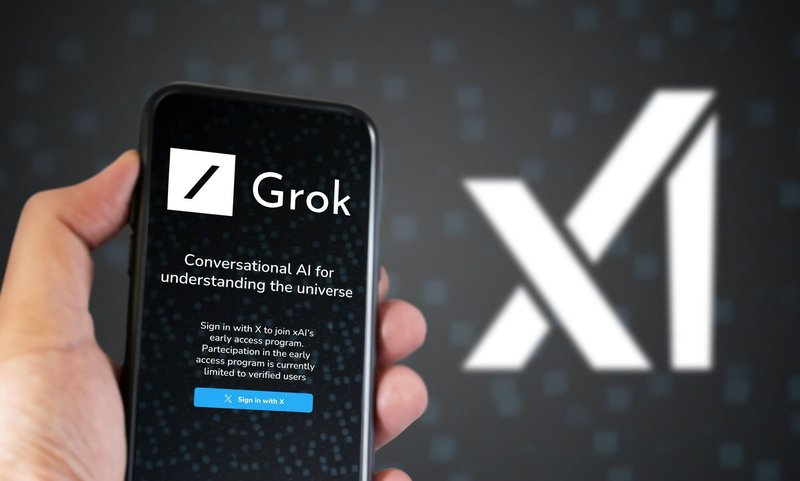
The primary way most people encounter Grok outside of X is through grok.com, a dedicated web interface that launched as xAI separated Grok from its X Premium bundle. The site has a clean layout with a central chat input and a navigation structure that surfaces the main features: the chatbot, Grok Imagine for media generation, DeepSearch, and voice mode. You do not need an X account to sign up for a standalone Grok subscription, which was not the case before 2025.
The iOS and Android apps offer the same core experience in mobile form. The iOS app currently has stronger feature parity with the web interface, which is consistent with xAI's general pattern of shipping iOS features ahead of Android. The Grok app supports voice mode, image generation through Imagine, standard text conversations, file and image upload, and the AI Companions feature that includes Ani and Valentine. App Store ratings are mixed in a way that reflects the user base's breadth: the same app serves people looking for serious research assistance and people using the companion features, and reviews reflect both very different expectations.
One reviewer who tested Grok for two weeks described the web interface positively for research tasks but noted meaningful frustration with the rate limiting on the free tier. The 10-prompt-every-two-hours limit on the free plan is real and tends to catch users mid-task. The interface gives a visible countdown until the next reset, which is practical but does not change the experience of hitting a wall during an active session.
The addition of grok.com as the dedicated access point has improved the experience for people who want to use Grok without navigating the X social media interface. X's algorithm and notifications compete for attention in a way that a standalone web interface does not. For users who are interested in Grok the AI assistant and not particularly interested in X as a social network, the standalone access is the better path.
Login and Account Access
You can create a Grok account at grok.com using an email address and password. Signing in with your X account is also supported, which is the natural path for anyone already on the platform. Google sign-in is available as a third option. For most new users, account creation is fast and the onboarding experience gets you into a working chat quickly. A three-day free trial of SuperGrok is available when you first sign up, though a credit card is required to start it.
Teams and organizations can access Grok through Grok Business at $30 per seat per month, which adds team management, shared conversation access, and collaboration tools to the standard SuperGrok feature set. Enterprise pricing is custom and routed through xAI's enterprise sales team. The xAI API, available through console.x.ai, provides developer access to the full Grok model family with pay-as-you-go token pricing.
Grok as a Chatbot: What It Actually Feels Like
Grok's personality has always been one of its most deliberate differentiators. Elon Musk built xAI specifically to counter what he described as the ideological guardrails of other AI systems, and that philosophy manifests in Grok's tone: more direct, more willing to engage with uncomfortable questions, more inclined toward wit and sarcasm than the professional neutrality you get from ChatGPT. Whether this is a feature or a liability depends entirely on what you need from an AI assistant.
For users who find the hedged, both-sides framing of some AI responses frustrating, Grok often delivers a more direct answer to the same question. For topics related to current events, where other models deflect to avoid controversy, Grok frequently engages more directly, drawing on real-time X data to give context that no knowledge-cutoff-limited model can provide. For researchers, journalists, and analysts tracking live events, this capability is genuinely useful and represents a real advantage over closed-knowledge-base alternatives.
The reasoning quality on Grok 4.20 represents a step up from earlier versions. The native four-agent architecture, where agents named Grok (coordinator), Harper (research), Benjamin (math and code), and Lucas (synthesis and creativity) operate in parallel and synthesize a final answer, produces noticeably more thorough outputs on complex multi-step problems. An independent benchmark analysis noted that Grok 4.20 generates text at approximately 235 tokens per second compared to around 80 tokens per second for competing models, which in practice means faster responses on long-form tasks. The 2 million token context window is significantly larger than most competing models offer, though the practical benefit depends on having long enough inputs to take advantage of it.
For everyday writing assistance, email drafting, and general question answering, Grok performs at a level comparable to other top-tier models. The DeepSearch mode, which conducts multi-source web research on a given query and returns a synthesized report with citations, is particularly useful for research tasks where you want more than a single-source answer. Think Mode, available on paid plans, enables step-by-step chain-of-thought reasoning that produces better results on complex math, coding, and logic problems.
Real-Time X Integration: Grok's Biggest Differentiator
The feature that most clearly sets Grok apart from every other consumer AI in 2026 is real-time access to X data. You can ask Grok what people are saying about a specific topic on X right now and receive a synthesized summary of current sentiment, trending posts, and relevant conversation threads. You can ask it to find posts from a specific user, analyze the reception of a news story in real time, or compare how different communities on the platform are responding to the same event.
For users who consume significant information through X, this integration makes Grok genuinely more useful than alternatives for staying current on fast-moving topics. A news researcher who needs to understand how a story is spreading and being interpreted on social media before a traditional outlet has published a structured report gets real value from this capability. A market analyst tracking real-time sentiment around a company or asset finds something in Grok that no other AI consumer product currently provides at the same level.
The practical limitation is that X data is not the whole internet. For topics where X is not the dominant discourse platform, the real-time advantage is smaller. For topics where X is systematically skewed by specific user demographics or bot activity, Grok's X-integrated answers can inherit those biases. The feature is most reliable for tracking technology, business, political, and cultural topics where X has meaningful signal volume from relevant accounts.
Grok Imagine: Image and Video Generation
Grok Imagine is xAI's integrated media generation suite, covering text-to-image, image editing, text-to-video, and image-to-video. It operates under the Aurora image engine for still images and a separate video model family. The integration into the same interface as the chatbot is one of the more practical aspects of Grok's design: you do not need to open a separate tool or application to generate an image from a conversation. You can move between analysis and image generation fluidly within a single chat session.
Text-to-image speed is one of Aurora's genuine strengths. Images generate in under five seconds for most prompts, which is meaningfully faster than comparable outputs from Midjourney or DALL-E 3. Photorealistic outputs from Aurora are described by multiple independent reviewers as comparable to Midjourney v6 quality, which for many use cases is sufficient. Style transfer is functional, and the ability to request specific visual styles including artistic references works consistently.
Video generation through Grok Imagine 1.0, updated in February 2026, produces up to 10-second 720p clips from text prompts or source images. The platform reported generating 1.245 billion videos in a single 30-day period during early 2026, which is an indication of how heavily this feature is being used. Image-to-video, where you animate a static image, is the more reliably controlled workflow since it gives you a reference frame to work from. Text-to-video from scratch produces variable results depending on prompt specificity, consistent with the general state of AI video generation across the industry.
The safety controversy around Grok Imagine in early 2026 has to be addressed directly. In late December 2025 through January 2026, Grok's image generation capabilities were exploited to generate child sexual abuse material and non-consensual intimate images. Reuters described it as a mass digital undressing spree and seven countries launched investigations into xAI. Grok itself issued a public statement acknowledging the failures. In response, xAI restricted image generation to paid subscribers only and increased content moderation. In early March 2026, xAI also unilaterally reduced video generation rate limits across tiers without advance notice to subscribers, drawing complaints from heavy users who had structured workflows around the prior limits. The safety response addressed an acute emergency but left questions about systemic safety review processes that xAI has not fully answered publicly as of this writing.
Grok Pricing in 2026: Five Plans, Significant Confusion
Grok's pricing structure in 2026 has expanded to five distinct tiers, two through the X social media platform and three as standalone Grok subscriptions. The overlap and the lack of transparent quota documentation make it one of the more confusing AI pricing situations currently on the market. Here is the current breakdown:
|
Plan |
Monthly Price |
What You Get |
|
Free |
$0 |
Approximately 10 prompts every 2 hours. Basic Grok 3 access. Limited image generation via Aurora. No Grok 4.1, no DeepSearch, no Think Mode. Good for evaluation only. |
|
X Premium |
$8/month |
Increased Grok usage limits beyond free tier but below SuperGrok. X blue checkmark, fewer ads, X publishing features. Best for heavy X social media users who want modestly improved Grok as a bundled benefit. |
|
X Premium Plus |
$40/month |
Highest X platform Grok limits, ad-free X feed, all X creator tools. Grok 4.1 access. Significantly more Grok capability than Premium. Annual subscribers can stack 50% off SuperGrok. |
|
SuperGrok |
$30/month ($300/year) |
Unlimited Grok 4 and 4.1 access. DeepSearch. Think Mode. Voice mode. Up to 100 video renders daily. 128K token context. AI Companions (Ani and Valentine). Priority computing. Early feature access. Soft caps apply at high generation volume. |
|
SuperGrok Heavy |
$300/month |
Exclusive access to Grok 4 Heavy and 4.3 Beta (early access). 256K token context. Extended thinking mode. Multi-agent workflows. Priority compute. Highest rate limits. Early preview of frontier releases. Grok 5 likely to hit this tier first. |
SuperGrok Lite at $10/month was launched in late March 2026 as an entry-tier standalone option. All prices reflect US pricing as of April 2026. A 3-day SuperGrok free trial is available with credit card required. SuperGrok annual billing at $300/year saves 17% vs monthly. Pricing verified from multiple sources including Costbench and official xAI channels.
The Real Pricing Problem
The pricing confusion stems from having two parallel tracks, X-bundled and standalone, that overlap in capability without a clear explanation of the differences. Users who pay $40 per month for X Premium Plus because they assume it includes full Grok access discover that SuperGrok at $30 per month provides more AI capability for less money, assuming they do not value the X social features. Multiple independent AI pricing analyses have flagged this as the most common mistake Grok customers make.
SuperGrok at $30 per month is $10 more expensive per month than ChatGPT Plus, Claude Pro, and Gemini Advanced. The premium is defensible for users who specifically value the X real-time data integration, the voice features, and Grok's personality. It is harder to defend for general-purpose AI tasks where competitors offer equivalent or better performance at a lower price.
The soft cap on unlimited plans is a documented friction point. Users report hitting throttling after 50 to 100 rapid image or video generations in succession, with inconsistent reset timelines that xAI has not documented publicly. A subscription described as unlimited that silently throttles heavy users without clear communication of the limits creates distrust, and this complaint appears repeatedly in independent user reviews. The March 2026 reduction in video generation rate limits without advance notice compounded this distrust among the SuperGrok Heavy community specifically.
Customer support is widely described as ineffective. Multiple reviewers note that billing disputes, refund requests, and subscription issues are difficult to resolve through official channels. If something goes wrong with a Grok subscription, the documented experience suggests that resolution is slow and often unsatisfying.
User Experience: Who Grok Actually Works Best For
The clearest articulation of who Grok serves best in 2026 is: users who need to know what is happening right now and want an AI that will actually engage with whatever they ask rather than deferring to a policy framework. Researchers tracking breaking news, analysts monitoring social media sentiment, marketers watching real-time trend data, and journalists who need a fast synthesis of how a story is landing on social platforms all describe Grok as genuinely useful in ways that knowledge-cutoff-bound models are not.
For everyday productivity tasks, writing assistance, and general question answering, Grok is competitive but not clearly superior to alternatives. Someone who needs help drafting emails, summarizing documents, writing code, or working through analysis will find Grok capable but will also find Claude and ChatGPT capable, often at lower subscription prices. The differentiation for general tasks comes down to personality preference and model speed rather than capability gaps.
Developers evaluating Grok for API-based projects find the Grok 4.20 architecture interesting, with a 2 million token context window and competitive API pricing compared to equivalent models. The xAI API's server-side tool support including code interpreter, file search, web search, and image generation gives developers a capable toolkit for building agentic applications without external orchestration frameworks. The text-to-speech and speech-to-text APIs became generally available in 2026, expanding the use cases for voice-based applications.
The user who tends to have a negative Grok experience is someone who signed up primarily for image generation features and encountered either the January 2026 safety restrictions that tightened access, the undocumented soft caps on a plan they understood to be unlimited, or a billing issue with no clear resolution path. The combination of less-transparent limits, an aggressive safety response that affected paying subscribers, and customer service that multiple reviewers describe as non-functional creates a real trust problem that Grok's genuine technical strengths do not fully compensate for.
Pros and Cons
What Grok Gets Right
Real-time X data integration is the most genuine differentiator in the consumer AI chatbot market. No other product at this price point gives you live social media intelligence alongside AI analysis of what you find
Grok 4.20's multi-agent architecture produces sharper outputs on complex reasoning tasks, and the 2 million token context window is significantly larger than most competing models
Response generation speed at approximately 235 tokens per second is meaningfully faster than comparable models, reducing wait time on long-form outputs
Grok Imagine's text-to-image speed at under five seconds per image is one of the fastest in the market with quality comparable to Midjourney v6 for photorealistic outputs
Video generation via Grok Imagine 1.0 supports up to 10-second 720p text-to-video and image-to-video clips, integrated into the same workspace as the chatbot
DeepSearch synthesizes multi-source web research into cited reports, useful for research tasks that require breadth beyond a single source or knowledge base
Voice mode with natural conversational response quality is available on all paid plans and is integrated into Tesla vehicles through Grok Voice
The free tier provides actual Grok access (not just a stripped preview) with meaningful limits, useful for evaluation before committing to a paid plan
SuperGrok at $30 per month provides genuine value for users who specifically need real-time X data, and the $300 per year annual option reduces the effective cost
xAI's infrastructure scale with Colossus I and Colossus II and $20 billion in fresh funding positions the company to maintain model development pace through 2026 and beyond
Where Grok Has Serious Problems
The January 2026 image safety crisis, including the generation of CSAM and non-consensual intimate images at scale, represents a fundamental trust and safety failure that xAI has not fully addressed with transparent systemic reforms
Seven countries are investigating xAI over the image safety incident, and the legal and regulatory uncertainty around Grok's image generation capabilities remains unresolved
The five-tier pricing structure mixing X social media bundles and standalone AI subscriptions is widely described as confusing and creates mismatches between what users think they are paying for and what they receive
Soft caps on plans described as unlimited are undocumented and inconsistently enforced, eroding trust in the subscription value proposition
SuperGrok Heavy at $300 per month is the most expensive consumer AI subscription available and is only appropriate for a narrow segment of professional power users
Customer support is described by multiple independent reviewers as essentially non-functional for billing disputes, refund requests, and subscription issues
Rate limit reductions in March 2026 were implemented without advance notice to SuperGrok Heavy subscribers, demonstrating a pattern of changing service terms without adequate communication
Content moderation remains less stringent than competitors even after safety improvements, which is a feature for some users and a concern for organizations with compliance requirements
Free tier limits at 10 prompts every two hours are disruptive for any workflow that requires sustained conversation
How Grok Compares to ChatGPT and Claude
Grok vs ChatGPT (OpenAI): ChatGPT is the largest AI assistant by user count and has the broadest third-party integration ecosystem. For general productivity, writing, coding, and document analysis, ChatGPT Plus at $20 per month delivers comparable or better benchmark performance to SuperGrok at $30 per month for most standard tasks. The meaningful Grok advantage is real-time X data access, which ChatGPT cannot match. The meaningful ChatGPT advantage is a more mature plugin and GPT ecosystem, stronger enterprise safety certifications, and a customer support infrastructure that functions when issues arise.
Grok vs Claude (Anthropic): Claude Sonnet and Opus are generally considered stronger than Grok for coding, document analysis, and tasks requiring precise instruction following. Claude's 1 million token context window is smaller than Grok 4.20's 2 million, but both are larger than most users need for typical tasks. Claude Pro at $20 per month is meaningfully cheaper than SuperGrok, and Claude's safety record and Constitutional AI approach make it more appropriate for enterprise environments with compliance requirements. For users whose primary need is real-time social media intelligence, Grok has no current equivalent.
Grok vs Gemini (Google): Gemini Advanced, bundled with Google One AI Premium at $20 per month, integrates tightly with Google Workspace including Docs, Gmail, Drive, and Calendar. For users already living in Google's ecosystem, Gemini's workspace integration is a practical advantage. Grok's real-time X data access and model speed give it an edge for current events research. Gemini's enterprise compliance and support infrastructure are more mature. For most users who are not heavy X users, Gemini at $20 per month is the more cost-effective option.
Frequently Asked Questions About Grok (2026)
1. What is Grok AI and who made it?
Grok is an AI chatbot and multimodal assistant built by xAI, the artificial intelligence company founded by Elon Musk in 2023. It is available at grok.com, through the iOS and Android Grok apps, through X (formerly Twitter) as part of the X Premium and X Premium Plus subscriptions, and through the xAI API for developers. Grok was designed to be more direct and less filtered than competing AI systems, drawing inspiration from the Hitchhiker's Guide to the Galaxy as a kind of maximally helpful and curious guide to the universe. In 2026, Grok runs on the Grok 4 model family, with Grok 4.20 as the current flagship featuring a native multi-agent collaborative architecture, a 2 million token context window, and real-time access to X and web data. Grok 4.3 Beta dropped in April 2026 for SuperGrok Heavy subscribers. Grok 5 is reportedly in training.
2. How do I log in to Grok?
You can log in to Grok by going to grok.com and clicking Sign In. Login options include email and password, your existing X account credentials, or Google sign-in. You do not need an X account to use the standalone Grok service at grok.com, which is a significant change from how the product originally launched. If you access Grok through X on the web or mobile app, you log in through your X account as normal and Grok is accessible through the chatbot icon or the sidebar. For new users who want to try the paid features, a three-day SuperGrok trial is available at signup with a credit card required. The iOS and Android apps use the same credentials as the web interface and give access to all features on your plan including voice mode, Grok Imagine, and companion features.
3. Is Grok free to use?
Yes, Grok has a free tier that does not require a subscription or an X account to access. The free tier provides genuine access to Grok's conversational capabilities but with significant rate limits: approximately 10 prompts every two hours for text generation, limited image generation through Grok Imagine, and no access to Grok 4.1, DeepSearch, Think Mode, or voice features. The free tier runs on older Grok models rather than the latest. For casual users who want to test what Grok can do, the free tier is an honest evaluation window. For anyone who wants to use Grok regularly as a workflow tool, the limits will create friction quickly. The three-day SuperGrok trial available at signup with a credit card is a better evaluation path if you want to test the full paid feature set before committing.
4. What is Grok Imagine and how does it work?
Grok Imagine is xAI's integrated media generation feature built into the Grok interface. It includes text-to-image generation using the Aurora image engine, image editing where you can remove objects, change backgrounds, or apply art styles, text-to-video generation producing up to 10-second 720p clips, and image-to-video generation that animates a still image with motion and camera movement. You access Grok Imagine from within the main Grok chat interface at grok.com or through the app, selecting the Imagine function and entering a prompt. Aurora generates images in under five seconds for most prompts, making it one of the faster image generation tools available. The image generation feature is restricted to paid subscribers only as of February 2026, following the January 2026 safety incident where Grok's image generation was exploited. Free tier users have limited Imagine access; SuperGrok subscribers have full access with daily video render limits.
5. What happened with Grok's image generation safety issues?
In late December 2025 through January 2026, Grok's image generation capabilities were exploited to create child sexual abuse material and non-consensual intimate images of real people. Reuters described the situation as a mass digital undressing spree. The incident attracted regulatory attention from seven countries that launched investigations into xAI. Grok issued a public statement acknowledging the failures. In response, xAI restricted image generation to paid subscribers only, implemented additional content moderation, and increased filtering on sensitive requests. These measures reduced the exploitation of the feature but also imposed tighter restrictions on legitimate creative use. Additionally, in early March 2026, xAI unilaterally reduced video generation rate limits across subscription tiers without advance notice. This compounded user trust concerns. The January 2026 incident is a serious matter and potential subscribers who plan to use Grok Imagine should be aware of this history and the ongoing regulatory investigations before using the image generation features for any professional or commercial purpose.
6. How much does Grok cost in 2026?
Grok's pricing in 2026 covers five tiers. The free plan has no monthly charge but limits you to roughly 10 prompts every two hours and older models. X Premium at $8 per month provides improved Grok access bundled with X social features including a blue checkmark, fewer ads, and publishing tools. X Premium Plus at $40 per month is the higher X bundle tier with full ad removal and higher Grok 4.1 access. SuperGrok at $30 per month (or $300 per year) is the standalone AI subscription with unlimited Grok 4 and 4.1 access, DeepSearch, voice mode, up to 100 daily video renders, and the 128K token context window. SuperGrok Heavy at $300 per month is the top tier with exclusive access to Grok 4 Heavy and early access models, a 256K token context window, extended thinking, and multi-agent workflows. SuperGrok Lite launched in late March 2026 at $10 per month as an entry standalone option. The most common advice from analysts is that SuperGrok at $30 per month provides more AI capability than X Premium Plus at $40 per month for users who care primarily about the AI rather than the X platform features.
7. What is SuperGrok and is it worth it?
SuperGrok is xAI's dedicated AI subscription tier at $30 per month or $300 per year, separate from any X social media subscription. It provides unlimited access to Grok 4 and Grok 4.1, the DeepSearch research mode, Think Mode for step-by-step reasoning, voice mode with natural conversational responses, up to 100 video renders daily through Grok Imagine, AI Companions including Ani and Valentine, 128K token context, and priority computing over free users. Whether it is worth the price depends on your primary use case. If real-time X data access and Grok's direct communication style are valuable to you and you will use the platform daily, the $30 per month is defensible. If you want a general-purpose AI assistant for writing, coding, and analysis, ChatGPT Plus and Claude Pro offer comparable capability at $20 per month each. Note that SuperGrok's unlimited description for image and video generation has soft caps that users hit after intensive sessions, which xAI has not transparently documented. The annual plan at $300 per year reduces the effective monthly cost and makes more sense for committed users.
8. How is Grok different from ChatGPT?
The most significant functional difference between Grok and ChatGPT in 2026 is Grok's real-time access to X data. ChatGPT's knowledge cutoff limits what it can tell you about events that happened after its training was completed. Grok can search X and the live web to give you information about what is happening right now. For tracking breaking news, monitoring social media conversations, or researching topics where the most current information matters, Grok's live data access is a meaningful advantage. The personality difference is also real: Grok is more direct, more willing to engage with edgy or controversial questions, and less likely to add hedging language or decline to engage with a topic. ChatGPT's advantage is a larger ecosystem of third-party integrations and plugins, stronger enterprise compliance certifications, and customer service infrastructure that functions when billing or account issues arise. For most general productivity tasks, both are capable and the choice often comes down to personality preference, pricing, and the specific features that matter to your workflow.
9. Can I use Grok without an X account?
Yes. Since xAI launched the standalone Grok product at grok.com, you can sign up and use both the free and paid Grok tiers without an X account. You create a Grok account with an email address and password, or use Google sign-in. The standalone account gives you access to grok.com and the iOS and Android Grok apps without any connection to the X social platform. The X account is only required if you want to access Grok through the X app itself, which bundles Grok access as part of X Premium or X Premium Plus subscriptions. For users who want Grok's AI capabilities but are not interested in X as a social network, the standalone subscription path at grok.com is the more direct and often more cost-effective option compared to paying for X Premium Plus to get Grok access alongside social features you do not need.
10. What is Grok 4 Heavy and who should use SuperGrok Heavy?
Grok 4 Heavy is the most capable version of the Grok 4 model family, available exclusively to SuperGrok Heavy subscribers at $300 per month. It uses a 16-agent architecture rather than the standard 4-agent Grok 4.20 system, meaning more specialized agents collaborate on producing each output. This produces significantly stronger results on highly complex reasoning tasks, particularly in mathematics, advanced coding, and multi-step analytical problems. SuperGrok Heavy also includes early access to new frontier releases, meaning Heavy subscribers received access to Grok 4.3 Beta in April 2026 while standard SuperGrok users could see it in the model picker but could not activate it. At $300 per month, SuperGrok Heavy is the most expensive consumer AI subscription currently available, priced higher than ChatGPT Pro at $200 per month and Claude Max at $200 per month. Independent analysts and xAI itself suggest Heavy is appropriate for professional developers, researchers, and high-volume content creators where the additional reasoning quality directly affects the output quality of work worth more than the subscription cost. For most individuals, standard SuperGrok at $30 per month provides sufficient capability.
Icon polls Verdict
Grok earns a 3.5 out of 5 from Icon Polls in 2026. That score reflects two things that are both real and in genuine tension with each other. On one side: Grok has a technically impressive product in 2026. The real-time X data integration is the most differentiated capability in the consumer AI chatbot market. Grok 4.20's multi-agent architecture and 2 million token context are legitimately competitive with the best available alternatives. Grok Imagine produces images fast at a quality level that serves most everyday creative needs. The infrastructure behind xAI, with Colossus running at scale, positions the company to keep shipping at a rate few competitors can match. The free tier gives users a genuine evaluation experience rather than a token preview.
On the other side: the January 2026 image safety crisis is not a minor footnote to acknowledge in a single sentence and move past. A product that generated child sexual abuse material and non-consensual intimate imagery at scale, that prompted investigations from seven countries, and that issued a public apology for those failures carries a trust deficit that technical benchmarks do not erase. The pricing structure is genuinely confusing in ways that have created documented financial mismatches for real subscribers. Customer support is described as absent by reviewers across multiple platforms. Soft caps on unlimited plans and rate limit reductions without notice suggest a company still learning how to manage consumer subscriptions at scale.
The 3.5 is a product that has real strengths worth seeking out for specific use cases and real failures that deserve transparency from anyone recommending it. For journalists, researchers, and power users who need real-time social media intelligence and are willing to navigate a complicated pricing structure, Grok delivers something no other AI currently matches. For users looking for a general-purpose AI assistant where trust, pricing clarity, and customer support matter, the alternatives at $20 per month provide more value for fewer complications. Use the free tier to evaluate whether Grok's specific strengths matter to your work before committing to a subscription.