Quick Verdict
Happenstance AI solves a problem that nearly every professional hits eventually: you know the right person is somewhere in your network, but finding them manually is painful enough that you either give up or settle for a cold outreach instead of a warm introduction. The platform connects your Gmail, LinkedIn, Twitter, and other accounts, then lets you search across all of those contacts using plain-language questions the way you would ask a knowledgeable colleague. The search quality is genuinely impressive for precise queries, and the Groups feature for pooling team networks is one of the more practical ideas in professional networking software in years. Founded in 2023, backed by Y Combinator and other investors, and already generating meaningful early revenue, Happenstance is a company with real momentum. The limitations that keep the score from reaching 4.5 or higher are real too: search accuracy drops on broader or repeated queries, the platform cannot reach outside your existing connections, there is no way to edit your own AI-generated profile, and the product is still early enough that several rough edges remain. We rate Happenstance AI 4.0 out of 5 for 2026.
At a Glance: Icon Polls Ratings
Here is how Happenstance AI scored across the areas we evaluated in our 2026 research:
|
Category |
Stars |
Score |
|
Core AI Search Quality |
★★★★☆ |
4/5 |
|
App Interface and Ease of Use |
★★★★★ |
4.5/5 |
|
Integrations and Data Sync |
★★★★☆ |
4/5 |
|
Groups and Team Features |
★★★★★ |
4.5/5 |
|
Pricing and Free Plan Value |
★★★★☆ |
4/5 |
|
Search Accuracy and Reliability |
★★★★☆ |
3.5/5 |
|
Profile Control and Transparency |
★★★☆☆ |
2.5/5 |
|
Overall |
★★★★☆ |
4/5 |
What Is Happenstance AI?
Happenstance AI is a people search platform that turns your existing professional network into a searchable database using artificial intelligence. The core idea is straightforward: instead of manually scrolling through LinkedIn or digging through Gmail contacts to find the right person for a hire, an introduction, or a sales conversation, you describe who you are looking for in plain language and Happenstance searches across every account you have connected to surface the most relevant matches instantly.
The product was founded in 2023 and is headquartered in San Francisco. The name itself reflects the founding premise: meaningful professional connections often feel like coincidences, but with the right tool they can be found deliberately. Happenstance went through Y Combinator, the startup accelerator whose alumni include Airbnb, Dropbox, and Stripe, which gave the team both validation and a first wave of users among the YC network. The company has raised $2.5 million in seed funding from investors including Y Combinator, Team Ignite Ventures, Pioneer Fund, and Zelda Ventures.
The team is small, six people as of the most recent available data, which is relevant context for understanding both the product's momentum and its current rough edges. Happenstance hit $330,000 in revenue with that three-person founding team in 2025, which is a genuine milestone for a seed-stage B2B SaaS product and suggests the core use case is resonating with paying users well ahead of where many early-stage tools are at a comparable stage.
The platform is used primarily by founders who need intros to investors, sales teams prospecting for warm leads, recruiters searching for passive candidates, and community managers connecting their members to relevant people. Any role where warm introductions outperform cold outreach, which is most relationship-dependent professional work, maps naturally onto what Happenstance is built to do.
The Happenstance App: Built Around a Search Bar That Actually Works
Getting started with Happenstance takes less than ten minutes. You create an account at happenstance.ai, connect the accounts you want to include in your searchable network, Gmail, LinkedIn, Twitter, Outlook, or a combination, and within minutes you have a working database of your contacts that you can query in plain English. There is no CSV import required for most users, though manual uploads are supported if you have contact data in spreadsheet format.
The interface is clean and minimal. The homepage presents a search bar and a prompt suggesting the kinds of searches the platform handles well. You type your query, hit enter, and a results table appears showing matching people with their title, company, which account they were sourced from, any mutual connections between you and the match, and an AI confidence score explaining why the system ranked them as relevant. That last detail, the confidence score and the explanation of the match logic, is meaningfully different from how most professional search tools handle results. LinkedIn does not show you why a result appeared. Happenstance does, and the transparency makes it easier to calibrate whether you trust the result.
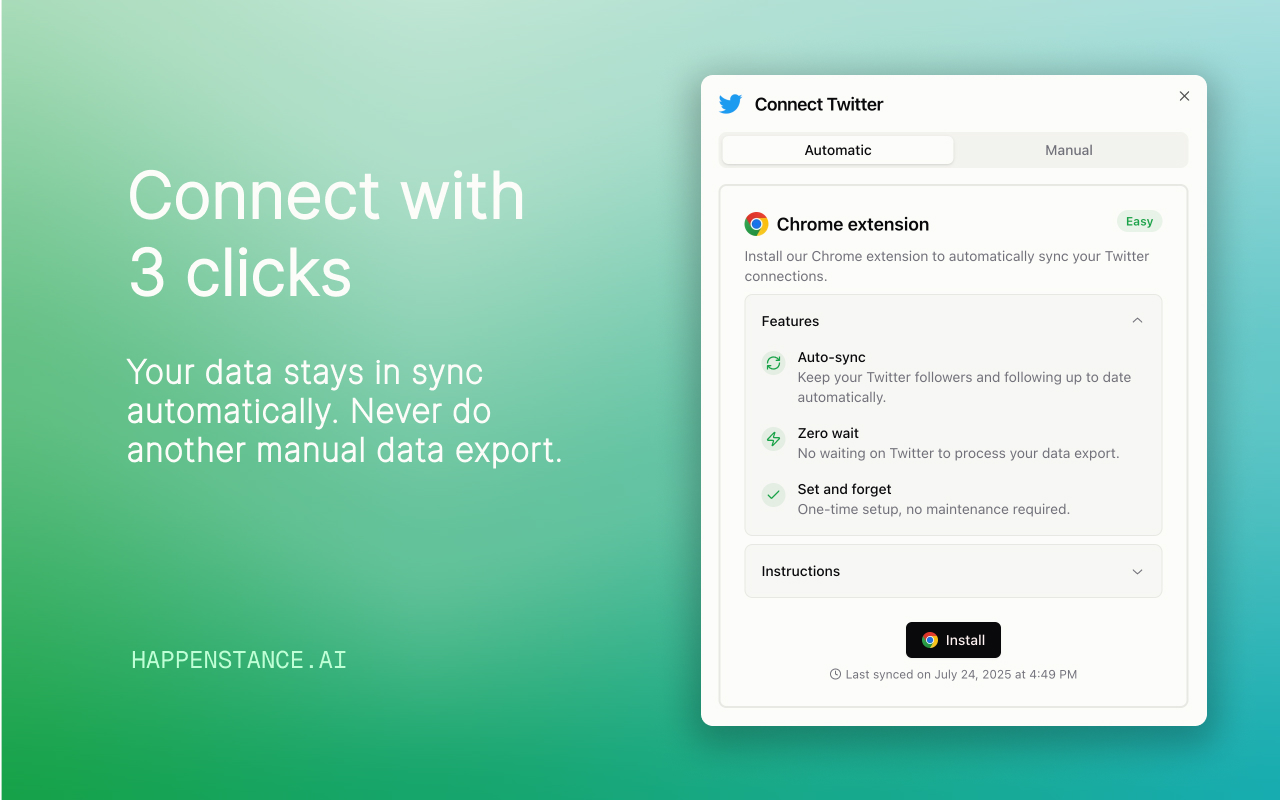
Hot reloading of contact data is handled through a Chrome extension that syncs your LinkedIn and Twitter connections automatically without requiring manual exports. This matters because professional networks change constantly: people change roles, join new companies, and move between industries in ways that a one-time data import would quickly make stale. The extension keeps your contact database current in the background so searches reflect your actual network at the time you run them rather than where your connections were when you signed up.
The Slack integration is one of the more practically designed features. You install the Happenstance bot in a Slack workspace, and team members can tag the bot directly in conversations to run searches without leaving Slack. For sales teams who are coordinating introductions in Slack already, being able to ask the bot for people who match a specific profile without opening a new app fits naturally into an existing workflow. Pro users can also forward emails to [email protected] to trigger searches by email, which adds another surface for running queries without disrupting whatever working environment someone already lives in.
Search Quality: Where the Platform Earns Its Rating
The AI search is where Happenstance either wins or loses a user's trust, and for well-defined queries it tends to win. A search like VP of Engineering at a Series B to D fintech in New York or San Francisco, with experience scaling an engineering organization from 50 to 200 people returns a structured list of people who match those specific criteria, drawn from across your Gmail contacts, LinkedIn connections, and other connected accounts simultaneously. The query runs in seconds. The result includes people you had completely forgotten were in your network and people whose specific background would have taken you thirty minutes to recall manually.
The platform describes the matching logic in enough detail that you understand why each person surfaced. It is not a black box that returns a list and expects you to trust it. For professionals who have spent years frustrated by LinkedIn's opaque search ranking, this transparency is refreshing.
The accuracy limitations are also real and worth being specific about. Independent testing documented in a February 2026 review found that contextual expansion in broader searches can cause misclassification, where the system surfaces people who are tangentially related to the query rather than precisely matching it. Repeated or iterative searching on similar queries sometimes produces inconsistent results. For narrow, precisely worded searches the platform performs well. For broad or exploratory queries where you are not sure exactly what you are looking for, the results require more filtering. Reviewers consistently advise treating search specificity as the most important variable in getting useful results out of the platform.
Groups: The Feature That Changes the Math for Teams
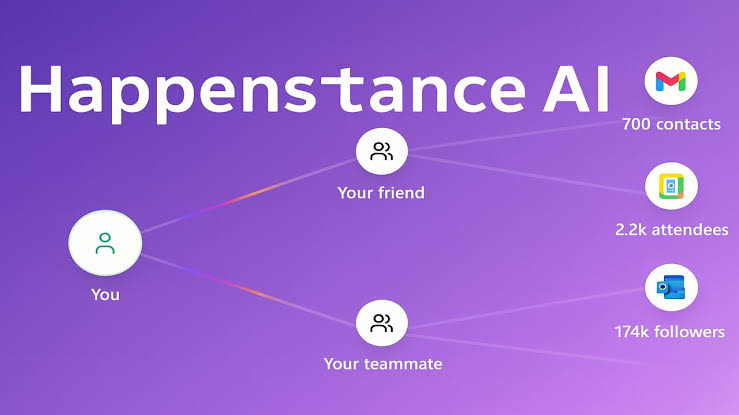
If the individual search capability is Happenstance's core product, Groups is its most compelling expansion. A Group in Happenstance is a shared pool of networks where team members contribute their individual contacts and the combined database becomes searchable by everyone in the group, without any member losing control over who can access their individual connections or how.
The practical applications are significant. A sales team of five people each with 2,000 LinkedIn contacts creates a group that effectively gives every team member search access to 10,000 contacts, including warm paths they would not have individually. A hiring team can pool their networks to source passive candidates with genuine internal connections rather than cold outreach. A startup's founding team and advisors can collectively search for the most relevant investor introductions across everyone's combined relationships. A VC firm can create a group that lets portfolio companies search the firm's LP and co-investor relationships for partnership opportunities.
One reviewer who tested Groups with a sales team described the experience as electric: instead of spending time figuring out who in the team's network would be relevant to a new pitch, the team ran a single search and surfaced the exact profile of contacts they needed from across the pooled network within seconds. That kind of speed difference is what converts someone from a casual user to a person who reorganizes their workflow around a tool.
The privacy model in Groups deserves specific mention because it is one of the more thoughtful aspects of the platform's design. Individual users in a Group do not automatically expose their full network to everyone else. The system respects individual access controls and allows users to manage what they share. One early reviewer expressed discomfort with the Group feature's suggestion of people to add, feeling uncertain about who might gain access to their contacts without explicit permission. Happenstance has worked to address this concern by clarifying the access model, but the privacy nuance in pooled network products is real and potential users who are protective of their contacts should read the privacy documentation before joining or creating a group.
Pricing: Simple, Accessible, and Honest
Happenstance AI's pricing is more straightforward than most B2B software in 2026, and the free plan is functional enough to give new users a genuine sense of what the platform does before committing money.
|
Plan |
Cost |
What You Get |
|
Free |
$0/month |
Connect unlimited accounts, create and join unlimited groups, Slack and Discord integration. Approximately 15 searches per month. Good for occasional use and evaluating the platform before paying. |
|
Pro |
~$24/month (annual) |
Unlimited searches with unlimited results per search. CSV export of search results. Email agent feature (forward to [email protected]). All Free plan features. Best option for anyone using the platform regularly. |
Prices verified April 2026. Annual billing applies to the Pro plan rate shown. Monthly billing is available at a higher rate. Group plans for teams may have separate pricing for organizations needing admin controls or higher volume. Check happenstance.ai for current rates.
Value Assessment
At around $24 per month on annual billing, the Pro plan sits at a price point that most professionals and small teams can absorb without a significant budget conversation. The free plan's 15 monthly searches is enough to genuinely evaluate whether the search quality matches your use case before committing. This is a more honest evaluation experience than many tools offer, where the free tier is so limited it gives you no real signal about the paid experience.
For sales teams, the ROI math is straightforward: a single warm introduction that converts to a closed deal is worth multiples of the annual Pro subscription. For recruiters, successfully sourcing one passive candidate through a warm network connection rather than a cold application saves meaningful agency or sourcing fees. The question is whether Happenstance's search reliably surfaces those connections, and for well-defined searches in strong personal networks the answer from independent reviewers is consistently yes.
The CSV export feature on Pro, which lets you download search results, is important for users who want to integrate Happenstance results into a CRM workflow. Without it, the platform becomes a research tool that requires manual note-taking. With it, search results can flow directly into HubSpot, Salesforce, or whatever contact management system a team uses. For anyone doing volume outreach or hiring, this changes how central Happenstance can be to the workflow rather than a supplementary lookup tool.
Funding, Investors, and Company Trajectory
Happenstance was founded in 2023 and entered Y Combinator the following year, completing the accelerator's program and receiving its standard seed investment. Y Combinator's involvement matters for a few reasons beyond the check size. YC companies get access to the broader YC network including thousands of founders, investors, and operators, which for a professional networking platform creates a natural first user base of exactly the kind of people who would benefit most from the product. The YC alumni network is one of the densest professional networks in tech, and Happenstance's own Groups feature within that community is a proof of concept for the product in the kind of environment where warm introductions carry significant economic value.
Beyond Y Combinator, Happenstance has raised $2.5 million in seed funding from Team Ignite Ventures, Pioneer Fund, and Zelda Ventures. Pioneer Fund is notable for backing very early-stage companies, often pre-product, and their involvement alongside the YC participation suggests the founding team and their thesis resonated with investors focused on the professional networking infrastructure space. Total funding of $2.5 million is modest by 2026 AI startup standards, but the revenue milestone of $330,000 achieved with a founding team of three suggests the company has been disciplined about building a product people pay for before pursuing growth capital aggressively.
The six-person team size as of the most recent data reflects a company that is still in focused build mode rather than scaling a large organization. For users evaluating Happenstance as a long-term tool, the small team means product development is concentrated and responsive to user feedback, which is consistent with the community's description of fast issue resolution. It also means the product roadmap is tightly prioritized and the company's ability to absorb and maintain a large feature surface is limited compared to better-capitalized competitors.
The broader AI networking and professional intelligence sector has seen significant investor interest through 2025 and 2026. Happenstance occupies a specific niche within that sector: it is not a cold outbound data provider like ZoomInfo, not a social network like LinkedIn, and not a CRM like HubSpot. It is specifically a warm network search tool, which is a distinct enough category that the competitive landscape is less crowded than the adjacent spaces. The closest direct competitors are Yena.ai and Clay's Swarm feature, both of which operate on similar principles but with different product emphases.
Careers at Happenstance AI
With six employees as of April 2026, Happenstance is a very early-stage company from a team size perspective. Open positions, when they exist, are typically posted on the company's LinkedIn page and directly on the Happenstance website. Given the stage, hiring at Happenstance at this point means joining a founding team environment where early employees have significant influence over product direction, work across functions, and take on responsibilities well beyond any formal job title.
The kinds of roles that a company at Happenstance's stage typically recruits for include full-stack engineering, AI and machine learning focused on search and NLP, growth and partnerships to expand the user base, and customer success to retain and expand paying teams. For people who are interested in the intersection of AI and professional networking, a company that has already demonstrated revenue traction and has institutional backing is a more attractive early-stage bet than a pre-revenue startup.
Candidates interested in working at Happenstance should be aware that the product itself is the best demonstration of the company's culture and priorities. A company building a tool for warm professional networking and using AI to surface contextual matches is one that values precision over volume, relationship quality over contact count, and product design that respects user privacy alongside search utility. That set of values tends to attract people who think carefully about how technology shapes professional relationships rather than people drawn primarily to raw scale metrics.
The company's Y Combinator affiliation also means that candidates from the broader YC ecosystem have natural context about the founding team's background and the investors' expectations, which can make the fit conversation more efficient than at companies without that kind of network visibility.
User Experience: What Day-to-Day Happenstance Actually Looks Like
The user who gets the most out of Happenstance in 2026 is someone who has been professionally active for long enough to have built a substantial network, specifically 1,000 or more meaningful contacts across email and social platforms, and who regularly needs to make introductions or find specific people for specific purposes. For a founder raising a round, a recruiter searching for a VP with a specific background, or a sales leader looking for warm paths to decision-makers at target accounts, the platform's search capability directly addresses the core task in a way that saves real time.
The experience of setting up Happenstance for the first time has been described by multiple reviewers as surprisingly smooth. Connecting Gmail and LinkedIn takes a few clicks. The Chrome extension for auto-syncing runs without requiring attention after initial setup. The first search, which most new users describe as a moment of genuine surprise at how fast and relevant results are, tends to be the hook that converts a skeptical new user into a regular one.
Where the experience gets messier is at the edges. The AI-generated profile system, where Happenstance creates a profile for you based on data pulled from your social accounts, currently gives users no way to review or edit that profile. If the system misclassifies your expertise or gets a detail wrong, there is no self-correction mechanism. For a platform that describes itself as prioritizing precision and transparency, this is a meaningful inconsistency. Independent reviewers have flagged it as one of the more important missing features, and it is a credible concern for anyone who cares about how they are being represented in searches run by other users on the platform.
The network scope limitation is the other primary friction point. Happenstance searches your existing network. It does not expand beyond people who are already in your connected accounts. This means the quality of Happenstance's results is directly determined by the quality and breadth of your network coming in. A founder with 500 LinkedIn connections will get less useful results than a founder with 5,000. For users whose networks are still developing, the platform's value is lower until the network itself reaches a critical mass. This is not a product failure, it is the fundamental constraint of warm-network search, but it means Happenstance is more immediately useful for established professionals than for people earlier in their careers.
Pros and Cons
What Happenstance AI Gets Right
Natural language search across connected Gmail, LinkedIn, Twitter, Outlook, and other accounts simultaneously, with results in seconds rather than the minutes of manual searching
AI confidence scoring and transparent match explanations show users exactly why each result surfaced, which is meaningfully more trustworthy than the opaque ranking systems most professional platforms use
The Chrome extension auto-syncs LinkedIn and Twitter connections continuously so the contact database stays current without requiring periodic manual re-exports
Groups allow teams to pool their individual networks into one searchable database, giving every member access to warm paths they would not have found individually, with individual access controls preserved
The Slack bot integration and email agent let users run searches without leaving their existing work environment, reducing friction for teams already coordinating in Slack
Pricing is accessible, with a functional free plan at roughly 15 searches per month and a Pro plan at approximately $24 per month annually that includes unlimited searches and CSV export
Y Combinator backing provides credibility and a natural first user community in one of the most densely connected professional networks in tech
Revenue of $330,000 achieved with a small founding team demonstrates genuine product market fit rather than user vanity metrics
Search accuracy for narrow, precisely worded queries is consistently strong across multiple independent tests and reviews
Where Happenstance AI Has Limitations
Search accuracy degrades on broader or more exploratory queries, with contextual expansion sometimes producing results that are tangentially related rather than precisely matching the intent
The platform can only search your existing network. There is no cold discovery of people outside your connected accounts, which means the tool's value is directly bounded by the size and quality of the network you bring to it
Users cannot review or edit their own AI-generated profile, meaning incorrect or misclassified information about you has no self-correction path currently
The Groups feature's privacy model, while thoughtfully designed, requires users to understand the access controls before joining, as the perception of uncontrolled network sharing has generated early discomfort among privacy-conscious professionals
The product is still early and carries rough edges consistent with a six-person team: occasional inconsistency in repeated searches, limited documentation for edge cases, and a product roadmap that moves quickly but not always in the direction individual users are waiting for
The free plan's 15-search monthly cap is enough to evaluate the product but not enough to build a meaningful workflow around it, which means anyone with regular search needs will pay or feel constrained
Integration depth is currently limited to major platforms. Users with significant networks on platforms not yet supported by Happenstance cannot bring those contacts into the searchable database
How Happenstance Compares to Alternatives
Happenstance vs LinkedIn Sales Navigator: LinkedIn Sales Navigator is the dominant professional prospecting tool and has far more powerful filters for cold outreach to people outside your network. Happenstance's advantage is specifically in warm-network search: finding people who are already connected to you or to members of your team. Sales Navigator cannot surface who in your email contacts is connected to a target account. Happenstance can. The two tools are complementary rather than competitive for teams that use both cold and warm outreach strategies.
Happenstance vs Clay (The Swarm): Clay is a personal CRM that auto-updates social profiles and includes a Swarm AI feature for finding warm intros. Clay's approach is more CRM-oriented, focusing on relationship management over time rather than real-time search. Happenstance is more search-first, optimized for the moment when you need to find someone specific right now. Teams that want ongoing relationship tracking tend toward Clay. Teams that frequently need to run specific searches prefer Happenstance.
Happenstance vs Yena.ai: Yena.ai is the closest direct competitor, also offering AI-powered network search synced with Gmail and LinkedIn. The products are similar enough in concept that the comparison tends to come down to search quality on specific query types and user interface preference. Happenstance's transparency features, including the confidence score and match explanation, are generally considered a differentiator. Users evaluating both should run the same test queries on both platforms during the free trial period and compare result quality in their own network context.
Frequently Asked Questions About Happenstance AI (2026)
1. What is Happenstance AI and what does it do?
Happenstance AI is an AI-powered people search platform that makes your professional network searchable through natural language queries. You connect your Gmail, LinkedIn, Twitter, Outlook, and other accounts, and the platform analyzes the contacts across all of those accounts to create a searchable database. Instead of manually scrolling through LinkedIn or digging through email contacts to find the right person, you describe who you are looking for in plain language, for example a VP of Product at a healthcare company with experience in HIPAA-compliant infrastructure, and Happenstance searches your entire connected network simultaneously and returns the most relevant matches in seconds. Results include the person's title, company, which of your accounts they came from, any mutual connections, and an AI confidence score explaining why they were considered a match. The platform is used by founders seeking investor introductions, sales teams prospecting for warm leads, recruiters finding passive candidates, and professionals who regularly need to make or receive introductions.
2. Who founded Happenstance AI and when was it started?
Happenstance AI was founded in 2023 and is headquartered in San Francisco, California. The company was accepted into Y Combinator, the prestigious startup accelerator, in 2024, which provided both seed funding and access to one of the most connected professional networks in technology. The founding team built the initial product while still small, reaching $330,000 in annual revenue with a three-person team by 2025, which is a meaningful early commercial milestone for a seed-stage SaaS product. As of April 2026, the company has grown to approximately six employees and has raised $2.5 million in total seed funding from investors including Y Combinator, Team Ignite Ventures, Pioneer Fund, and Zelda Ventures. The company's name reflects its founding thesis: the best professional connections often feel like coincidences, but they can be found deliberately with the right tool.
3. How much has Happenstance AI raised in funding?
Happenstance AI has raised $2.5 million in seed funding. The investors include Y Combinator, which invested as part of the standard accelerator program, along with Team Ignite Ventures, Pioneer Fund, and Zelda Ventures. The funding has supported product development, infrastructure, and early team growth. For context in the broader AI startup ecosystem, $2.5 million in seed funding is a relatively modest raise, which reflects the company's early stage and its focus on building revenue traction before pursuing larger growth rounds. The $330,000 in revenue generated by a small founding team in 2025 suggests the company has prioritized demonstrating commercial viability, which typically makes subsequent fundraising rounds more favorable.
4. How does Happenstance AI's search actually work?
Happenstance AI's search works by processing your connected accounts to build a private indexed database of your contacts, then using a large language model to interpret your natural language query and match it against that database. When you type a query, the system analyzes the intent of your question, identifies the key criteria you are describing, and surfaces contacts from your network who match those criteria along with an explanation of why each person was ranked as relevant. The result table shows each person's current title, company, which account they came from, whether any mutual connections exist between you and the result, and an AI confidence score. For extended searches, the system can also surface people who are connected to your direct contacts rather than only first-degree connections, which expands the search to your second-degree network when you want to find warm introduction paths rather than direct connections. Search accuracy is strongest for precise, specific queries. Broader or more exploratory queries can produce less accurate results where the AI's contextual expansion includes marginally related people.
5. What accounts and platforms does Happenstance integrate with?
Happenstance AI currently integrates with Gmail, LinkedIn, Twitter (X), Outlook, and Google Calendar for contact syncing. The Chrome extension handles automatic syncing of LinkedIn and Twitter connections in the background, keeping your contact database current as your network changes without requiring manual exports. Gmail integration pulls in email contacts, and Google Calendar integration can surface professional relationships from meeting histories. Slack integration is available as a separate feature where you can add the Happenstance bot to your workspace and run searches by tagging the bot in conversations. The email agent feature on the Pro plan lets you forward queries to [email protected] and receive search results by email. For platforms not currently natively integrated, Happenstance supports manual data upload through CSV files for users who have contact data in spreadsheet format. The company is likely to expand integration support as the product develops, but the current list covers the accounts where most professionals maintain their primary networks.
6. Is Happenstance AI free to use?
Yes, Happenstance AI has a permanent free plan that does not require a credit card to start. The free plan allows you to connect unlimited accounts, create and join unlimited groups, access the Slack and Discord integration, and run approximately 15 searches per month. The 15-search limit is enough to genuinely evaluate the platform's search quality and see whether it surfaces useful results from your specific network before deciding whether to pay. For anyone who wants to use Happenstance regularly, the Pro plan at approximately $24 per month on annual billing removes the search limit and adds unlimited results per search, CSV export, and the email agent feature. There is no middle tier between free and Pro. The practical implication is that occasional users can continue indefinitely on the free plan, while regular users, especially those doing hiring, sales prospecting, or frequent introductions, will find the search limit binding within a few days of active use.
7. What is the Groups feature in Happenstance?
Groups is a feature that allows multiple people to pool their individual professional networks into one shared, searchable database. A Group might be a sales team, a recruiting team, a startup founding team and its advisors, or a professional community. When Group members connect their accounts to the shared Group, searches run by any member can surface contacts from across the combined network rather than from just their individual contacts. For example, a five-person sales team each with 2,000 contacts effectively creates a Group with search access to 10,000 contacts, including warm paths that no single team member would have found alone. Individual access controls are maintained within Groups, meaning members manage what they contribute rather than automatically exposing their entire network. Groups are available on both the free and Pro plans. Teams interested in using Groups should review the privacy documentation to understand exactly how access is scoped before inviting members, particularly if network privacy is a concern.
8. Are there open jobs at Happenstance AI?
Happenstance AI is a small team of approximately six people as of April 2026, which means open positions are limited in number but significant in impact for the people who join. The company is at a stage where early employees work across functions and have direct influence on product direction, company culture, and go-to-market strategy. When positions are open, they are posted on the Happenstance LinkedIn page and sometimes on the company website directly. The types of roles a company at Happenstance's stage typically recruits for include full-stack software engineering, AI and machine learning engineering focused on search and natural language processing, growth and partnerships, and customer success for teams on paid plans. Candidates should be comfortable with the responsibilities and ambiguity of an early-stage role and interested in the specific problem Happenstance is solving rather than looking for the structure of a larger organization. The company's Y Combinator background means it operates within that network's expectations for pace, accountability, and product focus.
9. How does Happenstance AI compare to LinkedIn for finding contacts?
Happenstance AI and LinkedIn serve different search purposes that are complementary rather than directly substitutable. LinkedIn is a public platform where you can search anyone on LinkedIn including people entirely outside your network, with filters for industry, title, company, and location. It is the dominant tool for cold outreach at scale. Happenstance searches only your existing personal network across multiple platforms simultaneously, and the critical advantage is warmth: Happenstance surfaces people you or your teammates are already connected to, making introductions possible rather than requiring a cold message to a stranger. LinkedIn cannot tell you which of your Gmail contacts works at a specific company in a specific role. Happenstance can. LinkedIn cannot show you which of your team's combined connections have the technical background you need for a hire. Happenstance can. For professionals who want warm introductions rather than cold outreach, and who believe that a warm intro meaningfully outperforms a cold LinkedIn InMail, Happenstance addresses a gap that LinkedIn does not fill.
10. What are the main limitations of Happenstance AI?
The primary limitations of Happenstance AI in 2026 are the following. First, it can only search your existing network. People outside your connected accounts are invisible to the platform, which means the quality of results depends entirely on the depth and breadth of your professional network. Early-career professionals with smaller networks will get less useful results than established professionals with thousands of connections. Second, search accuracy varies significantly based on query specificity. Narrow, well-defined searches perform strongly. Broad or exploratory queries can surface tangentially related results that require more filtering. Third, there is no way to review or edit your own AI-generated profile on the platform. If the system miscategorizes your expertise or gets a detail wrong, you cannot correct it, which is a meaningful transparency gap for a tool that is used to search for and represent people professionally. Fourth, the free plan's 15 monthly searches constrain regular users who need a paid plan to get full value. Fifth, the product is still early-stage and carries the rough edges associated with a small team: occasional search inconsistency, limited support documentation, and a roadmap that continues to evolve. None of these are disqualifying for the right user, but they are honest limitations to understand before adopting the platform as a core professional workflow tool.
Icon polls Verdict
Happenstance AI earns a 4.0 out of 5 from Icon Polls in 2026, and the reasoning behind that score is grounded in a specific reality: for the problem it solves, finding the right person in your existing network without manual effort, it delivers better results than anything else currently available at this price point. The natural language search across multiple connected accounts is genuinely fast and genuinely useful for precise queries. The AI confidence score and match explanation make results more trustworthy than the black-box ranking of competing tools. The Groups feature for pooling team networks is one of the more practical ideas in professional networking software in years. And at $24 per month on the Pro plan, the barrier to trying the paid version is low enough that the decision is not a significant financial commitment.
The rating does not reach 4.5 because the limitations are real. Search accuracy on broader queries needs improvement. The inability to edit your own AI-generated profile is a gap that matters for anyone who cares about how they are being represented to others using the platform. The network-scope constraint, which is inherent to the warm-network model rather than a product failure, means the platform's ceiling is determined by the quality of network each user brings. And the product is still early enough that edge cases are less well-handled than they will be once the team has had more time to address them.
For founders, sales professionals, recruiters, and community builders who have substantial professional networks and regularly need to make or find warm introductions, Happenstance is worth trying immediately. Start with the free plan and run five searches that reflect your real use cases. If the results surface people you had forgotten were in your network and the match logic makes sense, upgrade to Pro. If your network is too small for the results to be useful yet, bookmark it and return when your network has grown.
Happenstance is not a tool for cold outreach, not a replacement for LinkedIn, and not yet the finished product it will likely become in twelve to eighteen months. It is a well-designed, commercially validated early product that solves a specific and real problem better than anything else currently does. That combination, a genuine solution to a genuine problem at an accessible price, is a reasonable foundation for a 4.0 rating in 2026.