
Quick Verdict
Readwise has built one of the most coherent knowledge-work tools available in 2026 by staying focused on a problem most productivity apps ignore: you read a lot, but you remember almost none of it. The original Readwise product addressed this through spaced-repetition review of your Kindle, iBooks, and web highlights delivered daily. Reader, the full-document reading app launched alongside it, turned that retention engine into a complete reading workflow where you can ingest articles, PDFs, newsletters, EPUBs, YouTube transcripts, and podcast audio into a unified inbox, annotate them with Ghostreader AI assistance, and have those annotations automatically cycle through the spaced-repetition system. Ghostreader alone reduces manual highlighting time by roughly 60 percent according to app reviewers in 2026. The exports to Obsidian, Notion, Logseq, and Roam Research close the loop from reading to personal knowledge management. For the audience this was built for, which is active readers who want to actually retain and use what they read, Readwise is genuinely the best tool in its category. The 3.5 rating reflects the equally honest limitations. There is no permanent free tier. The 30-day trial requires choosing a paid plan. The combined subscription at around $14 per month is at the top of this category. Ghostreader AI uses credits that heavy users can exhaust before the monthly reset. Kindle sync requires periodic re-authorization. There are no team workspaces or shared libraries. And the entire system delivers value only if you actually build a daily review habit, which many subscribers do not sustain.
At a Glance: Icon Polls Ratings
Here is how Readwise scored across the areas we evaluated in our 2026 research:
|
Category |
Stars |
Score |
|
Highlight Aggregation and Sync |
★★★★★ |
4.5/5 |
|
Spaced-Repetition Retention System |
★★★★★ |
5/5 |
|
Reader App and Reading Inbox |
★★★★★ |
4.5/5 |
|
Ghostreader AI Quality |
★★★★☆ |
4/5 |
|
PKM Export Integrations |
★★★★★ |
4.5/5 |
|
Free Tier Availability |
★★☆☆☆ |
1.5/5 |
|
Price-Value for Casual Readers |
★★☆☆☆ |
2/5 |
|
Overall |
★★★★☆ |
3.5/5 |
What Is Readwise?
Readwise is a knowledge retention and reading tool company founded in 2017, headquartered in Raleigh, North Carolina, and built by co-founders Tristan Homsi, Daniel Doyon, and Michelle Pokrass. The company has around 28 employees as of April 2026 and operates as a bootstrapped or lightly funded private company, with investors Velocity Consulting Services and Reform Ventures documented in company profiles. Despite its small team, it has built a product that is described by its most committed users as among the most useful single subscriptions they pay for.
The founding insight behind Readwise was simple and genuinely important: most people who read books and articles retain almost nothing from them within weeks. The forgetting curve is steep and well-documented by memory researchers. Readwise was built specifically to fight that curve by applying spaced-repetition review to reading highlights. Spaced repetition, originally developed for vocabulary learning through tools like Anki, schedules each piece of information for review at intervals calibrated to how well the learner knows it. Readwise took that mechanism and applied it to reading highlights rather than flashcards.
The original product, which is now the core Readwise subscription, pulls highlights from Kindle, iBooks, Google Play Books, physical books via OCR photo capture, Instapaper, Pocket, web articles via browser extension, and other sources into a single unified library. Every morning, a daily review email or notification presents 5 to 15 of your past highlights chosen by the spaced-repetition algorithm. Reviewing them takes two to three minutes. Over months, the cumulative effect of this practice is that you remember what you read, not just that you read it.
The Pocket shutdown on July 8, 2025 was a significant event for the read-later market and accelerated migration toward Readwise Reader as the natural successor for users who had built reading workflows around Pocket. Readwise Reader had already been available before the shutdown, but Pocket's disappearance removed one of the most widely used alternatives in the save-for-later category and gave Readwise an influx of users evaluating their options.
By 2026, the Readwise ecosystem comprises two distinct but deeply connected products. The core Readwise subscription handles highlight syncing and spaced-repetition review. Readwise Reader is a full-featured read-later app and document-level reading environment that feeds directly into the retention system. Together they form what the SaaSLens review describes as the connective tissue between reading and thinking, where highlights flow from books to Readwise to Obsidian or Notion, building a searchable knowledge base over time.
Downloading and Setting Up Readwise
Readwise and Readwise Reader are available across iOS, Android, web browser, and desktop. The iOS and Android apps for both products are free downloads from their respective app stores. The browser extension, which is essential for capturing highlights from web articles, is available for Chrome, Firefox, Safari, and Edge from each browser's extension marketplace. There is no standalone desktop application in the traditional sense for the original Readwise product. Readwise Reader has a desktop app, and both products are fully accessible through the web browser at readwise.io and read.readwise.io.
The initial setup involves connecting your reading sources. For Kindle users, the connection is made through your Amazon account and syncs highlights automatically from that point forward, though it requires occasional re-authorization when Amazon refreshes its API tokens. For iBooks and Apple Books, syncing requires the iOS app or Mac. For web articles, the browser extension handles one-click saving directly from any webpage. For newsletters, you forward your subscriptions to a personal @readwise.io email address and they appear in your Reader inbox automatically. PDFs can be uploaded directly. YouTube videos and podcast episodes can be added through URL import, with transcripts becoming highlightable text.
The setup investment is meaningful and is worth naming honestly as part of the onboarding reality. Connecting five different reading sources, installing the browser extension, setting up the newsletter forwarding address, and learning the keyboard shortcuts for highlight review takes a few hours spread across the first week. Users who go through this setup and build it into their workflow describe the result as transformative for their reading habits. Users who do not complete the setup or who use only one or two sources will get proportionally less value from the subscription.
Text-to-speech is available in Reader, which converts any saved document into audio for listening during commutes, walks, or household tasks. The Speed Reading Lounge review describes TTS and the highlight workflow as a backbone for knowledge work, and for users who process audio more efficiently than text, this feature meaningfully expands when and how they engage with saved content.
The Original Readwise: Spaced Repetition for Readers
The spaced-repetition review system is the feature that most distinguishes Readwise from every other reading tool on the market, and it is the reason the most committed users describe it as irreplaceable. Every highlight you make, whether in a Kindle book, a PDF, a web article, or a note you type manually, enters the Readwise review queue. Each morning, the system presents a curated set of your past highlights through a daily email or the Readwise app.
The review formats are more sophisticated than simply re-reading a highlight. The system uses multiple-choice quizzes where it shows you part of a passage and asks you to identify the author or source. It uses cloze deletions where a key word is blanked out and you recall it. It schedules highlights based on self-rated recall quality, showing frequently forgotten material more often and well-remembered material less often. These mechanisms engage active recall rather than passive re-reading, which is why memory researchers consistently find spaced repetition significantly more effective for long-term retention than rereading.
The daily review takes two to three minutes when practiced consistently. Users describe it as a beloved daily ritual, a term that appears independently in multiple reviews, which reflects how the practice tends to shift from a discipline into a habit for people who stick with it. The cumulative knowledge that accumulates over months and years of this practice is the product's genuine long-term value proposition, and it is one that takes time to appreciate. A user after one month sees modest benefit. A user after one year has a meaningfully richer recall of everything they read during that period.
The review system requires a daily habit to work. This is not a design flaw. It is the mechanism. Spaced repetition is effective precisely because consistent review at calibrated intervals is what builds durable memory. Users who subscribe with irregular reading and reviewing habits will not get the same value as those who make it a daily practice. This is worth stating plainly because it means the subscription's value is not passive and depends substantially on the user's own consistency.
Readwise Reader: The Full Reading Inbox
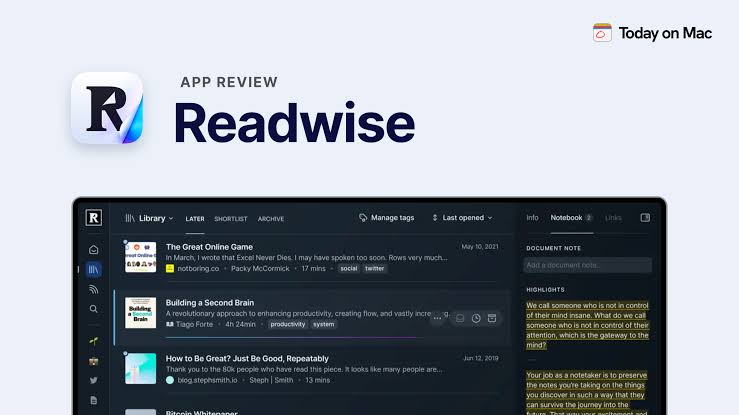
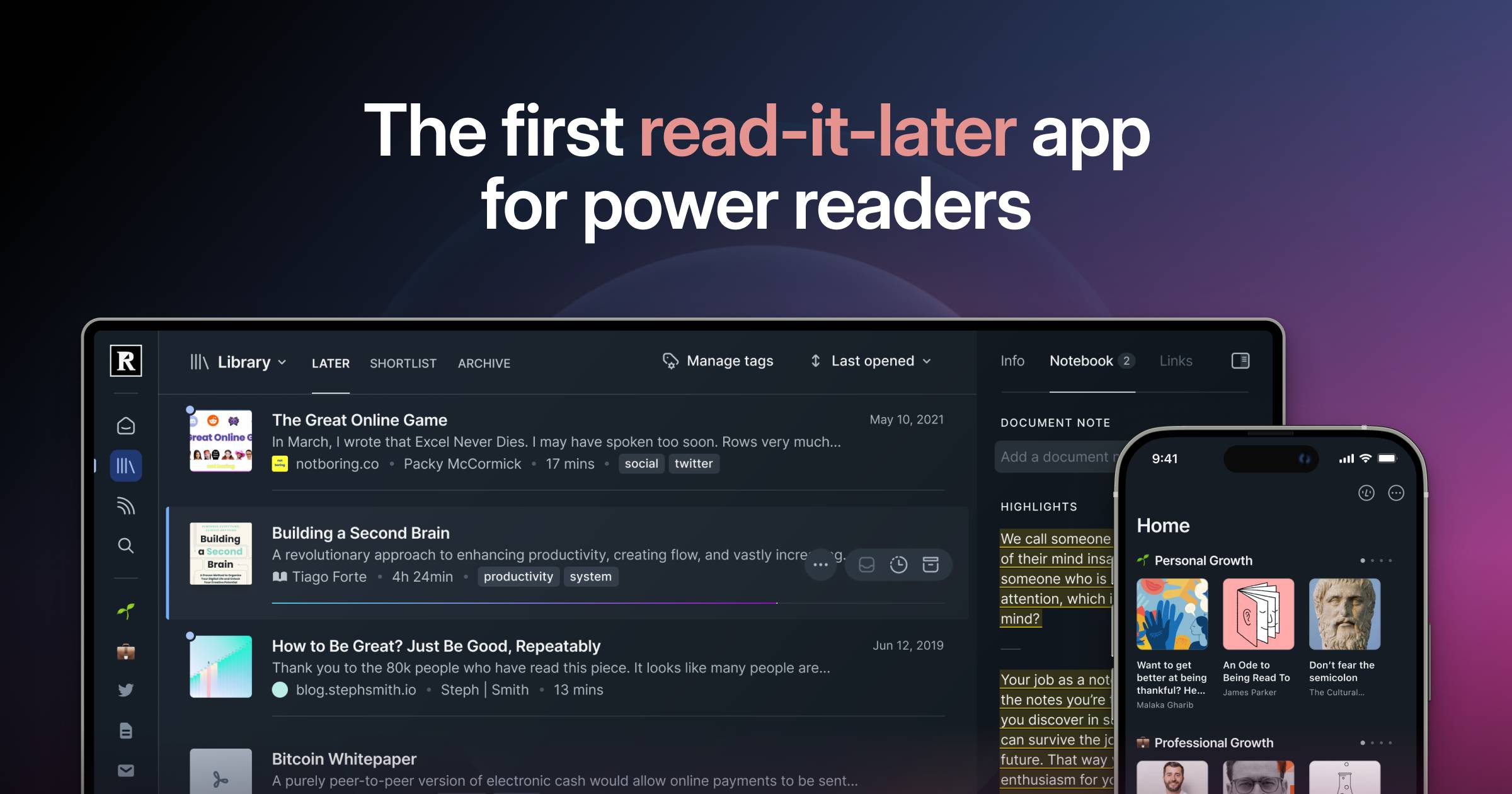
Readwise Reader is a read-later app and document-level reading environment that handles the full reading workflow from ingestion to annotation to export. It accepts a wider range of content types than any comparable tool: web articles, newsletters, PDFs, EPUBs, YouTube video transcripts, Twitter and X threads, podcast audio, and RSS feeds all enter the same unified inbox. The unified inbox is what the aipedia.wiki review calls the moat: having one place where all your saved reading lives, regardless of format or source, is a workflow simplification that seems trivial until you have experienced the alternative of managing saved articles in one app, PDFs in another, newsletters in email, and RSS feeds in a third tool.
The reading experience in Reader is polished. The document formatting handles most web articles cleanly, removing navigation and sidebar clutter and presenting the text in a readable format with adjustable fonts, margins, and line spacing. For PDFs, the reader supports direct annotation within the document rather than requiring an external PDF viewer. Highlighting is done by selecting text and choosing a color, and the mobile interface makes highlight gesture-based and fast enough to use without breaking reading flow.
The knowledge graph feature within Reader surfaces connections between highlighted passages across different documents. When you are reading an article and highlight a concept, Reader can surface other documents in your library that discuss the same concept. For researchers and writers who use Readwise to build a personal knowledge base, this surfacing of related material across the entire reading history is one of the features that makes the tool more than a reading inbox.
Ghostreader AI: In-Document AI Assistance
Ghostreader is Readwise's AI assistant that operates directly within documents in Reader. Unlike external AI tools where you copy a passage, switch apps, paste it into a chat window, and copy back the response, Ghostreader is contextually integrated into the reading experience. You select any text in a document, open the Ghostreader menu, and choose from options including summarize, simplify, define terms, translate, generate study questions, or run a custom prompt.
The tutorialswithai.com review from 2026 found that Ghostreader's auto-highlight suggestions reduce manual highlighting time by roughly 60 percent for typical reading workflows. This is the practical impact: Ghostreader suggests which passages are most worth highlighting rather than requiring you to identify them yourself, which both reduces the cognitive effort of active reading and improves the quality of what enters the spaced-repetition review queue.
Document-level AI is one of Ghostreader's more powerful features. You can chat with a full PDF, asking questions like what does this document say about the methodology or summarize the main argument in three sentences, and Ghostreader responds with answers cited back to specific passages in the document. For researchers processing multiple dense documents, this replaces the linear skimming that would otherwise be required to locate relevant information.
Custom prompts are a Ghostreader feature that power users value for recurring workflows. You can create saved prompts like extract all quotes that could be used in a presentation or generate five flashcard questions from this passage and run them consistently across any document with a single menu selection. For writers, researchers, or students who have established processing workflows for certain content types, this prompt library reduces the setup cost of each AI interaction to near zero.
Ghostreader AI consumes credits, and heavy users of document Q&A can exhaust their monthly allocation before the reset date. The Speed Reading Lounge review notes this as a limitation: for passive readers who want quick summaries and move on, Ghostreader adds modest value, but for readers who annotate deeply and want to extract maximum value from highlights, the inline context-aware design adds real workflow value that external AI tools cannot replicate without manual copying. The credit cap affects primarily the first group more than the second, but it is a documented friction point for any user who relies heavily on the document chat feature.
PKM Integrations and Exporting Your Knowledge
Readwise's export integrations are one of its most genuinely useful features for the audience of knowledge workers and researchers who have built systems around tools like Obsidian, Notion, Logseq, Roam Research, or Evernote. Highlights and annotations made in Reader or any connected source sync automatically and bidirectionally into these personal knowledge management tools. A highlight made in a Kindle book appears in your Obsidian vault. A passage annotated in Reader appears in your Notion database. Notes added in Readwise appear in Logseq.
The bidirectional sync means that edits or tags added to a highlight in Obsidian can flow back to Readwise, and new highlights made in Reader appear in the connected tool without any manual export step. For users who have built their note-taking and knowledge systems around these PKM tools, this is the feature that makes Readwise a genuine infrastructure tool rather than a standalone reading app. The highlight becomes the atomic unit that moves through the entire knowledge workflow without friction.
For users who do not use a dedicated PKM tool, the Readwise library itself functions as a searchable knowledge base. The full-text search across all highlights and documents allows retrieval of specific passages by keyword across every book, article, and document ever saved. One Medium reviewer cited in the Readless pricing review described Readwise as the single most beneficial tool in their workflow, and for knowledge workers whose value depends on synthesizing ideas across many sources, the searchable unified library is what makes that claim understandable.
Pricing and Subscription Structure
Readwise's pricing structure in 2026 has multiple tiers depending on which products you want to include:
|
Plan |
Price (Annual) |
What You Get |
|
Readwise Lite |
$5.59/month ($67.08/year) |
Highlight syncing and spaced-repetition daily review from all connected sources. No Readwise Reader app included. Best for users who already have a separate read-later solution. |
|
Reader Standalone |
$4.99/month (approx) |
Readwise Reader app only. No spaced-repetition review system or highlight export integrations. Best for users who only need a read-later inbox. |
|
Full Bundle |
$9.99/month ($119.88/year) |
Readwise Lite plus Readwise Reader together. Full highlight pipeline from ingestion to spaced review to PKM export. 30-day free trial included. Best overall value for serious readers. |
|
Monthly billing |
$12.99/month |
Full bundle on monthly billing. 23% more expensive than annual. No commitment required. |
Prices verified April to May 2026 from readwise.io and independent pricing databases. Annual billing saves 23% versus monthly. No permanent free tier after the 30-day trial. iOS App Store subscriptions are managed through Apple and subject to Apple's refund policy. Contact [email protected] for support. Combined Lite plus Reader bundle at $13.99/month also documented in some review sources reflecting Lite plus Reader separately.
Is the Pricing Justified?
The honest answer depends entirely on use intensity. The Readless pricing review puts it clearly: Readwise Reader is worth $119.88 per year if you highlight five or more articles per week, revisit your highlights regularly, and export to a knowledge tool like Obsidian or Notion. It is not worth it if you mainly skim newsletters or want AI-generated briefings instead of full-text reading. At $9.99 per month, Readwise bundles three distinct functions that would otherwise require separate tools: a read-later inbox, a highlight retention system, and a PKM export pipeline. Each of those functions has standalone tools that individually cost less, but the friction of stitching them together manually and the loss of integrated spaced repetition makes the bundle argument compelling for heavy readers.
For casual readers or people who primarily consume content by skimming rather than deep reading, the price-value ratio weakens significantly. A user who saves articles infrequently, makes few highlights, and does not engage with the daily review will be paying the same $9.99 for a fraction of the utility that a power user extracts from the same subscription. This is the honest caveat in every independent review of Readwise and it is worth understanding before subscribing.
Revenue, Company Scale, and Long-Term Reliability
Readwise is a small, privately held company with approximately 28 employees as of April 2026 and headquarters in Raleigh, North Carolina. It has received investment from Velocity Consulting Services and Reform Ventures. The company's exact revenue figures are not publicly disclosed, but it operates as a subscription business with a user base that independent reviewers describe as loyal and growing, particularly following the Pocket shutdown in July 2025 that sent a large wave of displaced read-later users evaluating alternatives.
The small team and bootstrapped-adjacent operating model have a direct implication for the product experience that users notice: Readwise is a tool built by people who are themselves serious readers and knowledge workers, and that genuine personal investment in the problem shows in the product quality and in how the founders communicate with users. The founders have a documented history of engaging directly with the community in forums like Reddit and Hacker News, explaining product decisions, gathering feedback, and responding to legitimate criticism with transparency rather than corporate language.
The sustainability question that naturally arises for any small subscription software company is worth addressing honestly: a 28-person company with a loyal subscriber base and steady subscription revenue from a differentiated product in a category with demonstrated demand is not a fragile business. It is not an enterprise with the resources to absorb major feature development in multiple directions simultaneously. Users who need enterprise features like team workspaces, shared libraries, or organizational administration will not find them in Readwise, and this is a deliberate product scope decision rather than a gap the company is working to fill imminently.
The pace of product development has been steady rather than rapid. Readwise Reader launched in public beta in 2022 and has received consistent updates since. Ghostreader AI capabilities have expanded. The export integrations are maintained and updated as partner PKM tools make changes. For users evaluating the long-term reliability of a tool they plan to build workflows around, the absence of major outages, the consistent update cadence, and the founders' track record of transparency are stronger signals than company size alone.
Limitations Worth Knowing Before You Subscribe
Honest reviews of Readwise have to name the limitations plainly, because the product is not right for every reader and the pricing requires genuine commitment to get full value from it.
There is no permanent free tier. After the 30-day trial, a subscription is required to use either product. There is no freemium middle ground with capped features. This is a harder line than most productivity apps draw, and it means users who want to casually maintain access to a handful of saved articles without an ongoing subscription have no option. The Readless pricing review confirms this plainly: there is no freemium middle tier the way Feedly, Inoreader, or Matter offer. If you want a free read-later workflow, you need to look at other tools.
Ghostreader AI credits run out for heavy users before the monthly reset. The aipedia.wiki review specifically names this as a documented limitation: heavy document Q&A can hit caps before the monthly reset. For users who primarily use Ghostreader for inline summaries and definitions rather than extended document chat sessions, this is unlikely to be a problem. For users who want to chat extensively with every PDF they process, the credit model creates an inconsistent monthly experience.
Kindle sync requires periodic re-authorization. When Amazon updates its API tokens, which happens with some regularity, the highlight sync connection breaks and requires the user to re-authenticate. This is not a Readwise policy decision but a consequence of Amazon's API management, and Readwise flags it in its own documentation. For most users this is a minor inconvenience. For users whose primary reading happens on Kindle, a broken sync that goes unnoticed for a week means that week's highlights do not enter the retention system.
There are no team workspaces or shared libraries. Readwise is individually oriented by design. There is no way to share a highlight library with a colleague, create a team reading list, or build a shared annotation database. For solo founders, independent researchers, students, and individual knowledge workers, this is not a limitation. For teams who want collaborative reading and annotation workflows, a different tool is needed for that specific use case.
Mobile has slightly less feature parity than the web experience. Several AI preview features in Reader and some of the more advanced Ghostreader capabilities are web-only or arrive on mobile with a lag. For users who do most of their reading on mobile, this means occasional features visible in reviews or in the web version are not yet accessible from the phone.
Pros and Cons
What Readwise Gets Right
The spaced-repetition daily review system is the most effective implementation of scientifically validated retention mechanics available in a consumer reading tool, and for consistent practitioners the long-term recall improvement is genuinely significant
Readwise Reader's unified inbox accepting web articles, newsletters, PDFs, EPUBs, YouTube transcripts, RSS feeds, Twitter threads, and podcast audio in one interface is the most comprehensive read-later format coverage of any tool in the market
Ghostreader AI reduces manual highlighting time by roughly 60 percent per independent 2026 reviewers and provides context-aware inline assistance without requiring app-switching or copy-pasting to an external AI tool
PKM export integrations with Obsidian, Notion, Logseq, Roam Research, and Evernote operate bidirectionally and automatically, making Readwise a genuine infrastructure layer in a knowledge work system rather than a standalone reading app
Full-text search across every highlight and saved document creates a personal knowledge base that grows more valuable with each month of use, enabling retrieval of specific passages from years of reading in seconds
The document chat feature in Ghostreader allows conversational Q&A with full PDFs, cited back to specific passages, replacing linear skimming with targeted information extraction for research workflows
Kindle highlight syncing, newsletters via forwarding address, browser extension saving, and OCR for physical book photo capture cover the major reading contexts without requiring separate tools for each
The 30-day free trial gives users a full month to build genuine reading and review habits before any commitment, which is a more realistic evaluation window than most apps provide
Where Readwise Has Genuine Limitations
No permanent free tier means any user who wants access after the trial must subscribe, with no freemium option for casual or occasional use
At $9.99 per month for the full bundle, Readwise is at the top of its pricing category and requires genuine active use of the highlighting and review system to justify the cost
Ghostreader AI credits are capped monthly, and heavy users who engage extensively with document-level chat can exhaust their allocation before the reset date
Kindle sync requires periodic re-authorization due to Amazon API token management, which creates an interruption in the highlight pipeline when it breaks and goes unnoticed
No team workspaces, shared libraries, or organizational features makes it an individual-only tool by design, which excludes team collaboration use cases
The full value of the subscription is accessible only to users who maintain a consistent daily review habit, which many subscribers do not sustain long-term and which erodes the retention benefit that justifies the price
Mobile feature parity lags the web experience in some areas, with certain Ghostreader AI preview features and Reader capabilities arriving on mobile after they appear on web
Cloud-only processing means highlights and AI queries flow through Readwise servers, which is not appropriate for regulated, legally sensitive, or highly confidential documents
Frequently Asked Questions About Readwise (2026)
1. What is Readwise and how is it different from a regular reading app?
Readwise is a knowledge retention and reading tool that solves a specific problem most reading apps ignore: the forgetting curve. When you read a book or article, you retain almost none of the specific information within weeks. Readwise addresses this by collecting all your reading highlights from Kindle, iBooks, web articles, PDFs, podcasts, and other sources into a single system and presenting them back to you daily using spaced-repetition scheduling. This daily review takes two to three minutes and, practiced consistently over months, dramatically improves how much you actually remember from what you read. The connected product, Readwise Reader, is a full read-later inbox that handles articles, newsletters, PDFs, EPUBs, YouTube transcripts, and RSS feeds in a single interface with an integrated AI assistant called Ghostreader. Together the two products form a complete reading workflow from initial saving through annotation, retention review, and export to personal knowledge management tools like Obsidian or Notion. A regular reading app stores content for you to read. Readwise helps you actually remember and use what you read, which is a fundamentally different purpose.
2. Is Readwise free to download?
The Readwise and Readwise Reader apps are free to download from the Apple App Store, Google Play, and the web at readwise.io. However, the apps require an active subscription or an active free trial to load and use content. There is no permanent free tier with capped features that you can use indefinitely without paying. Readwise offers a 30-day free trial that gives full access to the complete product including Readwise Reader, Ghostreader AI, all integrations, and the spaced-repetition review system. The trial does not require a credit card for some access paths, though annual subscription selection may be required for others depending on the platform. After the 30-day trial, a subscription at $9.99 per month (annual billing) or $12.99 per month (monthly billing) is required to continue using the products. The free apps themselves have no value without the subscription, since they are interfaces for accessing a subscription-based service rather than tools with meaningful free functionality.
3. What does Readwise cost and what plans are available?
Readwise pricing in 2026 has three main options. The Lite plan at $5.59 per month on annual billing includes the original Readwise highlight syncing and spaced-repetition review system but does not include the Readwise Reader app. Reader Standalone is approximately $4.99 per month and gives access to the Reader app without the full highlight retention system. The Full Bundle at $9.99 per month on annual billing, equivalent to $119.88 per year, includes both Readwise highlight review and the full Reader app, and is the plan most reviewers recommend for users who want the complete workflow. Monthly billing for the full bundle is $12.99 per month, which is 23 percent more expensive than annual billing and carries no long-term commitment. A 30-day free trial is available for the full bundle. Annual billing is the substantially better value for users who plan to use the product consistently. iOS subscribers should be aware that subscriptions purchased through the App Store are managed through Apple's subscription settings rather than the Readwise website, and Apple's standard refund policy applies.
4. What is Ghostreader AI and what can it do?
Ghostreader is the AI assistant built into Readwise Reader that operates contextually within documents without requiring you to switch to a separate AI tool. You select any text in a document and open the Ghostreader menu to access options including summarize, simplify, define terms in context, translate, generate study questions, suggest highlights, or run a custom prompt you have saved previously. For an entire document, you can open a document chat interface and ask questions about the content with responses cited back to specific passages in the text. Independent reviewers in 2026 found that Ghostreader's auto-highlight suggestions reduced manual highlighting time by roughly 60 percent for typical reading workflows. The custom prompt library allows you to create saved prompts for recurring workflows, such as extracting quotes for a specific purpose or generating flashcard questions, and run them with a single click on any document. Ghostreader AI consumes credits that reset monthly. Heavy document-level chat can exhaust the monthly credit allocation before the reset date. For inline assistance like summaries and definitions, the credit consumption is modest and typically does not cause issues within the monthly window.
5. Does Readwise work with Kindle highlights?
Yes. Kindle highlight syncing is one of Readwise's original and most frequently used features. Once connected through your Amazon account, highlights made in Kindle books automatically sync to Readwise. They enter the spaced-repetition review queue and are also available for export to connected PKM tools like Obsidian or Notion. The connection is automatic and requires no manual export step from the Kindle app. The documented limitation is that Kindle sync requires periodic re-authorization. When Amazon updates its API tokens, which happens occasionally, the connection between Kindle and Readwise breaks and needs to be re-established through your Readwise account settings. Readwise flags this in its documentation. For users who primarily read on Kindle, monitoring the sync status in account settings prevents highlights from being missed during periods when the connection has lapsed. In addition to Kindle, Readwise syncs highlights from iBooks, Google Play Books, Instapaper, Pocket, and web articles via browser extension.
6. Can I use Readwise to export highlights to Obsidian or Notion?
Yes. This is one of Readwise's most used features for knowledge workers. Readwise supports bidirectional export integration with Obsidian, Notion, Logseq, Roam Research, and Evernote. Once a connection is configured, highlights and annotations made in Readwise Reader or any connected source automatically appear in your chosen PKM tool. In Obsidian, each book or document typically gets its own note containing all highlights and annotations from that source, updated automatically as new highlights are added. In Notion, highlights appear in a database with metadata. The sync is automatic and bidirectional, meaning edits or tags added to a highlight in Obsidian can flow back to Readwise. For users who have built reading-to-note-taking workflows around these tools, Readwise functions as the pipeline that connects reading to thinking without any manual copying or pasting. The integration setup takes a few minutes per tool and configuration options allow customization of the export format to match existing note structures.
7. Is Readwise Reader a replacement for Pocket?
Pocket shut down permanently on July 8, 2025, making Readwise Reader the most frequently cited alternative for users who migrated from Pocket. Whether Reader is the right replacement depends on what you used Pocket for. Pocket was primarily a save-for-later and read-offline service with basic tagging and search. Readwise Reader is a more complete reading environment with deeper annotation tools, AI assistance through Ghostreader, RSS feed management, newsletter ingestion, and the spaced-repetition retention system that comes with a Readwise subscription. If you were a light Pocket user who saved articles occasionally and read them later without extensive annotation, Reader provides more features than you need and costs more than alternatives designed for casual use. If you used Pocket heavily, highlighted frequently, and wanted to actually retain and use what you read, Reader is a genuine upgrade from what Pocket offered, and the migration was widely described in developer and knowledge-worker communities as an improvement rather than just a replacement.
8. What is the daily review feature in Readwise?
The daily review is the core retention mechanism that makes Readwise different from every other reading tool. Each day, Readwise selects 5 to 15 of your past highlights from books, articles, and other saved sources and presents them for review in a morning email or through the Readwise app. The selection is managed by a spaced-repetition algorithm that schedules each highlight for review at intervals calibrated to how well you remember it. Highlights you rate as well-remembered appear less frequently. Highlights you forget appear more often. The review formats include multiple-choice questions about the source or context, cloze deletions where a key word is blanked for recall, and direct re-reading with a rating prompt. The entire daily review takes two to three minutes when practiced consistently. The cumulative effect over months is measurably improved recall of what you have read, which is the fundamental problem Readwise was built to solve. Users who practice the daily review consistently describe it as one of the highest-return habits in their productivity system. Users who subscribe but do not engage with the daily review do not get the retention benefit and are essentially paying for a read-later inbox at a price that alternatives offer more cheaply.
9. Is Readwise suitable for students?
Readwise is well-suited for students who read heavily and want to retain what they study, but the value case depends on the type of student and study approach. For graduate students, researchers, law students, medical students, and others who process large volumes of dense material and need to remember specific information over extended periods, the spaced-repetition system is directly applicable to academic material and can replace or supplement external flashcard tools like Anki. The ability to highlight directly in PDFs through Reader, have those highlights automatically enter the review queue, and export them to notes in Obsidian or Notion creates a workflow that many serious students find significantly more efficient than their previous approach. For undergraduates who read less intensively or who primarily use textbooks rather than digital sources, the $9.99 monthly cost may be harder to justify against the alternatives, particularly since textbook highlight syncing is less comprehensive than digital source syncing. The 30-day trial gives students enough time to run a full study cycle and assess whether the retention improvement justifies the subscription.
10. Does Readwise have a mobile app and how complete is it?
Yes. Readwise Reader is available as a native app for iOS and Android, and the original Readwise daily review app is also available on both platforms. The mobile apps handle all core functions including saving content, reading with highlighting, running Ghostreader AI features, and completing the daily spaced-repetition review. Text-to-speech for listening to saved documents is available on mobile, which is particularly useful for listening to articles during commutes or exercise. The documented limitation is that mobile feature parity lags slightly behind the web experience. Some Ghostreader AI preview features and certain Reader capabilities arrive on the web version before they are available in the mobile apps. For users who do the majority of their reading on a phone or tablet, this means occasional features visible in reviews or in the desktop version are not yet accessible from mobile. For most daily reading and review tasks, the mobile apps are complete enough that this is a minor rather than significant limitation. Newsletter forwarding to your @readwise.io address works regardless of device since it is an email-based ingestion system.
Icon polls Verdict
Readwise earns a 3.5 out of 5 from Icon Polls in 2026. That rating reflects a genuinely excellent product for a specific and well-defined audience, tempered by real limitations that make it the wrong choice for users outside that audience.
For active readers who highlight regularly, who want to actually remember and use what they read, and who have or want to build a personal knowledge system using tools like Obsidian or Notion, Readwise is probably the single most useful subscription they can purchase. The combination of a unified reading inbox, the best highlight retention system available, Ghostreader AI that reduces annotation friction by 60 percent, and automatic PKM export does not exist in any comparable configuration at a lower price. The SaaS lens review's description of Readwise as the connective tissue between reading and thinking is accurate for users who have built workflows around it.
The 3.5 rather than 4.0 reflects the no-permanent-free-tier policy, the credit-capped Ghostreader for heavy users, the Kindle re-authorization requirement, the team feature absence, the commitment that the daily review habit requires, and the genuine mismatch between the subscription price and the value it delivers to casual readers who save articles infrequently and do not engage with the retention system.
The most important piece of practical guidance from Icon Polls: use the full 30-day trial on your actual reading habits before deciding. During the trial, connect your Kindle, install the browser extension, set up a newsletter forward, and practice the daily review for at least three weeks. If by week four you find yourself looking forward to the review and genuinely using Ghostreader for document processing, the $9.99 per month is easy to justify. If after a month the daily review feels like a chore and your saved articles pile up unread, the subscription cost is not warranted and there are better-priced alternatives for casual use. Readwise is a tool that rewards commitment, and the trial is the only honest way to know which type of user you are.