Atyla is a relatively new platform that has been making noise in the digital marketing space since early 2026. It positions itself as a Generative Engine Optimization (GEO) tool, which is a fancy way of saying it helps brands figure out what AI chatbots like ChatGPT, Gemini, Perplexity, and Claude are saying about them. The concept is interesting and the timing is right, but after spending time testing it, Icon Polls has some mixed feelings about whether Atyla delivers enough value for what it charges.
In this review, we are going to break down everything we found during our research, from the AI technology behind it to the pricing structure, user experience, and everything else people have been searching about online.
Atyla Profile Overview
|
Platform Name |
Atyla |
|
Website |
atyla.io |
|
Category |
Generative Engine Optimization (GEO) |
|
Founded |
2026 |
|
Parent Technology |
Senthor.io |
|
Co-founder |
Tristan (CEO) |
|
Headquarters |
France |
|
AI Models Tracked |
ChatGPT, Gemini, Perplexity, Claude, Grok, Mistral (11 total) |
|
Pricing |
From EUR 19/month (Essential) |
|
Free Trial |
7 days, no credit card required |
|
Mobile App |
Not available |
|
GitHub Repository |
Not publicly available |
|
Users |
200+ marketing teams |
|
Icon Polls Rating |
2.8 / 5 |
Atyla AI
The core idea behind Atyla is built around AI search visibility. As more people start using AI chatbots instead of Google to find answers, brands are starting to lose control over how they are being represented in those AI generated responses. Atyla tries to solve that by tracking what AI models say about your brand when users ask questions related to your industry.
Atyla claims to support 11 AI models including ChatGPT, Gemini, Perplexity, Claude, Grok, and Mistral. It is powered by Senthor.io, which is essentially a bot traffic analytics platform that detects when AI crawlers visit your website. This is where Atyla has a genuine edge over some competitors. Most other GEO tools just simulate prompts and check what comes back. Atyla, on the other hand, can actually verify whether an AI bot crawled your content because it reads real server logs through Senthor.
That said, during our testing at Icon Polls, we noticed the AI powered recommendations can feel a bit generic at times. The GEO audit feature gives you a list of content gaps and suggested topics to write about, which is helpful, but it does not go deep enough to feel like a real competitive advantage. It feels more like a starting point than a full strategy.
Atyla Tools
Atyla offers a handful of core tools. The main ones include prompt tracking, brand mention monitoring, competitive analysis, GEO audits, and optimization recommendations. Prompt tracking lets you identify the specific questions users are asking AI chatbots that relate to your business. Brand monitoring tracks how often and in what context your brand shows up in AI responses compared to competitors.
The GEO audit is probably the most useful feature. It scans your website and tells you what content is missing, what needs restructuring, and what topics you should be writing about to get cited by AI models. It also identifies which sources AI models are pulling from when they mention your competitors, such as Reddit threads, Wikipedia entries, or industry blogs.
However, based on our Icon Polls findings, the toolset still feels limited compared to what established SEO platforms offer. There is no keyword research tool in the traditional sense, no backlink analysis, and no content writing assistant built in. Atyla is strictly focused on the GEO side of things, which is fine if that is all you need, but many marketers will still need to pair it with other tools to get the full picture.
Atyla Download
Atyla is a web based platform. There is nothing to download or install on your computer. You sign up at atyla.io, create an account, and everything runs inside your browser. This keeps things simple, but it also means you cannot use it offline or get desktop notifications unless you keep the tab open.
For teams that are used to working with desktop applications or prefer native software, this might feel limiting. But for a tool of this type, a web based approach is pretty standard across the industry.
Atyla App
As of August 2026, Atyla does not have a dedicated mobile app on iOS or Android. The platform is only accessible through a web browser. This is a notable gap, especially for marketing managers who want to check brand visibility metrics on the go. While the website does load on mobile browsers, it is clearly designed for desktop use first. Navigation on smaller screens feels cramped and some of the dashboard elements do not scale well.
Icon Polls sees this as one of the areas where Atyla could improve significantly. A mobile app, even a simple one for viewing reports and receiving alerts, would make the platform much more practical for busy marketing teams.
Atyla GitHub
Atyla does not have a public GitHub repository. The platform is entirely closed source, which is typical for commercial SaaS products but worth noting for developers and technical marketers who might want to integrate Atyla into custom workflows or build automations around it. There are no public APIs documented either, at least not at the time of this review.
For comparison, some competing tools in the broader SEO and analytics space do offer open source components or at least public API documentation. The lack of a GitHub presence or developer resources is a missed opportunity for Atyla to build community trust and attract more technical users who could become advocates for the platform.
Atyla Pricing
Atyla offers four pricing tiers. The Essential plan starts at EUR 19 per month and gives you 15 prompts to track. The Starter plan costs EUR 69 per month for 25 prompts. The Growth plan comes in at EUR 149 per month with 100 prompts and access to all AI models. There is also an Enterprise plan with custom pricing for large organizations and agencies that need unlimited prompts and dedicated account management.
All plans come with a 7 day free trial that does not require a credit card. Subscriptions are billed monthly or annually, and you can cancel at any time. Payments are processed through Stripe.
Our take at Icon Polls is that the pricing is on the high side for what you actually get, especially the Starter and Growth plans. The Essential plan at EUR 19 is reasonable enough to test things out, but 15 prompts is not a lot if you are trying to track brand visibility across multiple product lines or service categories. The jump to EUR 69 for just 10 more prompts feels steep. For small businesses and startups, this could be a hard sell when the results are not always immediately actionable.
Atyla User Experience
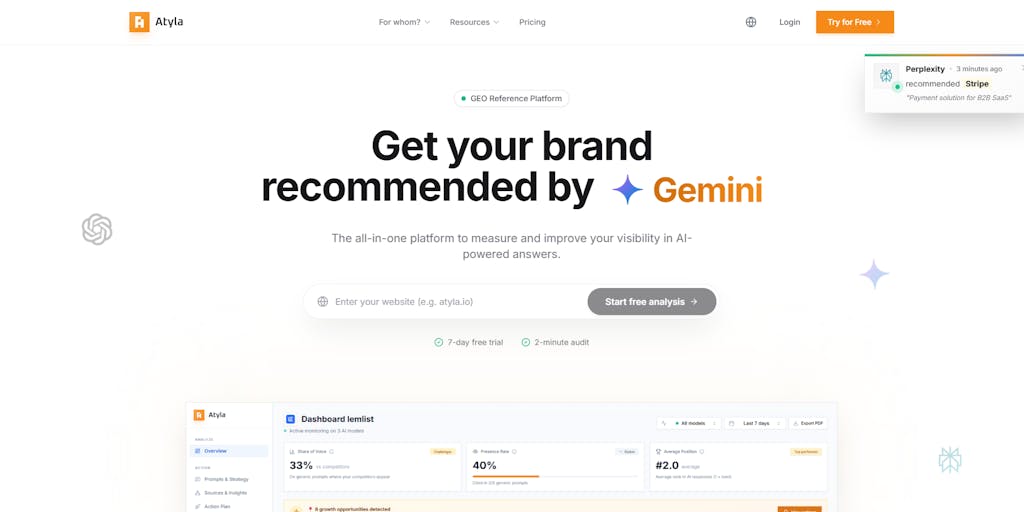
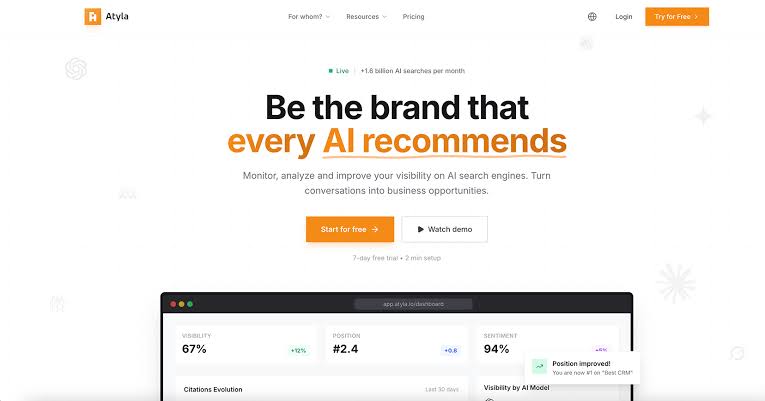
The onboarding process is fairly straightforward. You sign up, pick your plan, enter your brand name, set up the prompts you want to track, and let Atyla start scanning. The dashboard gives you a high level view of your brand mentions, competitor mentions, and overall visibility scores across different AI models.
On the positive side, the interface is clean and does not overwhelm you with too many options right away. The visualizations are decent, and the competitive analysis view makes it easy to see where you stand relative to other brands in your space.
On the downside, the platform can feel slow at times when loading reports, especially on the Growth plan with a lot of prompts running. Some users on Product Hunt have also mentioned that the data can feel inconsistent between scans, which raises questions about reliability. We noticed similar patterns during our review. The same prompt would sometimes return different visibility scores on back to back checks without any changes made to the underlying content.
Overall, Icon Polls gives Atyla a user experience that reflects a product still finding its footing. The idea is solid, the execution is decent, but there are enough rough edges to keep it from feeling polished.
What We Liked and What Needs Work
On the plus side, Atyla tackles a real problem that most marketers have not even started thinking about yet. AI search is growing fast, and brands that ignore it now will pay for it later. The Senthor.io integration gives Atyla a data advantage over tools that rely purely on prompt simulation. The free trial is generous and the Essential plan is affordable enough to test without much risk.
On the other hand, the prompt limits on lower plans are too restrictive. The lack of a mobile app is a clear gap. The recommendations engine needs to be deeper and more specific. There is no public API or developer documentation, and the pricing jumps between tiers feel a bit hard to justify given what you get for the extra cost. The platform also does not offer any content creation or content optimization tools built in, which means you will need to use other software alongside it.
Icon Polls Verdict
Atyla is a promising platform that addresses a genuine need in the marketing world. As AI search continues to grow, tools like this will become increasingly important. But in its current form, Atyla feels more like a monitoring dashboard than a full optimization suite. It tells you what AI is saying about your brand, but the guidance on what to do about it could be much stronger.
For enterprise teams with big budgets and dedicated GEO strategies, Atyla could be worth the investment. For freelancers, small businesses, and startups, the value proposition is harder to justify at the Starter and Growth price points. Icon Polls rates Atyla at 2.8 out of 5 for 2026. It is a tool worth watching as it matures, but not one we would recommend going all in on just yet.
Frequently Asked Questions About Atyla
1. What is Atyla?
Atyla is a Generative Engine Optimization (GEO) platform that helps marketing teams track and improve their brand visibility across AI search engines like ChatGPT, Gemini, Perplexity, Claude, Grok, and Mistral. It is powered by Senthor.io technology and was launched in early 2026.
2. Is Atyla free to use?
Atyla offers a 7 day free trial that does not require a credit card. After the trial, you need to choose a paid plan. The cheapest option is the Essential plan at EUR 19 per month. There is no permanent free tier available.
3. Does Atyla have a mobile app?
No. As of August 2026, Atyla does not have a mobile app for iOS or Android. The platform is only accessible through a web browser. It works on mobile browsers but the experience is not well optimized for smaller screens.
4. Is Atyla open source or available on GitHub?
No. Atyla does not have a public GitHub repository. It is a closed source SaaS product with no publicly available API documentation or open source components at the time of writing.
5. How much does Atyla cost in 2026?
Atyla has four pricing tiers. Essential costs EUR 19 per month for 15 prompts. Starter costs EUR 69 per month for 25 prompts. Growth costs EUR 149 per month for 100 prompts and access to all AI models. Enterprise pricing is custom and available upon request.
6. What AI models does Atyla support?
Atyla supports 11 AI models including ChatGPT, Gemini, Perplexity, Claude, Grok, and Mistral. The number of models you can access depends on which pricing plan you choose. All models are included on the Growth and Enterprise plans.
7. Who founded Atyla?
Atyla was co-founded by Tristan, who serves as CEO. The platform grew out of Senthor.io, a bot traffic analytics platform built by former executives of lemlist (lempire). The company is headquartered in France.
8. Can I download Atyla?
No. Atyla is a cloud based platform that runs entirely in your web browser. There is no desktop software or mobile app to download. You access it by creating an account at atyla.io.
9. What is the difference between SEO and GEO?
SEO (Search Engine Optimization) focuses on ranking your website in traditional search engines like Google. GEO (Generative Engine Optimization) focuses on making sure AI chatbots like ChatGPT and Gemini mention, cite, and recommend your brand when users ask relevant questions. Atyla is built specifically for the GEO side.
10. Is Atyla worth it in 2026?
Based on the Icon Polls review, Atyla earns a rating of 2.8 out of 5. It addresses a real and growing need in AI search visibility, but the limited feature set, restrictive prompt limits on lower plans, lack of a mobile app, and steep pricing jumps between tiers hold it back from a stronger recommendation. It is best suited for larger teams with dedicated GEO budgets.