|
Base44 Backend Platform Profile |
||
|---|---|---|
|
Brand Name |
Base44 |
|
|
Category |
AI-powered no-code app builder with built-in backend |
|
|
Founder |
Maor Shlomo (Israeli entrepreneur) |
|
|
Year Founded |
Early 2025 |
|
|
Parent Company |
Wix (acquired Base44 in June 2025 for a reported 80 million dollars) |
|
|
Headquarters |
Tel Aviv, Israel (with Wix infrastructure) |
|
|
Official Website |
base44.com |
|
|
App Editor URL |
app.base44.com |
|
|
Platform Type |
Web-based (browser only, no native desktop or mobile builder app) |
|
|
Mobile Availability |
No native Android or iOS builder app. Apps you build can be published to Google Play and the Apple App Store. |
|
|
Pricing Range |
Free plan to 200 dollars per month, plus custom Enterprise plans |
|
|
Free Plan |
Yes, 25 message credits per month with 5 daily cap and 500 integration credits |
|
|
GitHub Integration |
Yes, 2-way sync available on Builder plan and above |
|
|
Backend Access |
Currently in beta and free to use within existing credit allowances |
|
|
Trustpilot Rating |
Approximately 2.2 out of 5 from over 430 reviews |
|
|
ICON POLLS Rating |
2.1 / 5 |
|
|
Best For |
Quick prototypes, internal tools, MVPs, simple CRUD apps |
|
|
Not Ideal For |
Production apps that need to scale, complex SaaS, or apps that must avoid vendor lock-in |
|
What Is Base44 in 2026?
Base44 is an AI app builder that uses a chat style interface to generate full stack web applications from natural language prompts. Founded in early 2025 by Maor Shlomo, it crossed 10,000 users within three weeks and reached roughly 250,000 users in six months as a bootstrapped solo founder operation. Wix announced the acquisition in June 2025, and by 2026 the platform reportedly has over 400,000 signed up users.
Underneath the chat box, Base44 defaults to Anthropic Claude Sonnet 4 for code generation. On Builder plan and above you can switch the model to Claude Opus 4.5, Claude Sonnet 4.5, Gemini 2.5 Pro, Gemini 3 Pro, or GPT 5. The platform uses what it calls a Skills system, which gives the AI agent simplified abstractions for backend logic, data models, and external integrations.
Where Base44 differs from competitors like Lovable and Bolt is that everything lives inside one platform. The database, the user authentication, the hosting, and the deployment are all native. You do not need to wire up Supabase, set up Vercel, or configure auth providers. That convenience is the main selling point and, as you will see below, it is also the source of the biggest tradeoffs.
Base44 Download and Access
Here is the first thing prospective users need to understand. There is no Base44 app to download. The platform is fully browser based. You sign up at base44.com and the actual builder lives at app.base44.com. There is no Windows installer, no Mac DMG, no iPad version, and crucially no Android APK or Google Play listing for the Base44 builder itself.
Some users see APK download links circulating on third party sites. We strongly recommend ignoring those. They are not from Base44 and installing unverified APKs is a security risk. The official platform has clearly stated that the builder runs in the browser only.
There is one important nuance. While you cannot download Base44 itself onto Android, the apps you build with Base44 can be published to Google Play and the Apple App Store. Base44 added a guided publishing workflow in late 2025 that handles the packaging and submission steps for you. So your end users can install your Base44 built app from the Play Store, even though you the builder cannot.
Base44 Login Experience
Signing in to Base44 is straightforward. You go to base44.com, click Login or Sign Up, and authenticate using Google or email. The dashboard loads quickly and the onboarding is genuinely beginner friendly. New users get dropped into an Idea Library with prompt templates for common app categories like Travel, Finance, and Home Management, which softens the blank page problem.
Where the login experience falls apart is on the apps you build. Base44 forces its own branding onto the login screens of your published apps, and there is no way to fully redesign that flow. This is a real complaint in user reviews. When your customers sign up to use your product, they get bounced to a Base44 branded page, which causes confusion and noticeable drop off. For internal tools nobody cares, but for customer facing apps this is a serious limitation that other platforms in this category like Zite handle better.
We also flagged the February 3, 2026 outage. The entire Base44 platform went down for almost three hours that day. Every published app returned 502 errors and nobody could log in to the builder. There was a second incident on February 17 and another warning on February 20. This matters for login because the Base44 authentication system is centralised. When the platform breaks, every app on every customer site loses login functionality at the same time.
Base44 Functions and Backend Features
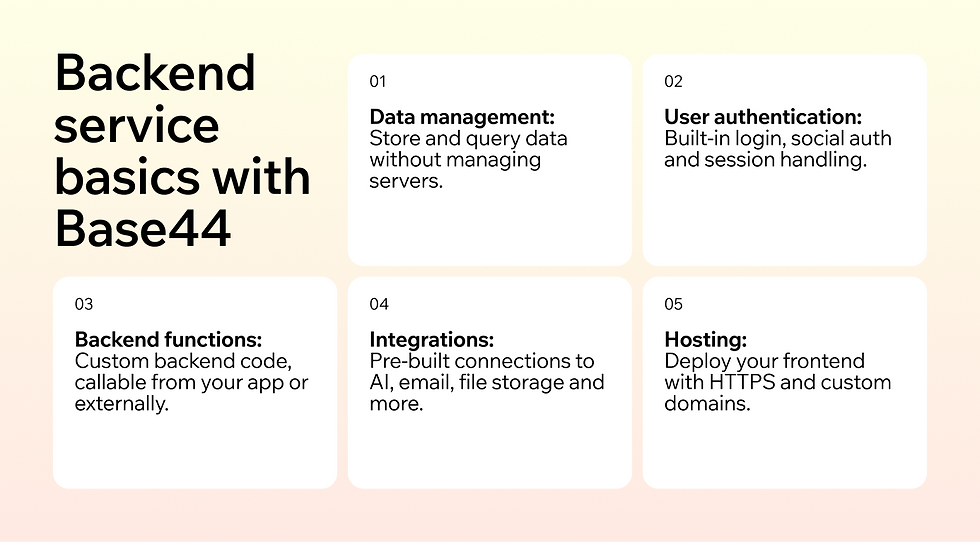
Base44 calls its backend layer a set of Functions, and as of 2026 the backend service is officially in beta and free to use within your existing credit allowance. There is no separate backend subscription. Backend operations consume integration credits from your monthly bucket.
Here is what Base44 Functions cover.
Built in database with auto generated tables based on your prompts. The platform uses MongoDB and Supabase under the hood as storage providers, but you do not interact with them directly.
User authentication with sign up, login, password reset, and role based permissions managed for you.
Auto generated API endpoints for every entity in your data model, secured by default.
Backend functions for custom server side logic. These unlock at the Builder plan ($40 per month annual).
Integrations with Stripe, Slack, OpenAI, WhatsApp, Gmail, Google Calendar, and over 100 other services. Each call from a published app consumes integration credits.
Workflow automation for triggering tasks, approvals, and notifications without code.
In testing, Functions work fine for simple CRUD apps. Trello style boards, project trackers, internal CRMs, inventory tools, basic SaaS scaffolding all generate cleanly. Where it falls apart is custom business logic. When we tried to build something with multi tenant permissions and conditional workflows, the AI hit a wall and started looping. We watched it burn 14 credits trying to fix a single bug it had introduced two prompts earlier.
The other backend concern is portability. You can export your front end code via GitHub on the Builder plan, but the backend logic, database schemas, and server side functions stay locked to Base44 infrastructure. If you outgrow the platform, you cannot take your backend with you. Multiple reviewers flagged this as a dealbreaker for production apps.
Base44 on Android
This is one of the most searched questions about Base44 in 2026, so we want to be very direct about it. There is no Base44 Android app. There is no APK on the Play Store. The builder is browser only and you cannot use a phone or tablet to build apps in any practical way. Even on a tablet browser the editor is cramped and the chat panel does not scale well.
If you want to use Base44 from an Android device, the realistic option is to open Chrome or Firefox on a tablet, log in to app.base44.com, and accept that the experience will be limited. We do not recommend trying to build apps from a phone.
On the publishing side, Base44 added Google Play deployment for the apps you build using the platform. The workflow handles packaging, signing, and submission, although you still need a Google Play developer account (currently 25 dollars one time fee) and you need to follow Google review policies. Apps published this way are essentially packaged web apps, not true native Android apps, which means performance and offline behaviour will be more limited than a fully native Kotlin or React Native build.
Base44 GitHub Integration
The GitHub story is one of the better parts of the Base44 review. The platform launched a one way export in March 2025, then upgraded to a full 2 way sync in late December 2025. The 2 way sync is genuinely useful and works as advertised.
When you connect, Base44 walks you through authorising the Base44 Builder app on GitHub, choosing an organisation or account, and either selecting an existing repo or creating a new one. After that, every change you make in Base44 commits to your repo automatically, and every push you make from your local environment syncs back into Base44. You can clone the repo, run npm install, set two environment variables (your app ID and backend URL), and edit the code in VS Code or any other editor.
The GitHub integration requires the Builder plan or higher. There are also a couple of gotchas worth knowing about. Once you connect GitHub to an app, the connection is permanent. You cannot transfer the project back to a Base44 only state. You also lose access to any version history from before the GitHub connection, since those versions are not stored in the repo. And the default branch must be named main, not master.
Most importantly, the GitHub export only contains the front end code. The backend logic, the database, the auth system, all of that stays on Base44 infrastructure. So while you can edit your React UI locally and push it back, you cannot fully migrate to a self hosted setup without rebuilding the backend from scratch. This is the vendor lock in we mentioned earlier and it is the single biggest reason Base44 lost points in our rating.
Base44 User Experience
The user experience splits cleanly into two stories. The first 80 percent of building a simple app is genuinely delightful. The last 20 percent of anything complex is genuinely painful. Both things are true, and both come up over and over in reviews.
What works well. The chat interface feels natural. The Idea Library and Discussion Mode both reduce the friction of getting started. The visual editor lets you click on a button and change colour or text without using AI credits. Apps generate in 5 to 20 minutes for typical use cases. The dashboard is clean. Activity logs show backend requests and response times even on the free plan, which is unusually transparent for a no code tool. Onboarding scores high in our internal tests for non technical users.
What does not work. Credits drain frighteningly fast. Every prompt costs one message credit whether the AI succeeded or produced broken code. When the AI breaks something, fixing it costs more credits, and reviewers regularly report burning 10 to 20 credits trying to fix a single bug. The free plan caps at 5 messages per day and 25 per month, which most users exhaust within a day or two. Credits do not roll over. The starter plan at $16 per month annual gives you 100 message credits, which one bad debugging session can wipe out. Forced upgrades are common when you run out mid month because Base44 does not sell small credit top ups.
Customer support. Multiple paid users mention slow response times when they hit blocking issues. For teams trying to ship, this uncertainty is a real problem. The Trustpilot distribution is striking. Around 23 percent of reviews are 5 star and around 66 percent are 1 star. There is very little middle ground, which usually means the platform works perfectly within its sweet spot and frustrates significantly outside it.
Reliability. The February 2026 outage already mentioned, and the fact that all Base44 apps share the same hosting infrastructure, means that a single incident takes everyone offline at once. That is fine for prototypes, very risky for paying customers.
Pricing Snapshot for 2026
Free: $0 per month, 25 message credits, 500 integration credits, 5 messages daily cap, no custom domain, no code editing, no backend functions.
Starter: $16 per month annual ($20 monthly), 100 message credits, 2,000 integration credits, in app code editing, unlimited apps.
Builder: $40 per month annual ($50 monthly), unlocks custom domains, backend functions, GitHub 2 way sync, model selection. This is the realistic minimum for serious work.
Pro: $80 per month annual ($100 monthly), larger credit pools, beta features.
Elite: $160 per month annual ($200 monthly), 1,200 message credits, premium support.
Enterprise: Custom pricing with dedicated architect support.
Pros and Cons
Pros
Genuinely fast. You can go from prompt to working app in under 30 minutes.
All in one. Database, auth, hosting, and deployment included with no external services to wire up.
Beginner friendly. The Idea Library and chat interface remove the blank page problem.
GitHub 2 way sync works well for the front end code.
Backed by Wix with serious infrastructure and a clear product roadmap.
SOC 2 Type II and ISO 27001 certified, GDPR compliant for EU data.
Cons
Backend lock in. You cannot take the database or backend logic off Base44.
Credit system is punishing during debugging and bad AI outputs still cost credits.
Trustpilot rating of around 2.2 out of 5 with 66 percent 1 star reviews.
Recent platform wide outages affecting every published app at once.
Login screens force Base44 branding with no full white labelling.
Customer support is slow according to many paying users.
AI hits a wall on complex business logic and multi tenant SaaS.
No native Android, iOS, or desktop builder app.
The ICON POLLS Verdict: 2.1 out of 5
Base44 is a real product with real users and a real parent company. It is not a scam and it is not vapourware. For prototypes, internal tools, hackathon builds, and quick MVPs, it does what it promises and does it fast. If your goal is to show an investor a clickable working version of your idea by Friday, Base44 will get you there.
That said, our review of the brand against the criteria that matter most to ICON POLLS readers (reliability, transparency, fair pricing, customer support, ownership of your work, and long term value) lands at 2.1 out of 5. The credit model penalises the user for the AI's mistakes. The backend lock in undermines the no code freedom story. The login branding hurts customer facing apps. The February 2026 outages exposed a single point of failure for everyone on the platform. And the Trustpilot distribution shows a very unhappy majority.
Use Base44 for what it does well. Treat it as a prototyping and internal tools layer, not as the foundation of a production business. If you do choose to build something serious on it, plan your migration path before you write your first prompt.
Frequently Asked Questions About Base44 in 2026
1. Is Base44 legit and safe to use?
Yes. Base44 is owned by Wix (NASDAQ: WIX) which acquired it for a reported 80 million dollars in June 2025. The platform holds SOC 2 Type II and ISO 27001 certifications and is GDPR compliant. It is not a scam. However, legitimate does not mean perfect, and the Trustpilot rating of around 2.2 out of 5 reflects real ongoing user complaints about credit consumption and reliability.
2. Is there a Base44 Android app or APK download?
No. There is no Base44 Android app and no official APK. The builder is browser based and lives at app.base44.com. Any APK files claiming to be Base44 are unofficial and should not be installed. You can however publish the apps you build with Base44 to the Google Play Store using the platform's publishing workflow.
3. How do I login to Base44?
Go to base44.com and click Login or Sign Up. You can authenticate using Google or email. After signing in, the editor opens at app.base44.com. If you have signed in to a Base44 built app as an end user, you log in through that specific app's URL using the Base44 hosted authentication system.
4. What does Base44 actually cost in 2026?
There is a free plan with 25 message credits per month. Paid plans on annual billing run $16 (Starter), $40 (Builder), $80 (Pro), and $160 (Elite) per month. Monthly billing costs roughly 25 percent more. Most serious users need at least the Builder plan because that is where backend functions, custom domains, and GitHub sync unlock. Enterprise pricing is custom.
5. Does Base44 have GitHub integration?
Yes. Base44 launched a 2 way GitHub sync in December 2025. It is available on the Builder plan and above. You can clone your app's repo, edit the code locally in your preferred editor, and push changes back to Base44 automatically. The sync is permanent once enabled and only the front end code is included. Backend logic stays on Base44 infrastructure.
6. Can I really build an app on Base44 without coding?
Yes for simple apps. The chat interface generates working CRUD apps, internal tools, dashboards, and basic SaaS scaffolds without you writing a single line of code. For complex business logic, multi tenant systems, or anything outside common patterns, you will likely need to either edit code manually (Builder plan and up) or hire a developer. Reviewers consistently report the AI hitting a ceiling on the last 20 percent of complex builds.
7. Do I own the apps I build on Base44?
Technically yes, you own the apps and the data inside them. You can delete everything from the dashboard. However, the backend code is tightly coupled to Base44 SDK calls and Base44 infrastructure. If you try to export and run your app elsewhere, you will need significant developer work to make it functional outside the Base44 ecosystem. This is the vendor lock in concern most reviewers raise.
8. Why is Base44's Trustpilot rating only 2.2 out of 5?
The rating reflects polarised user experiences. Around 23 percent of reviewers leave 5 star ratings praising speed and ease of use. Around 66 percent leave 1 star ratings citing credits drained by AI errors, slow customer support, the February 2026 outages, and the gap between marketing promises and production readiness. Base44 works very well in its sweet spot of simple apps and prototypes, and frustrates users significantly when pushed beyond that.
9. What are the best alternatives to Base44?
The most direct alternatives in 2026 are Lovable (better for developers who want cleaner React code with Supabase backend), Bolt (more modular and developer focused), Bubble (more powerful for complex logic but steeper learning curve), v0 by Vercel (better UI components but no backend), Glide (simpler spreadsheet based apps), and Zite (production ready with branded logins and visual workflows). Each has different tradeoffs depending on whether you prioritise speed, design, or long term ownership.
10. Is Base44 worth paying for in 2026?
It depends on your use case. For non technical founders validating an idea, designers building clickable prototypes, or teams making internal tools where polish matters less than speed, the Builder plan at $40 per month is reasonable value. For anyone planning a customer facing production app that needs to scale, the lock in, credit costs, and reliability concerns make Base44 a riskier choice. ICON POLLS recommends starting on the free plan, testing your specific use case first, and only upgrading once you are confident the platform fits.