
Quick Verdict
Hopper built its reputation on a genuinely interesting idea: use machine learning to predict when flight prices are going to rise or fall, and help travelers decide when to buy. For a window, that idea had real value. The prediction technology is still there and it still works reasonably well for simple one-way and round-trip flights on popular routes. But by 2026, the Hopper experience has been buried under a business model that now earns more from selling add-on features and fintech products than from giving travelers straightforward booking help. The Price Freeze feature that users most associate with the brand is loaded with limitations that make it functionally useless in many real-world scenarios. Refunds consistently come back as Carrot Cash locked inside the Hopper ecosystem rather than real money. Multi-city booking is genuinely broken in ways that route experienced travelers directly to Google Flights or airline websites instead. Hidden fees inflate fares at checkout above what users saw during the browsing stage. Customer service is documented as nearly unreachable without paying for VIP access. Out of 18 complaints filed at ComplaintsBoard as of 2026, exactly zero have been marked resolved. PissedConsumer shows a 2.7-star rating from 2,943 reviews with approximately 90 percent unfavorable. This review rates Hopper 1.0 out of 5, because when the transaction goes smoothly the product is forgettable, and when it goes wrong there is effectively no help available.
At a Glance: Icon Polls Ratings
Here is how Hopper scored across the areas we evaluated in our 2026 research:
|
Category |
Stars |
Score |
|
Price Prediction Technology |
★★★☆☆ |
3/5 |
|
Flight Search and Simple Bookings |
★★★☆☆ |
2.5/5 |
|
Price Freeze Feature Value |
★☆☆☆☆ |
1/5 |
|
Multi-City Flight Booking |
★☆☆☆☆ |
1/5 |
|
Packages and Hotel Add-Ons |
★★☆☆☆ |
1.5/5 |
|
Refund and Cancellation Process |
★☆☆☆☆ |
1/5 |
|
Customer Service Accessibility |
★☆☆☆☆ |
1/5 |
|
Overall |
★☆☆☆☆ |
1/5 |
What Is Hopper?
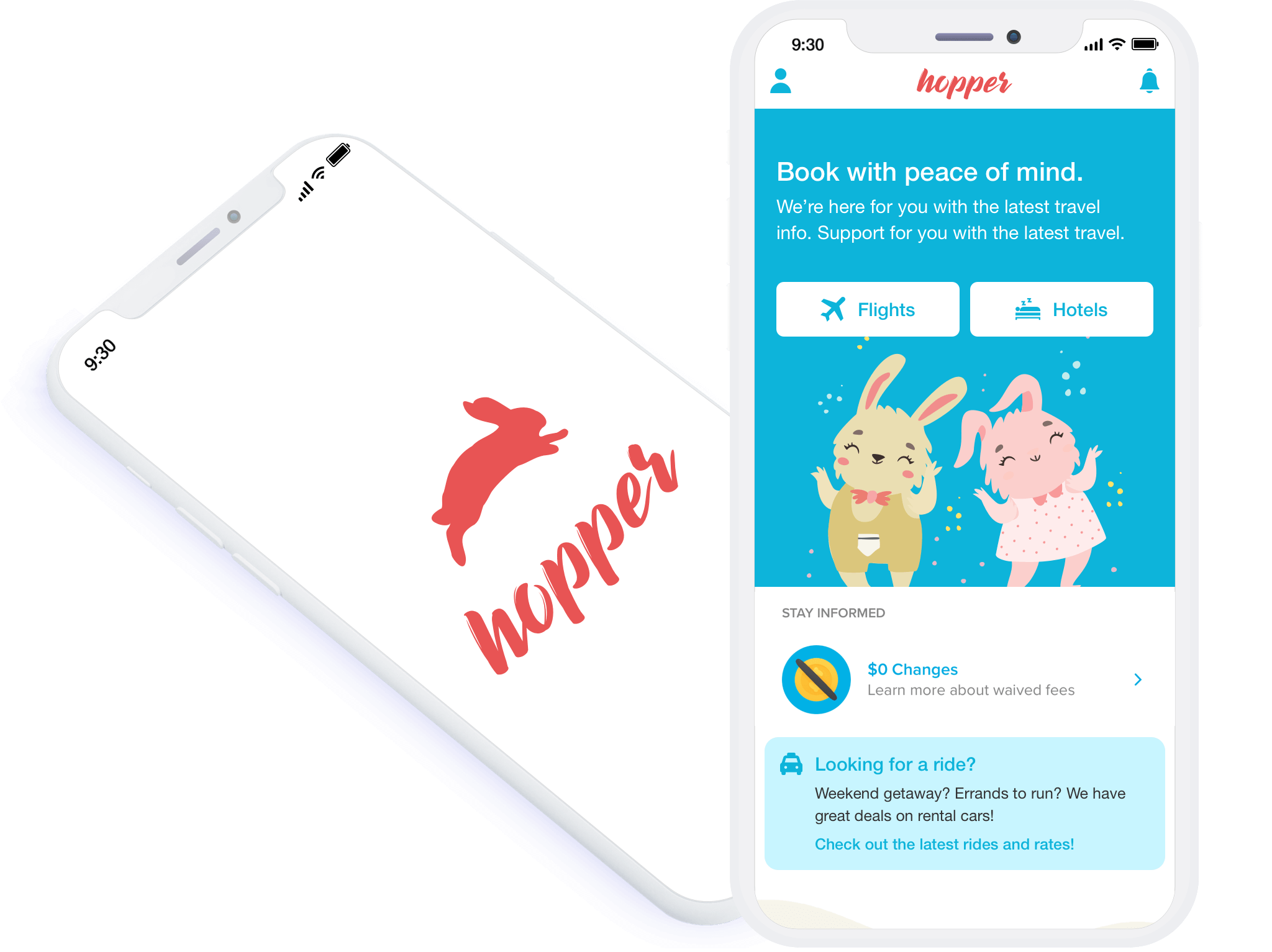
Hopper is a travel booking app founded in 2007 by Frederic Lalonde and Joost Ouwerkerk, headquartered in Montreal, Canada. It launched publicly as a consumer product in 2015 with a specific and genuinely novel value proposition: predictive analytics that could tell travelers with reasonable accuracy whether a flight price was likely to rise or fall, and by how much, over the coming days and weeks. The app uses an animated bunny to represent its brand and color-codes search results by price tier to help users quickly identify the cheapest available travel dates.
The app has been downloaded more than 100 million times and claims to have helped users save an average of $65 per trip compared to other travel booking channels. It is available on iOS and Android and accessible through hopper.com. Hopper's early promise was that it would earn commission from airlines and hotels for bookings made through the platform and pass some of that value back to users through superior timing intelligence. That model made sense and it attracted meaningful venture funding.
The business model has since evolved significantly. Hopper has increasingly moved toward selling optional add-on features, fintech products like its virtual credit card and bank account, and subscription services that bundle perks for frequent users. In 2024 and 2025 the company laid off significant portions of its workforce and shifted resources toward these fintech revenue streams. The consequence for the travel booking experience, which users come to the app for, is that the core product has received less attention while the monetization layer has received more.
By 2026, Hopper occupies an awkward position in the travel app market. It is not the most reliable booking platform for most use cases. It is not the cheapest, since multiple reviewers document finding lower fares on Google Flights or directly with airlines after Hopper showed them an inflated or add-on-laden price. It is not the most transparent, given the documented gap between the price shown during browsing and the total shown at checkout. And it is not the most supportive when something goes wrong, given the customer service barriers documented across PissedConsumer, ComplaintsBoard, and Product Hunt.
The Hopper App and Website: Getting Started
The Hopper app is a free download from the Apple App Store and Google Play. The website at hopper.com provides the same booking functionality in a browser for users who prefer desktop access. Both are free to use in terms of account creation and browsing. The app is genuinely well-designed for its primary use case of browsing flight prices and checking the prediction calendar. The color-coded calendar view, where dates are shaded from green for cheapest to red for most expensive, is an intuitive and useful visual for understanding price patterns across a travel window.
The first-use experience after downloading involves entering a destination, viewing the price prediction, and being guided through the booking flow if you decide to proceed. For straightforward round-trip bookings on routes with good data coverage, this flow is smooth and the predictions are presented clearly. The animated bunny bouncing across the screen while results load is either charming or grating depending on personal preference, and enough independent reviewers mention it to be worth noting as a design feature that not everyone responds to positively.
The app asks users to create an account before booking, using an email address or through Google or Facebook authentication. Account creation is fast and requires no credit card upfront. The wallet section of the app stores Carrot Cash credits and available vouchers. The Hopper Plus subscription option is presented during the initial browsing experience as an upgrade with additional perks, and the VIP support option is presented as a paid add-on during the booking flow.
The website experience at hopper.com mirrors the app closely but has slightly less polished navigation in some areas. For users who specifically want to plan trips involving multi-city itineraries, the website does not compensate for the documented limitations of multi-city search that are present across both platforms.

Price Predictions: The Feature That Built Hopper's Reputation
Hopper's price prediction engine is the product feature that built the company's reputation and remains the reason most new users try the app. The claim is that Hopper predicts flight prices with 95 percent accuracy up to a year in advance. In practice, independent testing and real-world user experiences paint a more nuanced picture that is worth understanding before relying on the predictions for booking decisions.
For popular routes between major hubs, the predictions are reasonably useful as a directional guide. When Hopper says prices are expected to rise in the coming week, that is often correct. When it identifies a specific date range as the cheapest window for a given trip, the calendar view frequently reflects genuine fare pattern data. For users who use Hopper purely as a price watching and monitoring tool, checking alerts and then booking directly with the airline, the prediction functionality adds genuine value at zero cost.
The accuracy problems emerge in less data-rich contexts and in the specific scenarios that make the predictions most consequential. One documented user experience describes receiving a Hopper prediction that prices on a specific route would drop within three months. The user waited and continued watching the prices increase rather than decrease as predicted. When the predicted drop date arrived, prices were still higher than when the watch began. The reviewer described losing access to their preferred flight itinerary during the waiting period and ultimately paying more for a less desirable option. The prediction was wrong by more than $200 on the total ticket cost.
The Hopper price watch notification system, which is supposed to alert users when prices reach a recommend-to-buy threshold, has been documented as unreliable in the timing of those notifications. Several users describe the app failing to send alerts when prices hit the recommended level, resulting in missed windows. The reliability of the notification system is central to the product's usefulness, and documented failures in that system undermine the core value proposition significantly.
The Price Freeze Feature: Documented Limitations and Complaints
Price Freeze is the product feature most prominently marketed by Hopper and the one that generates the highest volume of specific complaints across consumer review platforms. Understanding exactly how it works, and where it fails, is essential context for anyone considering using the app.
Here is the documented mechanics of Price Freeze: you identify a flight you want to book, pay a non-refundable deposit fee to freeze the price for a set period (typically 14 days or less depending on the booking), and during that freeze window Hopper promises to cover the difference up to a stated limit (commonly $300 per traveler) if the price rises before you complete the booking. If you complete the booking during the freeze window, you pay the frozen price. If the price drops during the window, you pay the lower price. If you choose not to book during the window, the deposit is forfeited. If the flight sells out during the freeze window, Hopper offers a refund of the deposit but cannot guarantee the booking.
The documented failure cases cluster around several specific scenarios. One user on JustUseApp described finding a Barcelona round trip at $600, using Price Freeze because their paycheck was coming on Friday, and arriving on Friday to find the fare at $900. The stated coverage limit was only $100 in that instance, meaning the price difference was $300 but Hopper only covered $100. The user had to decide between paying $800 for a ticket they found at $600, or losing the deposit and searching again. They characterized the experience as a scam. On Google Flights, the $600 fare was still available at the moment Hopper was showing them $900. The deposit fee, which is non-refundable when the user decides not to complete the booking, is the key financial risk. A $100 freeze fee on a $178 flight representing 56 percent of the ticket price in protection costs is not an economically rational decision for most travelers.
A user on ComplaintsBoard posted a complaint in March 2026 describing a $100 Price Freeze deposit that was not applied toward the final booking cost at all. The complaint states they paid $100 for the freeze and the money was not credited to the ticket price, despite their expectation that it would be. This speaks to the fine print of Price Freeze: the deposit does not constitute a partial payment on the ticket. It is a fee for the price protection service only. This distinction is documented in Hopper's terms but is not always understood from the marketing language, and the gap between expectation and reality is generating ongoing complaints.
Multi-City Flights: A Real and Documented Gap
Multi-city flight booking is a specific use case where Hopper's limitations are particularly visible, and it is a use case that a substantial proportion of international travelers regularly need. The short version is that Hopper's multi-city booking functionality is minimal, and for complex international itineraries it is effectively absent.
A highly upvoted response in the Rick Steves Travel Forum captures the experience precisely. The poster describes using Hopper to monitor airline price trends but always buying tickets directly through the airline. Their key observation is that Hopper does not allow multi-city searches in a meaningful way, which is often exactly what travelers to Europe need. They specifically contrast Hopper with Google Flights, which allows full multi-city itinerary searches across multiple destinations, and notes that the lowest-price Hopper offerings frequently have poor itineraries even for the routes it does support.
Travelers who routinely plan trips to multiple destinations, open-jaw itineraries where you fly into one city and depart from another, or trips that combine several short-haul legs around a region face a simple problem with Hopper: the tool cannot build those itineraries in the same session. Each booking is treated as a separate transaction. This means you lose the ability to optimize the full trip cost across legs, you cannot compare alternative itinerary combinations efficiently, and you may end up booking legs at different times as prices change between transactions.
For the large category of international travelers who frequently need multi-city routing, the practical advice that experienced reviewers consistently give is to use Hopper only to check price trends on individual routes and then move to Google Flights or ITA Matrix for actual multi-city booking. Using Hopper as a data tool and booking elsewhere is a workflow that preserves whatever value the prediction feature offers without subjecting the booking to Hopper's documented service failures.
Hopper Packages: Hotels, Cars, and Bundled Travel
Beyond flights, Hopper offers hotel bookings, car rentals, and limited bundled travel packages that combine flights and accommodation. The hotel search works in a similar format to the flight search, with price prediction and color coding for cheaper versus more expensive nights. Car rental search is available in the app alongside flights and hotels. For simple, standard bookings at major chains or well-reviewed properties in popular destinations, the hotel booking experience is functional.
The packages offering, combining flights and hotels into a single booking, is where the documentation becomes more concerning. A Product Hunt review describes a pattern of failed reservations, bait-and-switch room or flight details, and changed bookings that users then have to fight to resolve. A reviewer on Trustindex describes a booking experience where they were charged prices they did not agree to and received items that were not as described. A user on Product Hunt who describes previously thinking of Hopper as a top-notch booking site specifically had their experience change when they attempted to rebook a hotel room after finding the same room cheaper, describing the credit chase as a reason to think twice before booking.
The Carrot Cash refund mechanism is the specific friction point that follows most hotel and package disputes. When a booking goes wrong and a refund is issued, Hopper's default is to issue Carrot Cash rather than a return of the original payment method. Carrot Cash is Hopper's internal credit system where 1 Carrot Cash is equivalent to $1, but it can only be spent on future Hopper bookings. For a user who has had a bad experience and does not want to use Hopper again, receiving a refund locked inside the Hopper ecosystem rather than returned to their credit card is an outcome that feels like a second failure piled on top of the first.
Pricing Transparency: Hidden Fees and Final Costs
The gap between the price shown during Hopper's browsing stage and the price shown at checkout is one of the most consistently documented complaints from users across multiple platforms, and it represents a transparency problem that is distinct from the Price Freeze issue.
FlightDeck's independent review describes noticing hidden fees appearing in the booking flow that make the final fare more expensive than the initial display suggested. The reviewer recommends cross-checking Google Flights and airline direct booking pages to see how fares compare, and specifically notes that Hopper does not always offer the lowest fares available. The price-match policy is documented as nonexistent: Hopper will not match a lower fare found elsewhere after a booking is already made.
One specific documented experience involves a user who was charged more after completing a Price Freeze than the terms appeared to promise. Despite paying the deposit and completing the booking within the freeze window, the final charge was higher than expected, with the difference attributed to fine print about maximum coverage limits. Finding that the protection you paid for covers only part of the price increase, and paying more than you expected in total, is the outcome that generated the most pointed criticism of the Price Freeze product in independent reviews.
Trustindex reviews from 2024 and 2025 specifically document a pattern of prices increasing as users proceed through the booking flow, fees being added for services that were not clearly disclosed during browsing, and the total at checkout being materially higher than what the user initially saw. This is not unique to Hopper in the travel booking industry, but Hopper's particular combination of the practice with the Price Freeze product creates a context where users feel doubly misled: they believed they were protected from price increases and found out at checkout that the protection was more limited than they understood.
One tip from a Trustindex reviewer specifically warns: prices get inflated the further you go into booking. They list also not providing guidance on travel documents as a separate documented failure, describing a connecting flight through India where a visa was required and Hopper's platform did not surface that requirement, resulting in the airline canceling the ticket and the traveler missing two connecting flights.
Customer Service: The Barrier That Defines the Experience
Hopper's customer service situation in 2026 is documented across every major consumer review platform as one of the most significant failure points of the product. The documented experience is not just that customer service is slow or unhelpful. It is that meaningful customer service is structurally inaccessible for standard users and has been partially moved behind a paid tier.
Hopper VIP is a paid add-on that can be added to an individual booking for a variable fee. VIP is specifically described in independent reviews as providing easier access to customer support, which implies that standard support is difficult enough that this is a selling point. In other words, you pay extra not for a better flight or a better hotel, but for the ability to speak to someone when your booking goes wrong. This is the architecture of a service that knows its standard support is inadequate and has monetized the gap.
PissedConsumer's aggregate of 2,943 Hopper reviews from 2026 documents widespread complaints about inaccessible customer service and long hold times, repeated reports of delayed or denied refunds and unresolved refund requests, and instances of duplicate charges, booking errors, and unwanted subscription billing. The 2.7-star rating reflects approximately 90 percent unfavorable reviews, with only 5 percent of reviewers saying they are likely to recommend the service.
ComplaintsBoard shows 18 complaints filed against Hopper with 100 percent of them unresolved as of 2026. Not a single complaint has been marked as resolved. The most recent complaint posted was about a flight booking in March 2026. A reviewer there describes being completely unable to get help through either the app or the website when an airline offered a full refund for a flight that went through Doha during a conflict period. The user wanted to accept the airline's refund offer but could not navigate Hopper's system to do so.
The route through customer service that PissedConsumer documents is a cycle: users call the support number, are placed on hold for extended periods, receive scripted responses that do not address their specific situation, are told to wait for a refund that does not arrive, call again, receive different information from a different agent, and repeat the process without resolution. Several users describe eventually disputing the charge with their credit card company as the only effective resolution path, which is the same external escalation pattern documented in PayPal complaints and underscores how often this becomes the practical outcome when platform dispute processes fail.
Refunds, Cancellations, and What Happens When Plans Change
The refund and cancellation experience at Hopper in 2026 is documented as one of the most consistently frustrating aspects of the platform, and it disproportionately affects users who encounter real-life events that require changes to travel plans.
A review on Trustindex from 2024 describes canceling a round-trip flight from Asheville due to Hurricane Helene, a genuinely extraordinary circumstance where the airline directly refunded the credits to Hopper. The traveler had the airlines' confirmation that the credits had been returned to Hopper. Despite this, the traveler could not recover the refund or credit through Hopper's system. They spoke to Hopper representatives, submitted documentation from both airlines, and even disputed the charge with their credit card company. As of the time of the review, nothing had been resolved. The reviewer specifically warns readers to stay away from third-party websites for travel, a conclusion drawn from a situation where the airlines did the right thing and the platform sitting between them and the traveler absorbed the refund and did not pass it through.
A Product Hunt review describes an American Airlines cancellation due to unsafe weather. The user had booked a multi-airline itinerary through Hopper with the outbound on American and the return on Frontier two days later. American canceled the outbound due to weather. The user could not make their event and therefore did not need the return flight. Hopper's policy as applied in this situation: the user was not able to cancel the Frontier return and receive a refund. The trip had become pointless because the outbound was canceled, but because the outbound was on a different airline than the return, and because Hopper acts as a middleman between the user and each carrier separately, there was no mechanism to void the full itinerary and receive a refund for the now-useless return.
Refunds issued as Carrot Cash rather than to the original payment method are a recurring documentation across FlightDeck, Product Hunt, and PissedConsumer reviews. The locked nature of Carrot Cash, which is only spendable on future Hopper bookings, turns a refund into a coupon for the service that just failed you. For users who have been through a frustrating Hopper experience and have no intention of booking with the platform again, this refund format is not a refund in any meaningful sense.
Pros and Cons
What Hopper Still Offers
The price prediction technology for simple round-trip flights on popular routes with good data coverage remains useful as a directional guide to whether a fare is likely to rise or fall in the near term
The color-coded calendar view makes it genuinely easy to identify cheaper travel windows across a date range, faster than manually checking individual dates on airline websites
The app is free to download and use for browsing without booking, which means it can be used as a price-watching tool without financial commitment until the moment of purchase
For users who find a good fare and complete a booking without needing to change it, the app experience is smooth and the booking completes without the failures that appear when modifications or refunds are needed
Carrot Cash rewards accumulate on bookings and can provide genuine savings for users who book frequently enough through the platform to use them before they expire
The Documented Failures That Justify the 1.0 Rating
100 percent of 18 ComplaintsBoard complaints are unresolved as of 2026, representing a complaint resolution rate that no legitimate service should reach
PissedConsumer shows approximately 90 percent unfavorable reviews from 2,943 reviewers with only 5 percent willing to recommend the service
The Price Freeze product is fundamentally misunderstood by a significant proportion of users because the marketing language does not adequately communicate the maximum coverage caps, the non-refundable deposit when users choose not to book, and the fact that the freeze does not hold inventory
Multi-city flight booking is not meaningfully available, routing international travelers with complex itineraries to other platforms for actual booking
Hidden fees inflate prices between the browsing stage and checkout, creating a gap between what users expect to pay and what they are charged
Customer service accessible without payment is documented as inadequate, with meaningful support effectively gated behind the paid VIP tier
Refunds are routinely issued as Carrot Cash locked inside the Hopper ecosystem rather than returned to the original payment method
The price prediction technology, while useful directionally, has documented cases of being wrong by $200 or more and of failing to send price alerts when fares hit the recommended buy threshold
Booking through Hopper rather than directly with airlines or hotels creates a third-party intermediary problem when cancellations occur, as the airline's refund to Hopper does not automatically result in the user receiving their money
Frequently Asked Questions About Hopper (2026)
1. Is Hopper a legitimate app or a scam?
Hopper is a legitimate registered travel agency and the app itself is a real, functional product that has been used to complete hundreds of millions of bookings. It is not a scam in the sense of being a fraudulent operation. However, the gap between what its marketing implies and what users frequently experience has generated enough documented complaints that the distinction between legitimate and trustworthy deserves to be drawn carefully. The Price Freeze product is particularly prone to misunderstanding because the marketing language implies protection that the fine print limits significantly. Refund policies that return Carrot Cash rather than the original payment method feel deceptive to users who did not read those terms before booking. ComplaintsBoard shows 100 percent of its 18 complaints against Hopper remaining unresolved as of 2026. PissedConsumer shows approximately 90 percent unfavorable reviews with a 2.7-star rating. These are not the statistics of a scam operation. They are the statistics of a platform that has significant systemic service failures that it is not addressing effectively.
2. What is the Hopper Price Freeze and is it worth it?
Hopper Price Freeze lets you pay a non-refundable deposit to lock in a displayed flight or hotel price for a set period, typically up to 14 days depending on the booking. During that period, Hopper promises to cover the price difference up to a stated limit (commonly $300 per traveler) if the price rises. If prices drop, you pay the lower price. If you decide not to book during the freeze period, you forfeit the deposit. The deposit does not count as a partial payment toward the ticket in all cases. The key limitations: the coverage cap means that if the price rises more than the stated maximum, you still pay more than the frozen price. The freeze does not hold physical inventory, so the flight can sell out while you hold a Price Freeze. The fee is non-refundable if you choose not to proceed. For a $178 flight with a $48 freeze fee and $300 coverage, the math works if the price rises. But many documented complaints describe situations where the coverage cap was lower than users understood, the flight sold out before they returned to book, or prices on Google Flights remained at the original level while Hopper showed a higher rate. Whether Price Freeze is worth the fee depends entirely on understanding those terms before paying the deposit, which many users document not having done clearly enough.
3. Can Hopper do multi-city flights?
Multi-city flight booking on Hopper in 2026 is extremely limited and not practical for complex international itineraries. The app handles straightforward one-way and round-trip bookings well. For trips involving three or more separate flight legs, open-jaw itineraries where you fly into one city and depart from another, or any trip that requires optimizing multiple segments together as a combined cost, Hopper does not provide a meaningful search and booking tool. Experienced travel forum users, including a specifically referenced response in the Rick Steves Travel Forum, describe needing to treat Hopper as a price monitoring tool only and use Google Flights for actual multi-city booking. Google Flights allows full multi-city itinerary construction, comparison across multiple routing options, and flexible date searching across all legs simultaneously. For international travelers who regularly build complex itineraries, Hopper is not the right booking tool regardless of how the price prediction feature performs on individual routes.
4. How do I get a refund from Hopper?
Getting a refund from Hopper in 2026 depends on the type of booking and the reason for cancellation. For bookings with a refundable rate, cancellations within the allowed window should be processed through the app. For non-refundable rates, the circumstances under which a refund is available are limited to specific documented exceptions. For disruptions caused by the airline or hotel, including cancellations, significant delays, or overbooking, you are entitled to a refund, but the documented experience suggests that Hopper may issue that refund as Carrot Cash rather than to your original payment method. For cases where the airline has already refunded the amount to Hopper and you cannot access the credit through Hopper's system, the most effective documented escalation path is to contact Hopper at +1-833-933-HOP1, keep records of all communications, and if unresolved, dispute the charge with your credit card company. Multiple reviewers document the credit card dispute as the ultimately effective path after Hopper's internal channels failed to produce a resolution. The Hurricane Helene case documented on Trustindex, where airlines refunded Hopper directly and the traveler still could not recover the money months later, illustrates how broken the pass-through refund mechanism is.
5. Are Hopper's prices actually cheap?
Hopper's prices are not consistently cheaper than booking directly, and multiple independent reviewers specifically document finding lower fares on Google Flights or airline websites after using Hopper. The app claims users save an average of $65 per trip and advertises discounts of up to 40 percent, but these figures are averages and promotional language rather than guaranteed minimums. Hidden fees that appear during checkout can inflate the final price above what was shown during browsing. The app earns a commission of 1 to 4 percent from airlines and hotels for bookings made through it, which sometimes means fares are slightly marked up relative to booking directly. The Hopper Wallet does contain Carrot Cash, discount codes, and vouchers that can provide genuine savings, but these are for specific carriers or destinations and may not apply to the trip you are planning. The practical recommendation from multiple experienced travel reviewers is to use Hopper to check price trends and predictions, then verify the actual best price on Google Flights and the airline website before booking anywhere.
6. What happens if my flight booked on Hopper gets canceled?
If an airline cancels a flight you booked through Hopper, the refund process passes through Hopper as the booking intermediary. The airline refunds the amount to Hopper, and Hopper is then supposed to pass that refund to you. In documented cases from 2026, this pass-through process fails with regularity. The Asheville Hurricane Helene case documents a traveler with confirmed airline refunds to Hopper who still had not received the credit months later despite multiple contacts and documentation submissions. A March 2026 complaint on ComplaintsBoard describes being unable to process an airline-approved full refund through Hopper's app or website when the airline itself was offering the refund directly due to a conflict-related route change. The practical advice from consumer advocates and documented user experience is: when an airline cancels a flight you booked through Hopper, attempt to process the refund through Hopper but simultaneously document everything and be prepared to escalate to a credit card dispute if Hopper's system does not resolve it within a reasonable timeframe.
7. How does Hopper's customer service work in 2026?
Hopper's customer service is accessible by phone at +1-833-933-HOP1, which is listed as available 24/7. In practice, documented user experiences describe long hold times before reaching an agent, scripted responses that do not address the specific situation, and resolutions that are promised but not delivered. Chat support within the app routes through automated responses before escalating to a human. VIP support, which is a paid add-on to individual bookings, is marketed as providing easier access to customer service, which implicitly acknowledges that the standard channel is difficult enough to warrant paying to bypass it. PissedConsumer's aggregate of Hopper reviews documents widespread complaints about inaccessible customer service as one of the three most common complaint categories alongside refund failures and booking errors. The ComplaintsBoard 0-out-of-18 complaint resolution rate is the sharpest measure of how effectively Hopper's support resolves documented problems. For users who need help with a specific booking issue, the phone number is the primary access point, but managing expectations about how quickly or completely that support will resolve the problem is important based on the documented record.
8. What is Carrot Cash on Hopper?
Carrot Cash is Hopper's internal credit system. Every booking made through the app earns a small amount of Carrot Cash, with 1 Carrot Cash being equivalent to $1 in value. Carrot Cash can only be spent on future bookings made through the Hopper app and cannot be withdrawn as cash or used anywhere outside the Hopper platform. It appears in your Hopper Wallet alongside any available vouchers or discount codes. The limitation that generates the most frustration is that Hopper frequently issues refunds as Carrot Cash rather than to the original payment method. For users who had a negative experience and do not intend to use Hopper again, a refund in Carrot Cash is effectively worthless because they will never book through the platform to spend it. The Hopper Wallet also contains time-limited coupons and promotions for specific carriers or destinations, and the Atlas Heart review notes that these are often too specific to be practically useful, for example a discount on Fiji Airlines to Australia or New Zealand is not helpful when planning a trip to Amsterdam.
9. Is Hopper good for booking hotels and packages?
Hopper's hotel booking and package functionality exists and works for basic bookings at properties where the listing is accurate and no changes or cancellations are needed. The price prediction and color-coded calendar apply to hotel rates the same way they do to flights, which can be useful for identifying cheaper check-in dates. The documented failures in hotel and package bookings mirror the flight booking failures: descriptions or listings that do not match reality, Carrot Cash refunds when complaints are raised, and customer service that is difficult to access when resolution is needed. Product Hunt reviews that specifically address hotel bookings describe failed reservations, bait-and-switch details, and long fights to receive refunds that the hotel provider had already approved. For straightforward hotel bookings at major established chains in popular destinations where disputes are unlikely, Hopper is a functional booking channel. For anything where accuracy of the listing, flexibility to cancel, or access to support if something goes wrong is important, the documented failure rate is high enough to recommend booking directly with the hotel or through a platform with better dispute resolution.
10. Should I use Hopper in 2026?
Use Hopper as a free price monitoring and prediction tool and book elsewhere for the actual transaction. That is the most useful summary of what Hopper offers in 2026 for most travelers. The price prediction calendar and the watching feature provide genuine value as a way to understand whether a fare is likely to rise or fall and to identify cheapest travel dates. Using those features, and then completing your booking directly with the airline or on a platform with stronger consumer protections, combines Hopper's analytical value with a booking channel that provides more reliable service when something goes wrong. If you do book through Hopper, pay with a credit card rather than debit so that a chargeback is available if refunds are not processed correctly. Do not pay for Price Freeze without reading and fully understanding the coverage cap, the non-refundable deposit terms, and the inventory hold limitations. Do not expect standard customer service to resolve complex disputes quickly. And for multi-city or complex international itineraries, use Google Flights or book directly with airlines from the start.
Icon polls Verdict
Hopper earns a 1.0 out of 5 from Icon Polls in 2026. The rating reflects the documented experience of users who encounter problems, which is the test that matters most for any service that handles your travel plans and your money.
The price prediction feature is real and has genuine utility as a monitoring and timing tool. That value is real and it is what earned Hopper its initial reputation and its 100 million downloads. But it does not compensate for a Price Freeze product that generates complaint after complaint about caps users did not understand, deposits that were not applied toward bookings users expected them to cover, and flights that sold out while the freeze was active. It does not compensate for a refund system that issues Carrot Cash instead of money. It does not compensate for multi-city booking that does not work. It does not compensate for customer service that is inaccessible unless you pay extra for VIP access. And it does not compensate for a complaint resolution record that shows zero resolved complaints out of eighteen formally filed.
Hopper is a product that works when nothing goes wrong. That is a reasonable description of a browser. It is not a reasonable description of a travel booking service that people trust with hundreds or thousands of dollars and the logistics of their vacations, business trips, and family travel. When something goes wrong with travel, you need help. Hopper's documented record in 2026 is of a company that is not reliably providing that help. The 1.0 is the honest conclusion of reviewing that record.