|
Field |
Details |
|
Product Name |
Meta AI |
|
Parent Company |
Meta Platforms, Inc. |
|
CEO |
Mark Zuckerberg |
|
Headquarters |
Menlo Park, California, United States |
|
Founded |
2015 (as Facebook AI Research / FAIR) |
|
AI Model |
Llama 4 (Scout, Maverick, Behemoth) |
|
Type |
AI Chatbot / Virtual Assistant |
|
Website |
https://ai.meta.com / https://meta.ai |
|
Available On |
WhatsApp, Instagram, Facebook, Messenger, Web |
|
Monthly Active Users |
1.2 billion+ (Q1 2026) |
|
Daily Active Users |
Approx. 40 million |
|
Countries Available |
60+ countries |
|
Languages Supported |
13+ languages |
|
Pricing |
Free (no paid tier) |
|
Key Features |
Chatbot, Image Generation (Imagine), Web Search, Writing Help |
|
AI Infrastructure Spend (2026) |
$125 billion to $145 billion |
|
ICON POLLS Rating |
1.6 / 5 (Poor) |
Meta AI Chatbot
The Meta AI chatbot is powered by Meta's Llama 4 model, which was released in early 2026. Llama 4 uses a mixture of experts architecture and comes in three variants: Scout and Maverick for everyday consumer use, and Behemoth for more advanced reasoning tasks. On paper, that sounds impressive. In practice, the chatbot handles simple everyday questions reasonably well. If you ask it for a quick recipe, a basic translation, or a casual trivia answer, it will get the job done.
However, when you push the chatbot into more complex territory, the cracks start showing fast. For long form writing, detailed research, coding help, or any task that requires deep reasoning, Meta AI falls noticeably behind competitors like ChatGPT and Claude. The responses tend to be surface level, and the chatbot sometimes generates information that is flat out incorrect without any warning or disclaimer. Multiple independent reviews throughout 2026 have confirmed this pattern. Meta AI is fine for casual use, but it is not a serious tool for professional or complex work.
There is also the safety angle, which cannot be ignored. Throughout 2025 and into 2026, Meta AI chatbots were at the center of multiple controversies involving minors. Reports surfaced that Meta's internal content guidelines at one point allowed conversations with children that were described as sensual in nature. Lawmakers, including U.S. Senator Edward Markey, publicly called on Meta to ban minors from accessing AI chatbots on its platforms. Common Sense Media conducted its own testing and described Meta AI's safety systems as fundamentally broken. Meta eventually introduced new restrictions and protections, but the damage to public trust was already significant.
To make things worse, in mid 2026, a security vulnerability was discovered where hackers exploited the Meta AI chatbot to take over Instagram accounts. The chatbot had elevated permissions to change account settings without properly verifying the identity of the person making the request. Meta patched the issue, but it raised serious questions about how much control AI tools should have over user accounts. For a company that serves over 3 billion people daily, these kinds of failures are not minor oversights. They point to a pattern of rushing features to market before they are properly secured.
Meta AI on WhatsApp
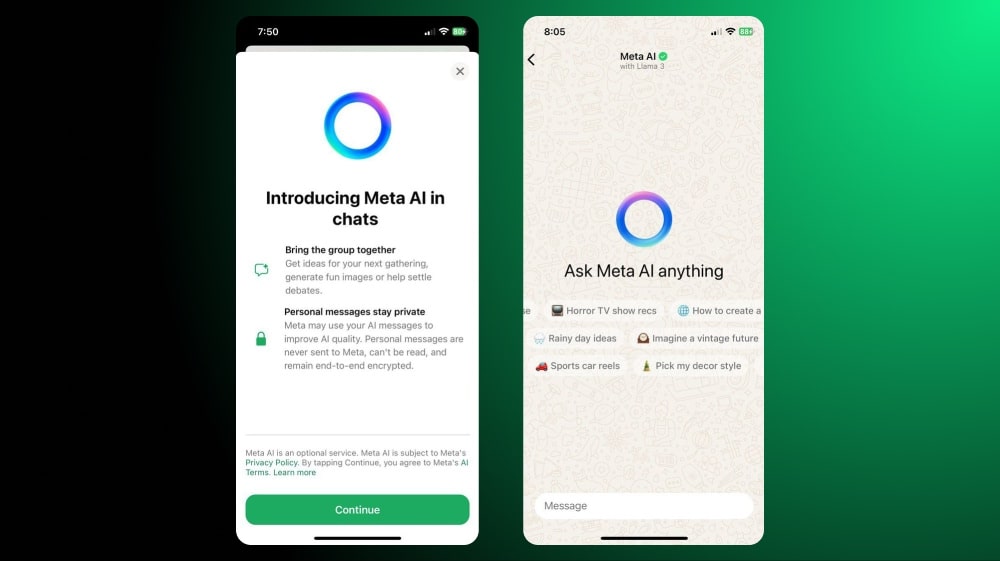
WhatsApp is the primary battleground for Meta AI, and it shows. Around 63% of all Meta AI interactions happen on WhatsApp, which makes sense given that WhatsApp has over 3 billion users worldwide. Meta AI is accessible directly within the chat interface. You can tag it in group conversations using @Meta AI, and it responds to queries right alongside your regular messages. For users in countries like India, where WhatsApp is essentially the default communication app, this means Meta AI is everywhere whether people asked for it or not.
One of the most controversial moves Meta made in early 2026 was banning all third party AI chatbots from WhatsApp. Starting January 15, 2026, general purpose AI assistants like ChatGPT, Microsoft Copilot, and Perplexity were blocked from operating on the WhatsApp Business API. Meta cited technical reasons and system burden, but the effect was clear. Meta AI became the only general purpose chatbot allowed on WhatsApp. This move drew antitrust scrutiny from regulators in the EU, India, Brazil, and Italy, with Italy going as far as issuing an interim order forcing Meta to suspend the restrictive terms.
The privacy dimension of Meta AI on WhatsApp is another serious concern. WhatsApp built its reputation on end to end encryption and private messaging. But when Meta AI enters a conversation, that dynamic changes. Conversations involving Meta AI are processed on Meta's servers. This creates a real tension between the privacy promises WhatsApp was built on and the data hungry nature of an AI assistant that, by definition, reads what you type. For people who use WhatsApp for sensitive discussions about health, finances, or personal matters, involving Meta AI in those conversations is something that deserves careful thought.
Meta's 2026 privacy policy update made the situation even more uncomfortable. The company now uses Meta AI conversation data to power its advertising targeting models. If you ask Meta AI about running shoes, that information feeds into the system that decides which ads you see across Facebook, Instagram, Messenger, and Threads. Users technically can opt out through a buried settings menu (Settings, then Privacy, then AI Data Usage), but the default is opt in, and most people will never find that toggle. Privacy advocates in the EU have already filed complaints with the Irish Data Protection Commission over this practice.
Meta AI Logo

In April 2026, Meta rolled out a redesigned logo for Meta AI. The previous logo used soft gradients and smooth abstract shapes, the kind of visual language you see across almost every AI brand. The new design is built around what Meta calls the Infinity Ring, a more grounded and functional icon that uses animated elements powered by Lottie based animations. When users interact with the chatbot, the ring reacts to input, expanding and glowing when the AI enters advanced reasoning mode.
The redesign also introduced a shimmer effect, described as resembling the surface of a soap bubble, which is meant to represent the flexibility of AI. The logo refresh came alongside the launch of Meta's Muse Spark model, developed by Meta's Superintelligence Labs. From a design standpoint, the new logo is cleaner and more recognizable at small sizes, which matters because Meta AI now appears across dozens of surfaces from tiny chat icons to tab headers on mobile screens.
While the logo redesign itself is competent from a visual design perspective, it does not fix any of the underlying problems with the product. A new logo does not address privacy concerns, safety failures, or the fact that the chatbot still trails its competitors in capability. It feels more like a brand distraction than a meaningful improvement, which is a common pattern with Meta. When the product itself is not winning on merit, the packaging gets a refresh.
Meta AI Website
Meta AI has a standalone website at meta.ai, which offers a more full featured experience than the in app versions. The website includes web search functionality, image generation through the Imagine feature, and a standard chat interface. The site recorded around 19.1 million total visits in February 2026, with the United States accounting for roughly 18% of that traffic.
The website is clean and loads quickly, but the experience is bare bones compared to what competitors offer. ChatGPT's interface supports file uploads, custom GPTs, plugins, voice mode, and a much richer ecosystem of tools. Claude offers projects, artifact creation, and a focused writing environment. Meta AI's website feels more like a demo page than a fully developed product. It does the basics and not much more. For a company spending upwards of $125 billion on AI infrastructure in 2026, the web experience does not reflect that level of investment.
The research division behind Meta AI operates at ai.meta.com, which houses documentation, research papers, and developer resources for the Llama model family. This side of the operation is more impressive, catering to developers and enterprise users. But the consumer facing meta.ai website still feels like an afterthought in Meta's AI strategy. Meta seems far more interested in pushing AI into WhatsApp and Instagram than in building a compelling standalone experience on the web.
User Experience
The biggest advantage Meta AI has is distribution. It is already built into apps that nearly 4 billion people use every month. There is no separate download, no new account to create, and no subscription to pay for. You just open WhatsApp or Instagram and the AI is there. For casual users who want to quickly ask a question or generate an image without leaving their messaging app, this is genuinely convenient. The adoption barrier is as close to zero as any AI product has ever achieved.
But convenience is not the same as quality. The daily active user numbers tell an interesting story. While Meta AI has over 1.2 billion monthly users, only about 40 million use it on any given day. That is a daily to monthly ratio of roughly 4%, which is very low. It suggests that the vast majority of people who encounter Meta AI try it once or use it occasionally, but they are not coming back to it as a regular tool. Compare that to ChatGPT, which has over 900 million weekly active users with much higher engagement rates. Meta AI's numbers are inflated by distribution, not by genuine user loyalty.
The user experience also suffers from trust issues. A 2026 Pew Research Center survey found that 78% of Instagram users were unaware their public posts could be used for AI training. Separately, 77% of Americans said they have little to no trust that social media leaders will handle user privacy responsibly. In July 2026, Meta was forced to remove a controversial AI image generation feature from Instagram after widespread backlash. The Muse Image model allowed users to generate AI images using another person's likeness by tagging their public account, without requiring that person's consent. The feature was pulled, but AI generated images that had already been created using people's likenesses remained.
From a pure functionality standpoint, Meta AI's responses are fast and conversational. The Llama 4 model delivers fluent text that feels natural in chat contexts. Image generation through the Imagine feature works reasonably well for basic creative tasks. But the overall package is shallow. There is no file upload support, no custom assistants, no advanced research mode that competes with what ChatGPT or Gemini offer, and no paid tier with enhanced capabilities. What you see is what you get, and what you get is a mid range chatbot wrapped in very good distribution.
Why We Gave Meta AI a 1.6 Rating
Our 1.6 out of 5 rating reflects a product that has massive reach but serious, unresolved problems across almost every category that matters. Here is how we broke it down:
Chatbot Quality (1.5/5): Adequate for casual queries but noticeably behind ChatGPT, Claude, and Gemini for anything requiring depth, accuracy, or complex reasoning. Frequent hallucinations with no safeguards to warn users.
Privacy and Data Practices (1.0/5): Conversation data used for ad targeting by default. Opt out options are buried. Users in most countries outside the EU cannot opt out of data being used for AI training. Fundamental conflict between WhatsApp's privacy reputation and Meta AI's data collection.
Safety (1.0/5): Documented failures involving minors. Internal guidelines that permitted inappropriate interactions with children. Security vulnerabilities exploited by hackers. AI chatbots impersonating real people and fabricating professional credentials.
Website and Features (2.0/5): Clean and fast but lacking compared to competitors. No file uploads, no plugins, no advanced tools. Feels like a demo rather than a finished product.
User Trust (1.5/5): Multiple privacy scandals, lawsuit filings, forced feature removals, and a general pattern of prioritizing growth over user safety have eroded trust significantly.
Meta AI is free and it is everywhere, but free does not mean good, and everywhere does not mean trustworthy. Until Meta addresses the fundamental issues around privacy, safety, and product quality, this is not a tool we can recommend.
Frequently Asked Questions (FAQs)
1. What is Meta AI and how does it work?
Meta AI is a free artificial intelligence assistant developed by Meta Platforms. It is powered by the Llama 4 large language model and is integrated directly into WhatsApp, Instagram, Facebook, and Messenger. Users can interact with it by typing questions or prompts in the chat interface. It can answer questions, generate images, help with writing tasks, and perform web searches. There is also a standalone website at meta.ai that offers additional features.
2. Is Meta AI free to use?
Yes, Meta AI is completely free. There is no paid subscription tier, no credit card required, and no usage limits beyond standard platform rate limits. All features, including image generation and web search, are available at no cost. However, the trade off is that your interaction data is used by Meta for advertising purposes and to train future AI models.
3. Does Meta AI read my WhatsApp messages?
Regular person to person WhatsApp messages remain end to end encrypted. However, when you interact with Meta AI within WhatsApp, those specific conversations are processed on Meta's servers. This means Meta AI does read the messages you send to it, and that data can be used for advertising targeting and AI model training. Your private chats that do not involve Meta AI are not affected, but it is important to understand the distinction before using Meta AI for anything sensitive.
4. How many users does Meta AI have in 2026?
As of Q1 2026, Meta AI has crossed 1.2 billion monthly active users. However, the daily active user count is approximately 40 million, which is a relatively low engagement ratio. About 63% of Meta AI usage takes place on WhatsApp, and India is its largest market. The high monthly number is largely driven by Meta AI being embedded in apps that billions of people already use, rather than users actively seeking it out.
5. Is Meta AI better than ChatGPT?
No. Based on our testing and multiple independent reviews throughout 2026, Meta AI is not on the same level as ChatGPT for most tasks. ChatGPT (now powered by GPT 5.4) significantly outperforms Meta AI in complex reasoning, long form writing, coding, and research tasks. Meta AI is competitive for basic, everyday questions, but for anything beyond casual use, ChatGPT, Claude, and Gemini are all stronger options. Meta AI's main advantage over ChatGPT is that it is free and already built into apps you use, while ChatGPT's full capabilities require a paid subscription.
6. Can I turn off Meta AI on WhatsApp?
You cannot fully remove Meta AI from WhatsApp, but you can avoid using it. Meta AI only activates when you directly interact with it, either by tapping its icon or tagging it in a group chat. If you want to limit how Meta uses your data, you can navigate to Settings, then Privacy, then AI Data Usage, and adjust the toggles there. However, complete removal of the Meta AI feature from the app is not an option that Meta currently offers.
7. Is Meta AI safe for children?
Based on the evidence from 2025 and 2026, Meta AI has not demonstrated a strong enough safety record when it comes to interactions with minors. Reports of internal Meta guidelines permitting inappropriate content for children, documented cases of AI chatbots engaging in romantic conversations with minors, and the lack of robust age verification all point to significant risks. Meta has introduced some new protections, but independent organizations like Common Sense Media have found these measures to be insufficient. Parents should exercise caution and consider restricting their children's access to Meta AI features.
8. Does Meta AI use my data for advertising?
Yes. As of the January 2026 Terms of Service update, Meta uses data from your Meta AI interactions to build advertising profiles. When you ask Meta AI about products, services, or topics, those conversations generate interest signals that feed into Meta's ad delivery system. These signals are applied across Facebook, Instagram, Messenger, and Threads. While users can opt out through the privacy settings menu, the default setting is opt in, and the opt out toggle is not easy to find. Users outside the EU and UK have even fewer options to limit this data usage.
9. Why did Meta ban other AI chatbots from WhatsApp?
In January 2026, Meta blocked third party AI chatbots, including ChatGPT, Microsoft Copilot, and Perplexity, from operating on the WhatsApp Business API. Meta stated that these AI tools placed excessive system burdens on WhatsApp and disrupted its monetization model. Critics and regulators argued that the real motivation was to eliminate competition and give Meta AI an exclusive advantage on one of the world's largest messaging platforms. Antitrust investigations were launched in multiple countries as a result.
10. What countries is Meta AI available in?
Meta AI is currently available in over 60 countries and supports more than 13 languages. Its largest market is India, driven by the massive WhatsApp user base in the country. Availability in some regions, including parts of the EU, has been affected by regulatory requirements around data privacy and AI training consent. Meta continues to expand availability but the pace has been slowed by ongoing legal and regulatory challenges in several jurisdictions.