The golden goal rule remains one of the most discussed regulatory experiments in the history of organised football. Introduced to resolve deadlocked knockout ties with more sporting drama than a penalty shootout, the rule fundamentally altered the nature of extra time for nearly a decade of elite competition. Among resources covering football formats and tournament structures — including the fairplay app — the golden goal era is consistently referenced as a defining period in how the sport attempted to engineer excitement through regulation. The experiment produced iconic moments, generated deep controversy, and ultimately failed on its own stated terms before being quietly retired in 2004.
Examining what the golden goal rule was in football, whether and how it was used, and which match produced the first ever golden goal in international football provides a complete picture of a short but consequential chapter in the sport's regulatory history.
What Is the Golden Goal Rule in Football
The golden goal rule stipulated that in knockout matches progressing to extra time, the first goal scored during the additional period would immediately end the match. The team scoring that goal was declared the winner without any further play. The remaining minutes of extra time — whether twenty seconds or twenty-nine minutes — were cancelled. The match concluded at the moment the ball crossed the line.
The International Football Association Board (IFAB) formally adopted the golden goal as an experimental rule in 1993. FIFA incorporated the regulation into its major international tournament framework from 1996. The conceptual foundation rested on a straightforward premise: conventional extra time in knockout football produced cautious, risk-averse play because both teams preferred to survive thirty additional minutes and contest a penalty shootout rather than expose themselves to a goal that would end the match. The golden goal was designed to remove that safety net entirely.
Under the rule's logic, no defensive posture offered genuine protection. A team retreating into a low block could still concede a single decisive goal at any moment, rendering passivity strategically irrational. Both sides, facing the permanent threat of instantaneous elimination, would — in theory — be compelled to attack.
Was the Golden Goal Ever Used in Football
The golden goal was not a theoretical provision that sat unused in the rulebook. It was applied across nine years of elite international and club competition, producing genuine eliminations at the highest levels of the sport.
|
Competition |
Years Active |
Stage Applied |
|---|---|---|
|
UEFA European Championship |
1996, 2000, 2004 |
Knockout rounds including final |
|
FIFA World Cup |
1998, 2002 |
Knockout rounds from Round of 16 |
|
FIFA Confederations Cup |
1997, 1999, 2001, 2003 |
Knockout rounds |
|
UEFA Cup |
1999–2004 |
Knockout rounds |
|
UEFA Champions League |
1993–2004 |
Selected knockout rounds |
|
Copa América |
1995–2003 |
Knockout rounds (selected editions) |
|
Olympic Football Tournament |
1996, 2000 |
Knockout rounds |
|
Copa Libertadores |
Late 1990s–early 2000s |
Knockout rounds |
Across these competitions, the golden goal functioned as a live, consequential rule. Clubs and national teams were eliminated by it. Tournament brackets were shaped by it. The rule was not peripheral to elite football during this period — it was central to how the sport's most significant knockout ties were resolved when scores remained level after ninety minutes.
The First Ever Golden Goal in International Football
The first ever golden goal in international football at senior level is most precisely attributed to the 1996 UEFA European Championship in England. Germany faced the Czech Republic in the final at Wembley Stadium on 30 June 1996. The Czech Republic led through a penalty before Germany equalised. In the fifth minute of extra time, Olivier Bierhoff struck the decisive goal — the first golden goal to settle a major international final.
That Wembley moment brought the regulation to global consciousness at the highest possible level. The abruptness of the conclusion — a major championship final ending mid-sentence, with twenty-five minutes of extra time never played — demonstrated both the drama and the structural peculiarity of the rule simultaneously.
Prior to Euro 1996, golden goal decisions had occurred in lower-tier competition following IFAB's 1993 introduction, but the Germany versus Czech Republic final established the rule's presence in football's collective memory. Two years later, the 1998 FIFA World Cup in France extended the golden goal to the sport's largest tournament, with Laurent Blanc's goal against Paraguay in the Round of 16 becoming the first golden goal in World Cup history.
Key Golden Goal Decisions in Major Competition
|
Year |
Match |
Scorer |
Competition |
Minute |
|---|---|---|---|---|
|
1996 |
Germany 2–1 Czech Republic |
Olivier Bierhoff |
UEFA Euro 1996 Final |
95' |
|
1998 |
France 1–0 Paraguay |
Laurent Blanc |
FIFA World Cup Round of 16 |
114' |
|
1998 |
Germany 1–0 Mexico |
Oliver Bierhoff |
FIFA World Cup Round of 16 |
95' |
|
2000 |
France 2–1 Portugal |
Zinedine Zidane (pen.) |
UEFA Euro 2000 Semi-Final |
117' |
|
2000 |
France 2–1 Italy |
David Trezeguet |
UEFA Euro 2000 Final |
103' |
|
2004 |
Greece 1–0 Czech Republic |
Traianos Dellas |
UEFA Euro 2004 Semi-Final |
105' |
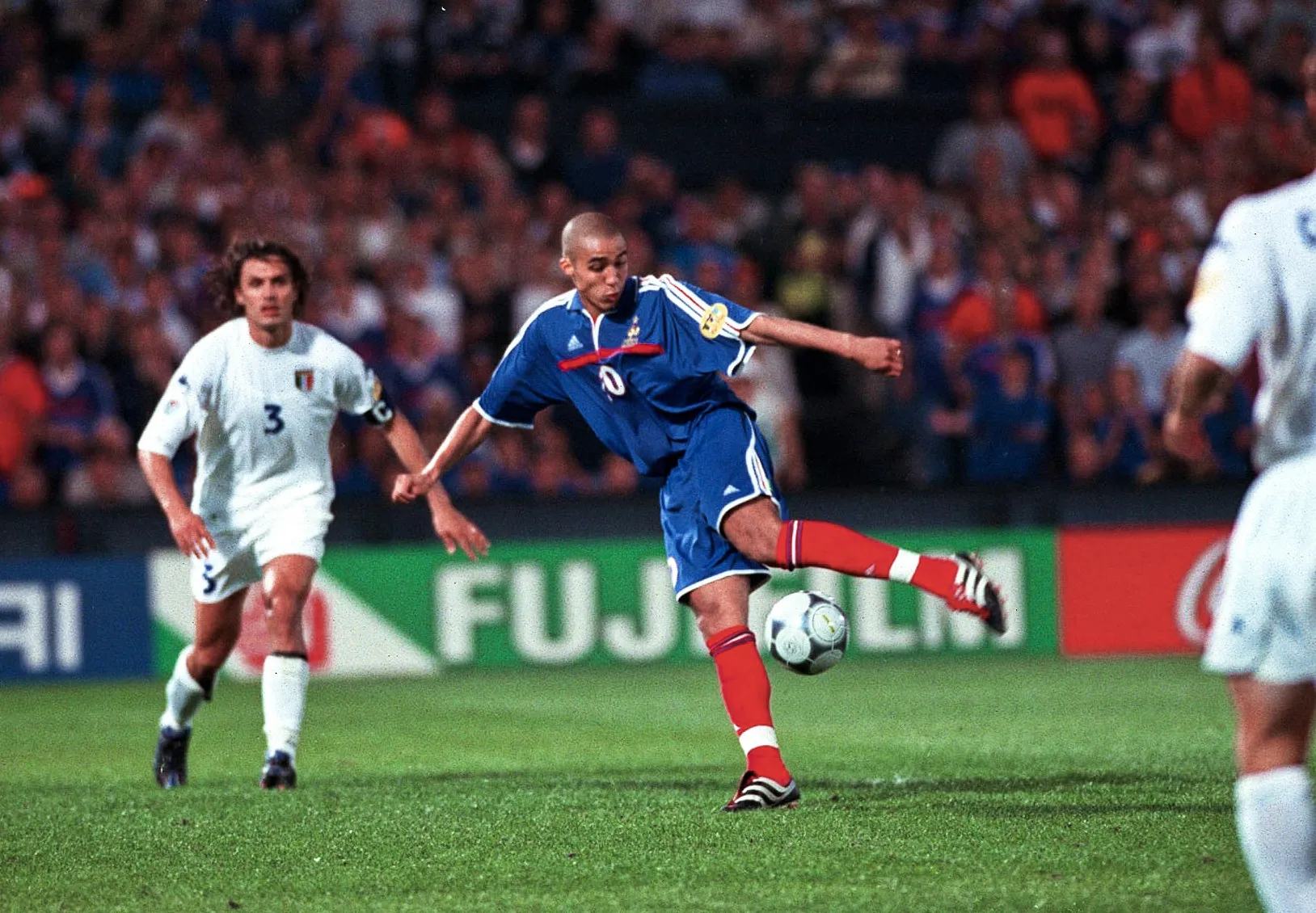
UEFA Euro 2000 stands as the tournament most comprehensively defined by the golden goal. Both the semi-final and the final were settled under the rule, with France advancing and winning the championship through golden goal decisions in consecutive knockout matches. The 2000 final — Trezeguet's volley ending the match in the 103rd minute — remains the most-viewed golden goal conclusion in the rule's history.
Why the Rule Did Not Produce the Intended Effect
The central failure of the golden goal rule lay in the gap between its theoretical incentive structure and the actual behaviour it produced. Rather than generating attacking football, the regulation consistently produced more defensive extra time than the conventional format it replaced.
The asymmetry at the heart of the rule explains this outcome. Attacking required committing players forward, creating spaces in behind, and accepting the possibility of a rapid counter-attack. Under conventional extra time, conceding to such a counter meant the match continued — thirty minutes remained for a response. Under the golden goal, the same concession ended the match with no recourse whatsoever.
The consequence of defensive error was not merely worse under the golden goal — it was categorically different in kind. A mistake in conventional extra time cost a goal. A mistake under the golden goal cost the match entirely, immediately, and irreversibly. The rational response to that asymmetry was not to attack more boldly but to defend more carefully. Both teams, aware of this calculation, retreated into structured defensive shape and waited for a set piece, an error, or a moment of individual brilliance to decide the tie.
Statistical analysis of matches played under the golden goal rule confirmed what observation suggested: scoring rates in extra time declined rather than increased. The rule produced the precise tactical behaviour it was designed to eliminate.
The Psychological Problem
Beyond tactics, the golden goal created psychological conditions that many within the sport found antithetical to competitive football. Players and managers operating under the rule described extra time as uniquely paralysing — the awareness that the next goal ended everything produced not urgency but anxiety.
For the trailing team in extra time, the situation offered no conventional football pathway. Pressing forward was necessary to score but created the spaces through which elimination could arrive instantly. Defending was insufficient because the stalemate would eventually end in a penalty shootout regardless. The rule placed teams in a strategic position with no clearly rational solution, which manifested in tentative, disjointed play.
For neutral observers, the abruptness of golden goal conclusions was frequently unsatisfying. A match of ninety minutes could end in the ninety-second, with the majority of scheduled extra time rendered irrelevant by a single moment. The trailing team received no opportunity to respond — football's normal rhythms of momentum, pressure, and recovery were simply cancelled.
The Silver Goal and the Return to Standard Extra Time
IFAB abolished the golden goal rule in 2004, citing insufficient evidence that the regulation had achieved its objectives and sustained criticism from participants at all levels of the sport.
A transitional experiment — the silver goal — was briefly trialled before the complete return to standard extra time. The silver goal held that a team leading at the conclusion of the first fifteen-minute period of extra time would be declared the winner, eliminating the need for the second period. UEFA Euro 2004 applied the silver goal rule, though no match at that tournament was actually decided by it before the regulation was withdrawn.
Standard extra time — two complete fifteen-minute periods, played to their conclusion regardless of scoring, followed by a penalty shootout if required — has been the universal format in major competition since 2004. The penalty shootout, which the golden goal was partly designed to replace as the decisive mechanism, remains in place and continues to generate its own debates about sporting fairness.
The Golden Goal's Place in Football History
The golden goal rule was applied at the highest levels of the sport for nearly a decade, settled major international finals, and produced moments that remain embedded in the history of tournament football. Its failure was not one of concept alone — the rule was implemented consistently and applied to genuinely consequential matches before the evidence of its shortcomings accumulated sufficiently to warrant abolition.
What the golden goal demonstrated, above all, was that regulatory interventions designed to alter tactical behaviour face fundamental limits when the competitive incentives produced by the rule diverge from the behaviour intended. Football's internal logic — risk, reward, and the asymmetry of irreversible consequences — proved stronger than the rule's architects anticipated. The regulation asked teams to behave in ways that were tactically irrational given the stakes, and teams declined to do so.
The golden goal era remains a reference point in discussions of football governance and tournament design: an ambitious experiment that reshaped elite competition for a decade before the sport concluded, decisively, that the problem it posed had no clean regulatory solution.