In March 2025, Tome announced it was killing the product that made it famous. It had 20 million users and had raised tens of millions in venture money on the promise that AI would replace PowerPoint. The presentation product was switched off at the end of April that year. The team pivoted the whole company to sales automation, relaunched as Lightfield, and the Tome brand was later sold off to AngelList.
The numbers behind that decision are brutal and instructive. Tome reached roughly 25 million users on an almost entirely free product and converted that into about $3.5 million in annual recurring revenue. Meanwhile Gamma, its closest rival, monetised early and aggressively, and by late 2025 had crossed $100 million in ARR while staying profitable, then raised $68 million from Andreessen Horowitz at a $2.1 billion valuation. Same category, same years, wildly different outcomes.
The lesson for anyone shopping in 2026 is that generating a good-looking deck is now a commodity. Dozens of tools do it competently for less than the price of lunch. What is not a commodity is everything that happens after you hit send: whether the buyer opened it, which pricing option they lingered on, whether the quote configures itself, whether they can sign without printing anything, and whether any of that lands in your CRM.
That distinction splits this market into two camps that most comparison articles blur together. On one side are AI deck generators built to make slides fast. On the other are proposal platforms built to close deals, which have bolted on AI writing over the last two years. If you send sales proposals for a living, the second camp usually matters more, even though the first camp gets all the search traffic.
Industry estimates put this market at around $1.94 billion in 2025, growing toward roughly $2.43 billion in 2026. That growth attracts noise, and one thing is worth flagging: a striking number of the "best AI presentation maker" lists currently ranking on Google were published by the vendors themselves, each placing its own product at number one. We have ranked these for winning deals rather than making pretty slides, and reasonable people will order them differently depending on how they sell.
The Shortlist at a Glance
|
Tool |
Best for |
Entry price |
Standout feature for proposals |
|
1. Qwilr |
Interactive proposals that read like microsites |
$35/user/mo |
Block-level engagement scoring and interactive quote tables |
|
2. PandaDoc |
End-to-end quote to signature workflow |
$19 to $49/user/mo |
E-signature, CPQ and payment collection in one place |
|
3. Gamma |
Fast, genuinely impressive AI-built decks |
$8 to $18/mo |
Best pure AI generation on the market |
|
4. Proposify |
Sales managers who need process control |
Mid double digits |
Approval workflows and follow-up automation |
|
5. Storydoc |
Scroll-based interactive pitches |
From about $20/user/mo |
Reader drop-off analytics by section |
|
6. Beautiful.ai |
Brand-locked corporate decks |
Paid only, no free tier |
Outline-first AI workflow added in 2026 |
|
7. GetAccept |
Live buyer engagement and video |
Quote based |
Digital sales rooms |
|
8. Plus AI |
Teams that must ship native slides |
Low double digits |
Clean PowerPoint and Google Slides export |
|
9. Microsoft Copilot |
Enterprises locked into Microsoft 365 |
Bundled or add-on |
Model selection inside PowerPoint |
|
10. DealHub |
Complex configured pricing |
Quote based |
CPQ-grade quoting on every deal |
1. Qwilr
Qwilr turns a proposal into a web page rather than a document, and for sales teams that is the whole point. Buyers scroll through embedded video, configure their own pricing with interactive quote tables, and sign from the same link, which updates in real time if you change something.
What earns it the top spot is the analytics. Qwilr reports engagement at block level, so you can see which section a prospect actually spent time on, and its Engagement Algorithm scores each proposal from highly engaged to highly disengaged against thresholds you set. That is a materially different conversation from "they opened the PDF." Native integrations cover HubSpot, Salesforce, Pipedrive and Zoho, and it holds a 4.6 out of 5 rating across more than 1,270 reviews on G2 and Capterra.
The trade-offs are real. PDF export is weak, formatting control is limited compared with a proper design tool, and it will not handle complex contract workflows. Business runs $35 per user per month billed annually, rising to $39 monthly. Enterprise is $59 per user per month with a hard 10-seat minimum, which puts it above $7,000 a year before you send anything. Salesforce sits behind that Enterprise wall, and the Business plan keeps only 120 days of analytics history, which teams tend to discover exactly when they want to look back at last quarter.
2. PandaDoc
PandaDoc is the safest choice for most teams and the one with the widest surface area. It covers proposals, quotes, contracts, e-signatures, configure-price-quote and payment collection, which means the deal never leaves the platform between first draft and signed agreement. With more than 3,000 verified G2 reviews it also has by far the deepest evidence base of any tool here.
Pricing is where it gets uncomfortable. There is a free e-signature tier capped at five documents a month, Starter at $19 per user per month annually, Business at $49 per user per month annually, and custom Enterprise. A newer Launch plan charges per document instead of per seat. Because everything else is per seat, costs climb fast: a ten-person Business team is around $5,880 a year before add-ons, and that includes the managers who only ever approve things. The Essentials tier was also quietly trimmed a couple of years ago, with templates capped and pricing tables removed.
3. Gamma
If your problem is that building the deck takes too long, Gamma is the answer and nothing else is particularly close. It generates a fully designed, card-based deck from a one-line prompt in under a minute, and version 3.0 added a built-in AI design agent that works from rough notes, uploaded documents or links.
The commercial story is remarkable and worth understanding, because it signals staying power. Roughly 70 million users, more than 400 million pieces of content created, over 600,000 paying subscribers, profitable since 2023, and all of it built by a team of about 50 people on only $23 million of initial funding. Gamma reports that 40 percent of Fortune 500 companies have at least one user. Plus is $8 a month, Pro $18, and an Ultra tier sits at $100.
For proposals specifically, though, understand what you are not getting. There is no e-signature, no quoting engine, no CRM-native deal tracking. PowerPoint export flattens the design, a known weakness of every web-first tool in this category. Gamma is the best way to build the narrative half of a pitch. It is not a proposal system, and pairing it with one is a perfectly sensible strategy.
4. Proposify
Proposify is the pick for sales leaders rather than individual reps. Where Qwilr optimises the buyer experience and PandaDoc optimises document breadth, Proposify optimises the process: approval workflows, governance controls, a managed content library, and analytics designed for someone forecasting a pipeline rather than chasing one deal. It also has built-in follow-up automation, which is rarer than it should be.
It carries around 1,000 G2 reviews at 4.6 out of 5, with reviewers consistently praising the content editor and templates. Practically, one detail matters more than the marketing: Salesforce support is available as a paid add-on on the Business plan with no seat minimum, which makes it meaningfully cheaper than Qwilr for a small team that needs Salesforce.
5. Storydoc
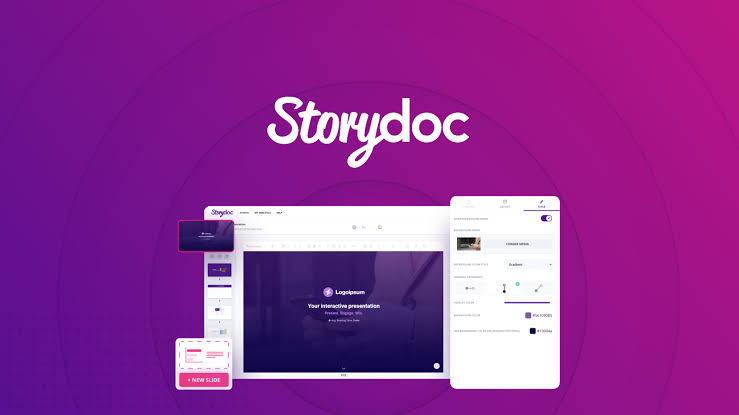
Storydoc treats a proposal as a story rather than a stack of pages, producing animated, scroll-based experiences closer to a well-built landing page than a document. AI handles both content and layout, and the engagement data is genuinely useful because it shows precisely where readers stop scrolling.
It suits founders and marketers who pitch visually and want proof of attention on every section. Pricing starts around $20 per user per month on Starter, with Pro reported anywhere between roughly $36 and $60 per user per month annually depending on source, plus a custom Teams tier. One thing to plan around: AI generation credits reset monthly and do not roll over.
6. Beautiful.ai

Beautiful.ai has always been the brand-safety option, enforcing design rules so that nobody on your team can produce an off-brand slide. In March 2026 it shipped a Context-Aware AI Workflow that forces the AI to draft a text outline before it designs anything, so you approve the narrative before committing to slides.
That change matters more than it sounds. The defining frustration of early AI deck tools was receiving twelve finished slides you then had to rebuild. Outline-first generation has quietly become the standard across the serious tools, and Beautiful.ai implemented it well. There is no free plan, which is either a filter or a dealbreaker depending on your budget.
7. GetAccept

GetAccept sits closer to sales enablement than slide design. Its digital sales rooms give a buying committee one shared space with video, chat and documents, which matches how enterprise purchases actually happen now that six or seven people sign off on everything. If live buyer engagement moves your deals, it beats any deck tool here. Pricing is quote based.
8. Plus AI

Plus AI exists for an unglamorous but very common constraint: your proposal has to arrive as a real PowerPoint or Google Slides file because that is what procurement or your own brand team requires. It generates into native formats rather than exporting to them, which avoids the layout collapse that afflicts web-first tools. If your final deliverable is a .pptx, start here.
9. Microsoft Copilot in PowerPoint
Copilot is the pragmatic answer for large organisations that will not approve another vendor. It now lets users choose between faster and more deliberate reasoning models directly inside PowerPoint, which is a genuine improvement on earlier versions. The honest caveat, and it applies equally to Gemini inside Google Slides, is that both are built to improve a deck you have already started rather than to create one from a prompt. Treat them as a supplement rather than your primary tool.
10. DealHub

DealHub earns its place for a narrow but expensive problem: deals where the pricing is genuinely complicated. Usage tiers, multi-year ramps, bundled services, regional variation. If your reps are hand-building quotes in spreadsheets and occasionally getting them wrong, the cost of that error dwarfs any subscription saving. This is sales operations software with a proposal layer, not the reverse.