For most of the last decade, the global meeting had an unspoken tax. Whoever spoke the best English set the pace, and everyone else edited themselves down to the safest possible sentence. Ideas were not lost because people lacked them. They were lost because forming them in a second language, in real time, while a recording ran, is exhausting.
That tax is finally being repriced. In 2026 the leading assistants no longer stop at transcribing an English call and mailing out bullet points. They detect the language in the room, translate speech into speech, keep something close to the speaker’s own voice and hand back a record every participant can read in their own language afterwards. The commercial pull is obvious: analysts put the AI meeting assistant market at roughly $3.5 billion in 2025 and forecast growth in the mid twenties percent annually through the early 2030s, with multilingual capability repeatedly named the single loudest demand coming from distributed teams.
The catch is that the label "supports 100 languages" now covers three very different products. Some tools translate the spoken moment and nothing else. Some translate the record and not the moment. A few, at real cost, do both. The ranking below reflects how each platform actually performs when a call is genuinely multilingual rather than English with an accent, weighing language depth, latency, security posture and what survives after everyone hangs up.
At a Glance: The 2026 Field
|
# |
Platform |
Language reach |
Standout multilingual capability |
Best suited to |
Entry price |
|---|---|---|---|---|---|
|
1 |
Microsoft Teams Interpreter Agent |
9 spoken languages; 100+ for transcript translation |
Speech to speech interpretation with optional voice simulation, now in calls and Teams Rooms |
Microsoft 365 shops with global staff |
Requires M365 Copilot licence |
|
2 |
Google Meet with Gemini 3.5 Live Translate |
70+ languages, 2,000+ combinations |
Continuous translated speech that keeps intonation and stays seconds behind the speaker |
Workspace enterprises running live cross border calls |
Paid Workspace or Google AI tier |
|
3 |
Wordly |
60+ target languages in one session |
Captions plus translated audio delivered to attendee phones with no app install |
Hybrid all hands, town halls and conferences |
Usage based subscription |
|
4 |
KUDO |
Up to 200 languages, 60+ on AI only |
Switchable human and AI interpretation in the same platform |
Regulated, diplomatic and high stakes sessions |
Quoted per event |
|
5 |
Interprefy |
80+ languages, thousands of pairs |
ISO 27001 posture with interpreter NDAs and encrypted delivery |
Security reviewed global enterprises |
Quoted per event |
|
6 |
HappyScribe |
150+ languages |
Bot free browser capture with EU data residency and GDPR handling |
European and privacy conscious teams |
Free tier, paid from low double digits |
|
7 |
Notta |
58 languages, translation into 42+ |
Transcribe in one language and export the record in another |
Asia Pacific and Japanese to English workflows |
About $8.25 per user monthly |
|
8 |
Fireflies.ai |
Broad, English led coverage |
AskFred conversational search across the whole multilingual archive |
Global sales and CRM heavy teams |
Free tier, Business $19 per user |
|
9 |
Zoom AI Companion |
46 caption languages, 5 for voice |
Automatic spoken language detection plus a Voice Translator beta |
Zoom first organisations |
Bundled, add on for translation |
|
10 |
tl;dv |
30+ languages |
Clipped, timestamped multilingual moments for async review |
Product research and distributed sales teams |
Free tier, Pro from $29 |
1. Microsoft Teams Interpreter Agent
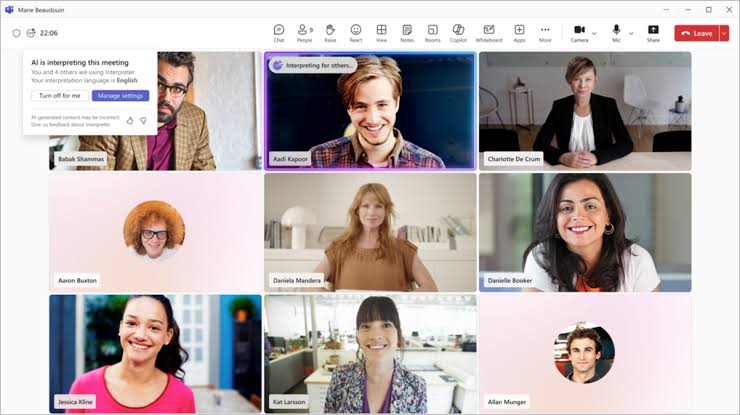
Microsoft has the strongest claim to the top spot for one reason: it moved interpretation out of the demo reel and into the plumbing of the workday. The Interpreter agent delivers real time speech to speech interpretation inside Teams, automatically detecting spoken languages and handling multi speaker, multilingual conversations through Azure AI Services. Its most disarming feature is voice simulation, which renders the translation in the speaker’s own tone and pitch. Microsoft is explicit that voice samples and biometric data are processed in the moment and never stored, a detail that matters enormously to security teams.
Through the first quarter of 2026 the agent expanded from meetings into Teams calls, including PSTN and VoIP, and rolled out to Teams Rooms on Windows for organisations with Rooms Pro licensing, with 20 hours of interpretation included per room account each month. Microsoft also raised the included allowance for Copilot licensed users from two hours to 20 hours a month, a signal that it expects heavy rather than occasional use.
The honest limits: live interpretation covers nine languages, the feature is gated behind a Microsoft 365 Copilot licence, government clouds were excluded from the rollout, and there is always a short delay that grows when several people talk at once. Post meeting transcripts can be translated into more than 100 languages, but the in call translated captions vanish when the meeting ends.
2. Google Meet with Gemini 3.5 Live Translate
Google spent the year closing a gap it had opened itself. Speech translation reached general availability in Meet on 27 January 2026, but only for English paired with Spanish, French, German, Brazilian Portuguese and Italian, which is a rounding error for a genuinely global company. Then in June came Gemini 3.5 Live Translate, and the numbers changed shape: automatic detection across more than 70 languages, and Google’s own figure of over 2,000 language combinations available in a single meeting rather than everything routing through English.
The engineering is the interesting part. Rather than waiting for a speaker to finish, the model generates translated speech continuously, preserving intonation, pacing and pitch while staying only a few seconds behind. Anyone who has endured turn by turn interpretation and its awkward silences will understand why that is a category shift rather than a version bump.
It sits second only because access remains uneven. The model began rolling out to Meet in private preview for selected business Workspace customers, with wider availability promised later in the year, and the older translated caption feature still requires a paid plan with a Gemini add on. It is also, by design, locked inside Meet. The moment your quarterly review moves to Zoom or Webex, none of it travels with you.
3. Wordly
Wordly is the pick for organisations whose multilingual problem is a room rather than a call. Building AI translation since 2017, it runs 60 plus target languages in a single session and delivers both captions and translated audio to attendees on their own phones, tablets or laptops, with no hardware to rent and no interpreter roster to coordinate. Participants pick a language and listen.
For an all hands broadcast to twelve markets, a supplier conference or a hybrid town hall, that simplicity is worth more than raw language counts. It works alongside the major conferencing platforms rather than replacing them, which suits companies that have standardised on Teams or Zoom but need something that behaves properly at scale. Pricing runs on subscription hours, so the arithmetic favours organisations with a steady programme of events rather than one summit a year.
4. KUDO
KUDO earns its place through range and credibility rather than novelty. The platform offers live speech translation and captions in up to 200 languages, spanning both a human interpreter marketplace and an AI speech translator covering more than 60 languages, and it plugs into whichever meeting platform the organisation already uses. Its visibility in the language industry is not incidental: KUDO was named official interpreting technology sponsor for LocWorld 2026 and 2027 and official live translation partner for Digital Enterprise Show 2026 in Malaga.
The reason it matters for corporate teams is optionality. Legal, regulatory and board level sessions rarely tolerate pure automation, while an internal engineering sync rarely justifies a human interpreter. Being able to move between the two inside one platform, with one procurement process, is the sort of practical advantage that only becomes obvious after a project goes wrong.
5. Interprefy
Interprefy comes at the same problem from a compliance first angle. It combines remote simultaneous interpretation with AI speech translation and live captions across more than 80 languages and thousands of language combinations, and publishes the security posture that enterprise buyers now ask for upfront: ISO 27001 certification, end to end encryption, controlled access and interpreter NDAs.
That specificity is the whole pitch. If your multilingual meetings involve patient data, regulated financial disclosure or public sector obligations, the deciding factor is rarely the demo. It is whether the vendor can survive a security review without three months of back and forth. The trade off is agility: Interprefy expects planning, and it is poor value for the spontaneous Tuesday afternoon call.
6. HappyScribe
Among the note taker class, HappyScribe has quietly become the default recommendation for multilingual teams that also care about where their data sleeps. The Barcelona built platform transcribes in more than 150 languages with accuracy it puts above 95 percent, syncs with Google and Outlook calendars to auto join scheduled calls, and stores data in the EU under GDPR terms.
Two design decisions lift it above the crowd. First, it does not force a bot into the room: you can record directly in the browser, which matters given how consistently research shows participants change their behaviour or withhold information once they spot a third party bot in the attendee list. Second, its free tier is unusually generous, allowing unlimited meetings capped at 45 minutes each, which makes a genuine pilot possible before anyone signs anything.
7. Notta
Notta is the strongest transcription first option for teams whose centre of gravity sits in Asia Pacific. It supports 58 languages, claims accuracy up to 98.86 percent under good conditions, and allows a meeting captured in one language to be translated into more than 40 others, then exported as text, Word, PDF or subtitle files.
Its Japanese to English handling is noticeably better than the western built alternatives, which is unsurprising given the product’s origins, and Pro pricing around $8.25 per user each month on annual billing undercuts most of the category. Reviewers consistently flag the same friction: the free plan cuts live transcription off after a few minutes per conversation, so evaluating it properly means paying first. Treat that as the price of entry rather than a defect.
8. Fireflies.ai
Fireflies remains the most useful choice when the multilingual requirement is downstream rather than in the room. It records, transcribes and summarises across Zoom, Google Meet and Microsoft Teams with broad language coverage, and its AskFred assistant turns the entire meeting archive into something you can interrogate conversationally, drafting follow ups and pulling answers out of calls nobody wants to rewatch. More than 100 native integrations, including Salesforce, HubSpot and Slack, mean the output actually lands somewhere people work.
Two caveats deserve daylight before purchase. AI credit limits apply on every tier, including paid ones, so heavy users of the smarter features can run dry mid month. And conversation intelligence, sentiment analysis and topic trackers sit behind the Business tier at $19 per user each month on annual billing, which puts the analytics that sell the product out of reach of the plan most small teams start on.
9. Zoom AI Companion
Zoom’s year was one of steady, slightly uneven progress. AI Companion now auto detects spoken language and produces real time captions in 46 languages, a Voice Translator entered beta in spring 2026 allowing participants to speak in one language while others hear synthesised speech, and on 18 May 2026 Zoom shipped Translator and Summarizer APIs so third party applications can generate multilingual transcripts and recaps.
The qualifications are significant enough to keep it out of the top half. Voice translation launched with five languages, English, Chinese, French, Japanese and Spanish, for paid customers on US based accounts, so German, Korean, Arabic and Hindi speakers fall back to captions. Translated captions are tied to the higher business and enterprise plans or a paid add on. And Zoom’s own documentation confirms that language interpretation does not follow participants into breakout rooms, which is precisely where multilingual workshops tend to happen. For teams already committed to Zoom it is a real improvement. For teams choosing on multilingual merit alone, it is not yet the reason to commit.
10. tl;dv
The German built tl;dv rounds out the list by solving the part of the problem everyone else treats as an afterthought: what happens to a multilingual conversation once it is over. With support for 30 plus languages, timestamp led navigation and smart clips that turn a two minute exchange into something shareable, it is built for organisations where a customer interview in Spanish needs to reach a product team in Poland without anyone sitting through the full hour.
It is not the tool to reach for if participants need to understand each other while speaking. It is the tool that stops the insight evaporating afterwards, and for asynchronous, research heavy and sales driven teams that is often the more expensive failure.